Ostheller Maike-Elisa, Balakrishnan Naveen Kumar, Groten Robert, Seide Gunnar
Aachen-Maastricht Institute for Biobased Materials (AMIBM), Maastricht University, Brightlands Chemelot Campus, Urmonderbaan 22, 6167 RD Geleen, The Netherlands.
Department of Textile and Clothing Technology, Niederrhein University of Applied Sciences, Campus Moenchengladbach, Webschulstrasse 31, 41065 Moenchengladbach, Germany.
Polymers (Basel). 2021 Mar 26;13(7):1024. doi: 10.3390/polym13071024.
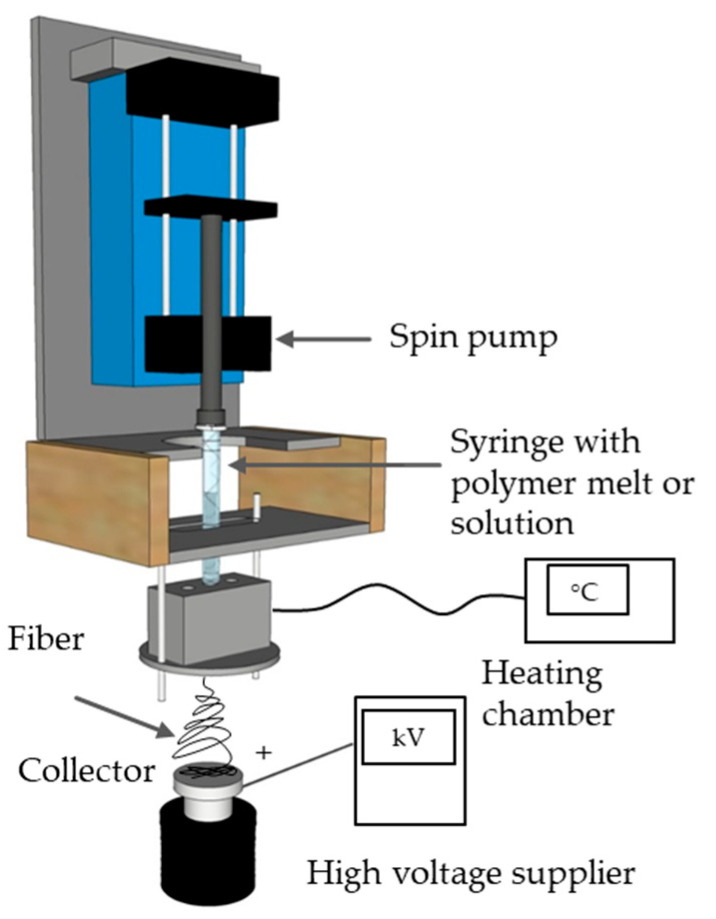
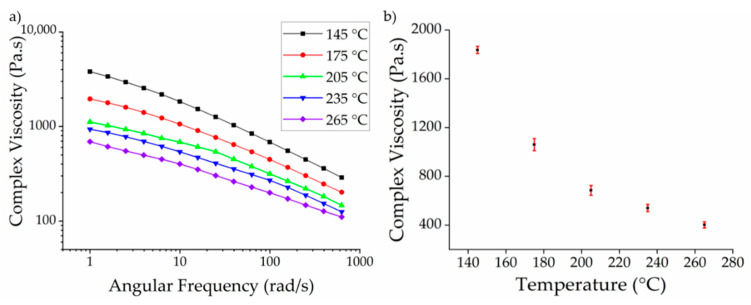
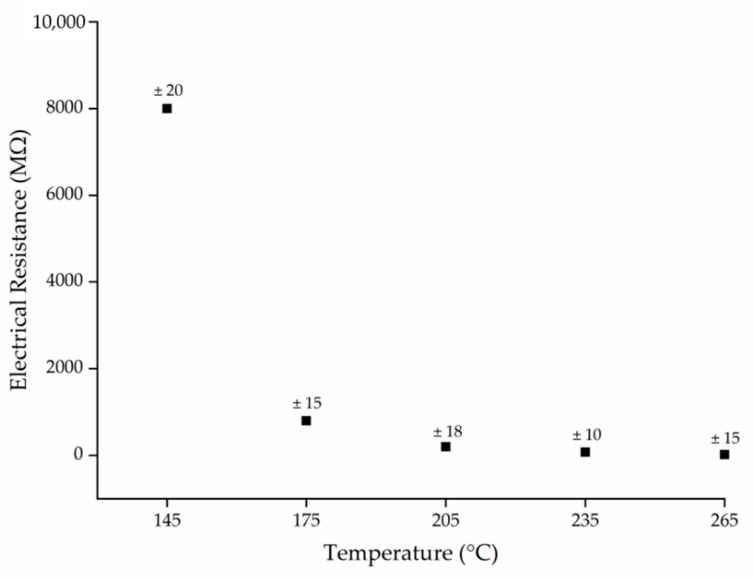
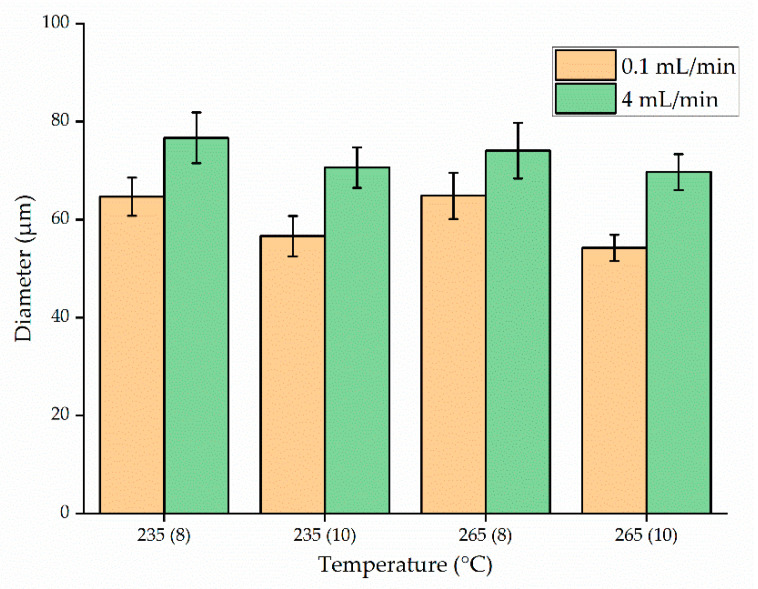
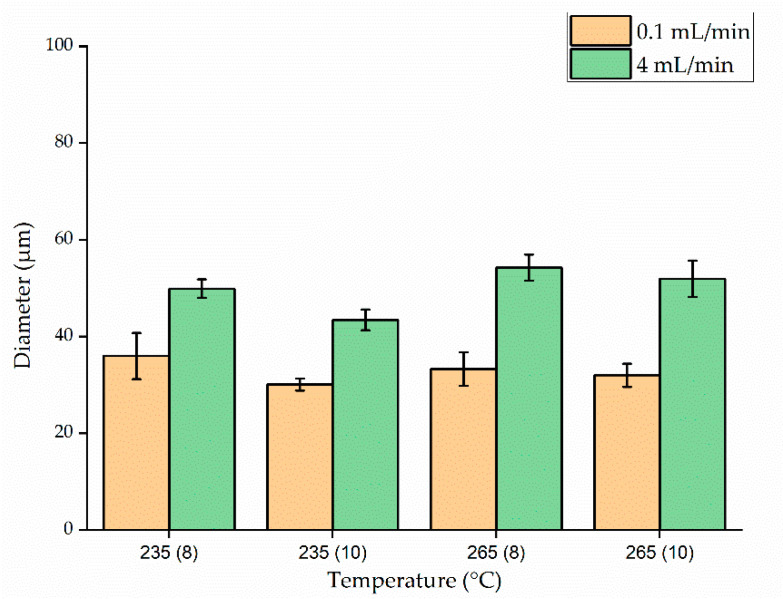
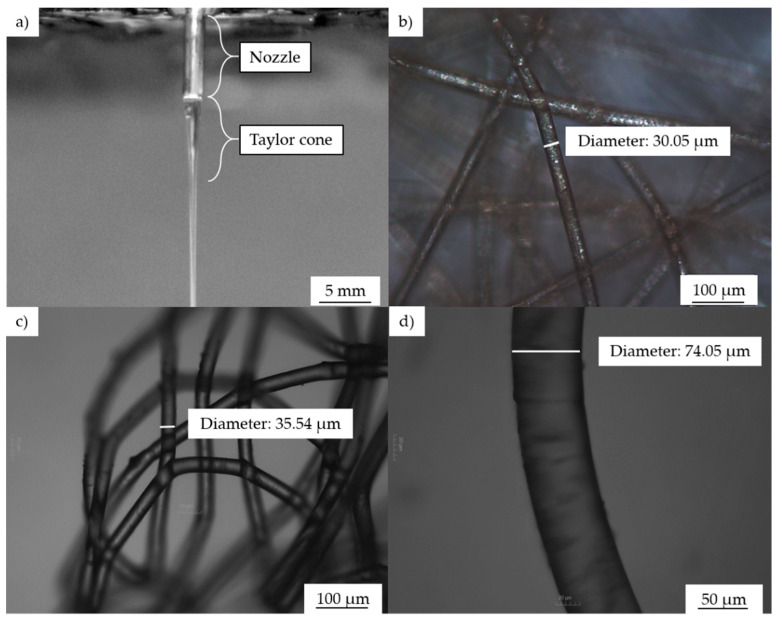
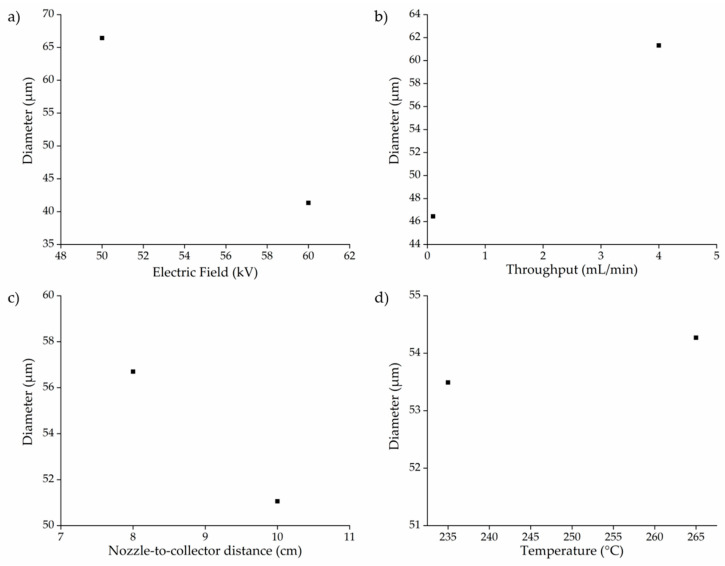
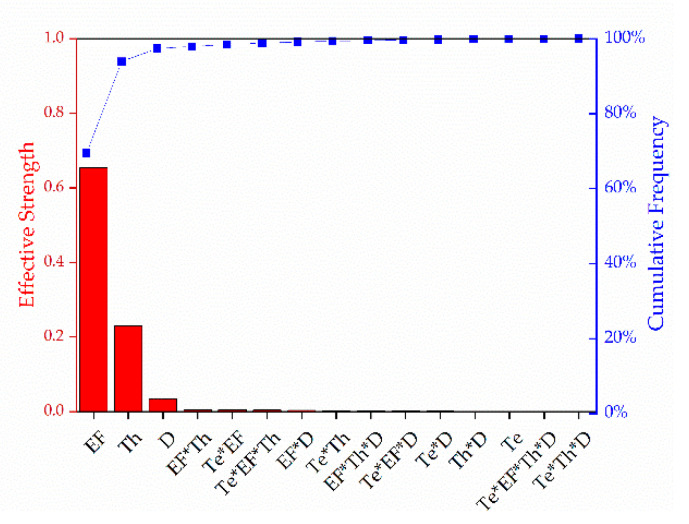
Melt electrospinning is widely used to manufacture fibers with diameters in the low micrometer range. Such fibers are suitable for many biomedical applications, including sutures, stents and tissue engineering. We investigated the preparation of polybutylene succinate microfibers using a single-nozzle laboratory-scale device, while varying the electric field strength, process throughput, nozzle-to-collector distance and the temperature of the polymer melt. The formation of a Taylor cone followed by continuous fiber deposition was observed for all process parameters, but whipping behavior was enhanced when the electric field strength was increased from 50 to 60 kV. The narrowest fibers (30.05 µm) were produced using the following parameters: electric field strength 60 kV, melt temperature 235 °C, throughput 0.1 mL/min and nozzle-to-collector distance 10 cm. Statistical analysis confirmed that the electric field strength was the most important parameter controlling the average fiber diameter. We therefore report the first production of melt-electrospun polybutylene succinate fibers in the low micrometer range using a laboratory-scale device. This offers an economical and environmentally sustainable alternative to conventional solution electrospinning for the preparation of safe fibers in the micrometer range suitable for biomedical applications.
熔体静电纺丝被广泛用于制造直径在低微米范围内的纤维。这类纤维适用于许多生物医学应用,包括缝合线、支架和组织工程。我们使用单喷嘴实验室规模的装置研究了聚丁二酸丁二醇酯微纤维的制备,同时改变电场强度、工艺产量、喷嘴到收集器的距离以及聚合物熔体的温度。在所有工艺参数下均观察到泰勒锥的形成以及连续纤维的沉积,但当电场强度从50 kV增加到60 kV时,鞭动行为增强。使用以下参数可生产出最细的纤维(30.05 µm):电场强度60 kV、熔体温度235 °C、产量0.1 mL/min以及喷嘴到收集器的距离10 cm。统计分析证实,电场强度是控制平均纤维直径的最重要参数。因此,我们报告了首次使用实验室规模的装置生产出低微米范围内熔体静电纺丝的聚丁二酸丁二醇酯纤维。这为传统溶液静电纺丝提供了一种经济且环境可持续的替代方法,用于制备适用于生物医学应用的微米范围内的安全纤维。