Institute for Translational Research, University of North Texas Health Science Center, Fort Worth, TX, USA.
Department of Pharmacology & Neuroscience, University of North Texas Health Science Center, Fort Worth, TX, USA.
J Alzheimers Dis. 2021;81(2):557-568. doi: 10.3233/JAD-201610.
The REFLECT trials were conducted to examine the treatment of mild-to-moderate Alzheimer's disease utilizing a peroxisome proliferator-activated receptor gamma agonist.
To generate a predictive biomarker indicative of positive treatment response using samples from the previously conducted REFLECT trials.
Data were analyzed on 360 participants spanning multiple negative REFLECT trials, which included treatment with rosiglitazone and rosiglitazone XR. Support vector machine analyses were conducted to generate a predictive biomarker profile.
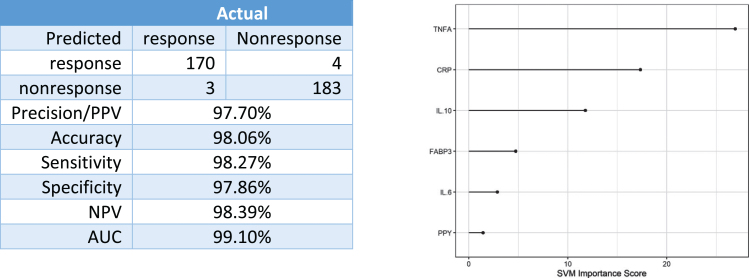
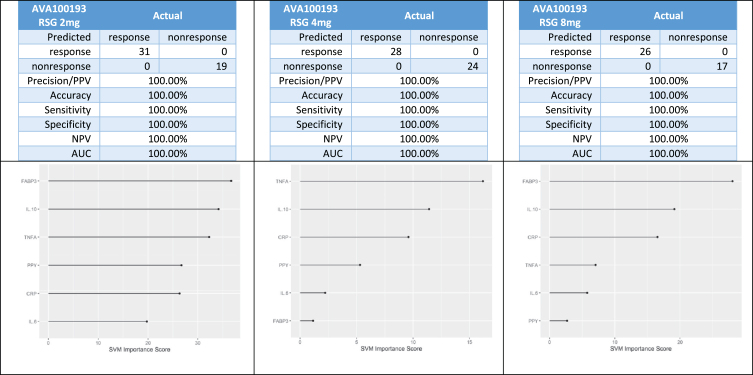
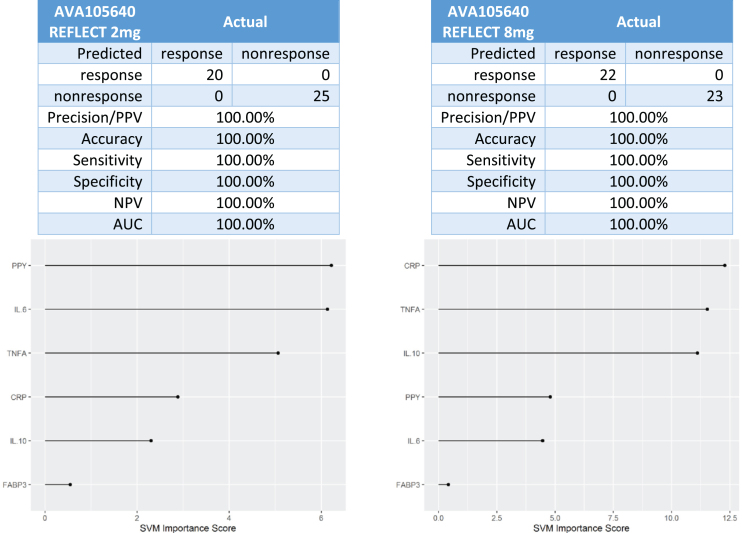
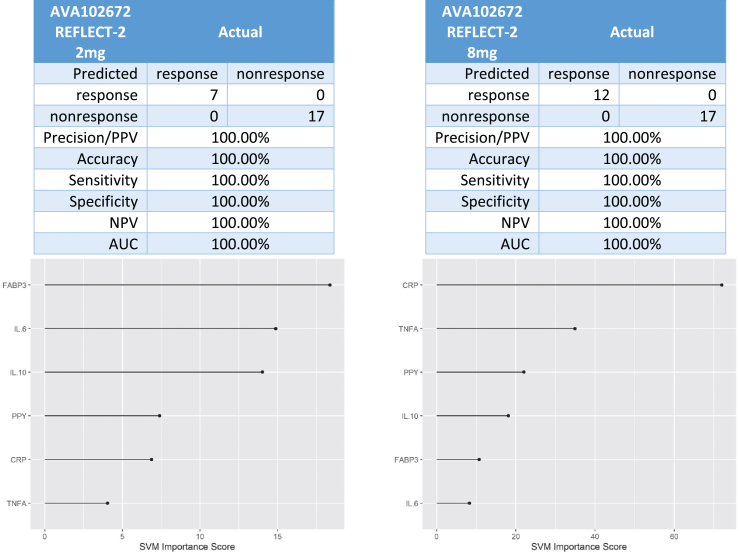
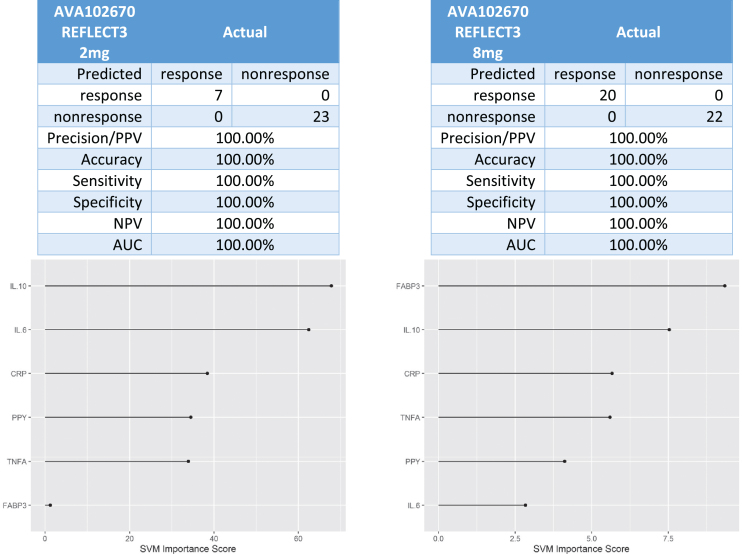
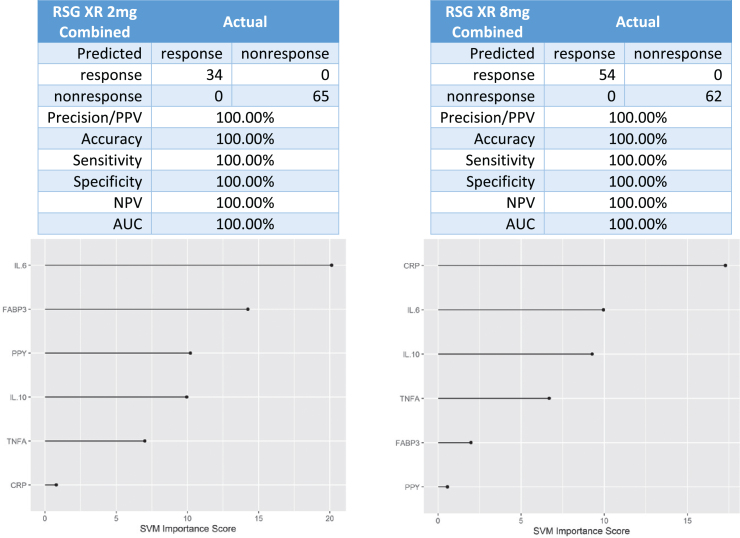
A pre-defined 6-protein predictive biomarker (IL6, IL10, CRP, TNFα, FABP-3, and PPY) correctly classified treatment response with 100%accuracy across study arms for REFLECT Phase II trial (AVA100193) and multiple Phase III trials (AVA105640, AV102672, and AVA102670). When the data was combined across all rosiglitazone trial arms, a global RSG-predictive biomarker with the same 6-protein predictive biomarker was able to accurately classify 98%of treatment responders.
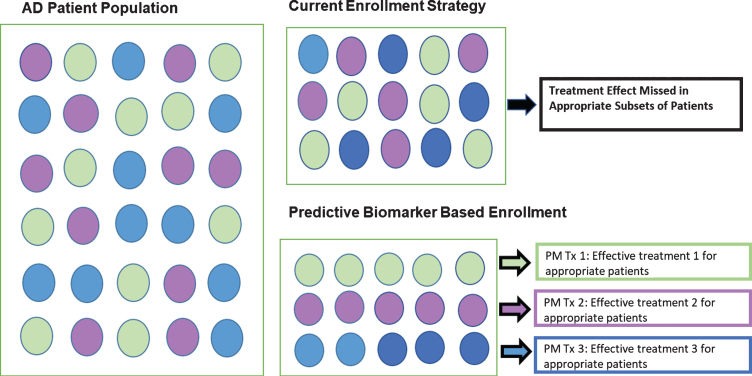
A predictive biomarker comprising of metabolic and inflammatory markers was highly accurate in identifying those patients most likely to experience positive treatment response across the REFLECT trials. This study provides additional proof-of-concept that a predictive biomarker can be utilized to help with screening and predicting treatment response, which holds tremendous benefit for clinical trials.
REFLECT 试验旨在研究过氧化物酶体增殖物激活受体 γ 激动剂治疗轻中度阿尔茨海默病的效果。
利用先前进行的 REFLECT 试验中的样本,生成一种能预测治疗反应的生物标志物。
对跨越多个 REFLECT 试验的 360 名参与者的数据进行了分析,这些试验均包含罗格列酮和罗格列酮 XR 的治疗。采用支持向量机分析生成了一个预测性生物标志物特征。
一个预先定义的 6 蛋白预测性生物标志物(IL6、IL10、CRP、TNFα、FABP-3 和 PPY)在 REFLECT 二期试验(AVA100193)和多个三期试验(AVA105640、AV102672 和 AVA102670)的所有研究组中,以 100%的准确率正确分类了治疗反应。当将数据合并到所有罗格列酮试验组中时,具有相同 6 蛋白预测性生物标志物的全球 RSG 预测性生物标志物能够准确分类 98%的治疗反应者。
由代谢和炎症标志物组成的预测性生物标志物在识别最有可能在 REFLECT 试验中获得阳性治疗反应的患者方面具有高度准确性。这项研究进一步证明了预测性生物标志物可用于帮助筛选和预测治疗反应,这对临床试验具有巨大的益处。