Sumiyoshi Tomiki, Watanabe Koichiro, Noto Shinichi, Sakamoto Shigeru, Moriguchi Yoshiya, Hammer-Helmich Lene, Fernandez Jovelle
Department of Preventive Intervention for Psychiatric Disorders, National Institute of Mental Health, National Center of Neurology and Psychiatry, Tokyo, Japan.
Department of Neuropsychiatry, Kyorin University School of Medicine, Tokyo, Japan.
Neuropsychiatr Dis Treat. 2021 Mar 26;17:945-955. doi: 10.2147/NDT.S288108. eCollection 2021.
Accumulating evidence suggests the presence of cognitive impairment in patients with major depressive disorder (MDD), which affects their psychosocial function and quality of life (QoL). PERFORM-J (Prospective Epidemiological Research on Functioning Outcomes Related to MDD in Japan) is an observational, multicenter study to assess longitudinal changes in depressive symptoms, psychomotor speed, subjective cognitive function, and psychosocial function.
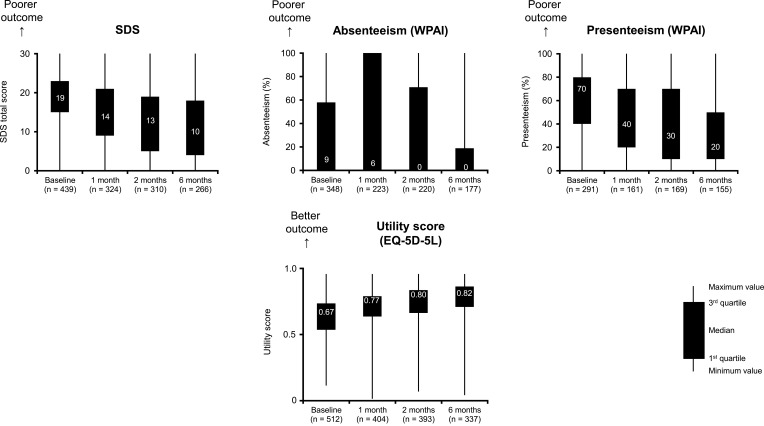
Five hundred and eighteen Japanese outpatients with MDD initiating new antidepressant monotherapy (first-line or switch from previous drug) as part of their routine medical care participated in this study. Assessments at baseline and over the 6-month observation period included physician-rated depression severity (Montgomery-Åsberg Depression Rating Scale), psychomotor speed (Digit Symbol Substitution Test; DSST), subjective cognition (Perceived Deficits Questionnaire-Depression), psychosocial function (Sheehan Disability Scale), and QoL (EuroQol-5 Dimension-5 Level).
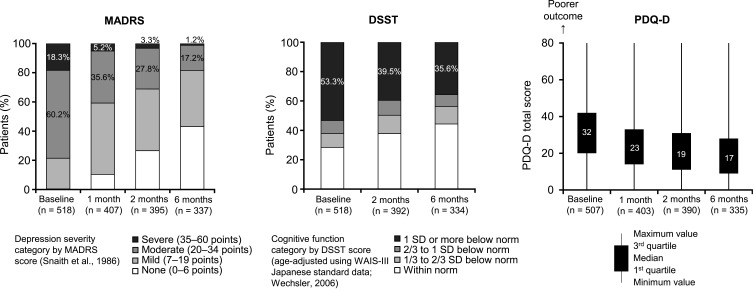
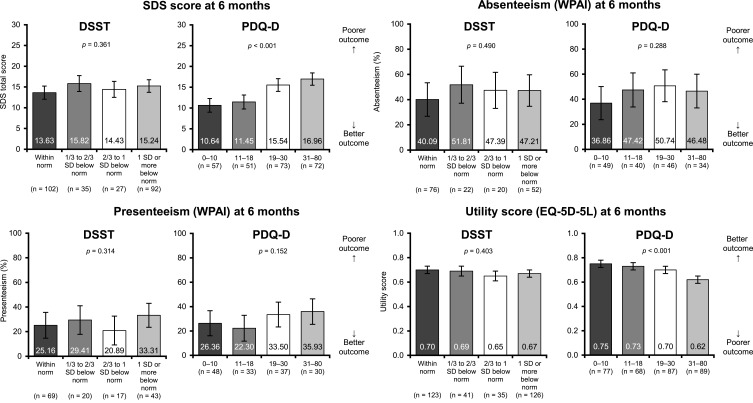
Antidepressant treatment for 6 months improved depressive symptoms and subjective cognitive impairment (cognitive complaints), whereas psychomotor speed remained impaired (ie, DSST total score was >1 standard deviation below the norm) in 35.6% of patients at 6 months. Impairment of subjective cognition, but not psychomotor speed at month 2 was associated with poor psychosocial function and QoL at 6 months. There was a trend for higher relapse rates at 6 months in patients with greater subjective cognitive impairment at 2 months.
These findings highlight the importance of evaluating cognitive difficulties to predict long-term outcomes in patients with MDD. Early intervention for cognitive complaints may decrease the relapse rate, which warrants further study.
越来越多的证据表明,重度抑郁症(MDD)患者存在认知障碍,这会影响他们的心理社会功能和生活质量(QoL)。PERFORM-J(日本MDD功能结局的前瞻性流行病学研究)是一项观察性多中心研究,旨在评估抑郁症状、精神运动速度、主观认知功能和心理社会功能的纵向变化。
518名开始新的抗抑郁单药治疗(一线治疗或从先前药物转换)的日本MDD门诊患者作为其常规医疗护理的一部分参与了本研究。基线及6个月观察期的评估包括医生评定的抑郁严重程度(蒙哥马利-阿斯伯格抑郁评定量表)、精神运动速度(数字符号替换测验;DSST)、主观认知(感知缺陷问卷-抑郁)、心理社会功能(希恩残疾量表)和生活质量(欧洲五维健康量表-5水平)。
6个月的抗抑郁治疗改善了抑郁症状和主观认知障碍(认知主诉),而6个月时35.6%的患者精神运动速度仍受损(即DSST总分比正常水平低>1个标准差)。2个月时主观认知障碍而非精神运动速度受损与6个月时不良的心理社会功能和生活质量相关。2个月时主观认知障碍较重的患者6个月时复发率有升高趋势。
这些发现突出了评估认知困难对预测MDD患者长期结局的重要性。对认知主诉进行早期干预可能会降低复发率,这值得进一步研究。