Cheng Cecilia, Wang Hsin-Yi, Ebrahimi Omid V
Department of Psychology, The University of Hong Kong, Hong Kong, China.
Department of Psychology, The University of Oslo, Oslo, Norway.
Front Psychiatry. 2021 Mar 19;12:626197. doi: 10.3389/fpsyt.2021.626197. eCollection 2021.
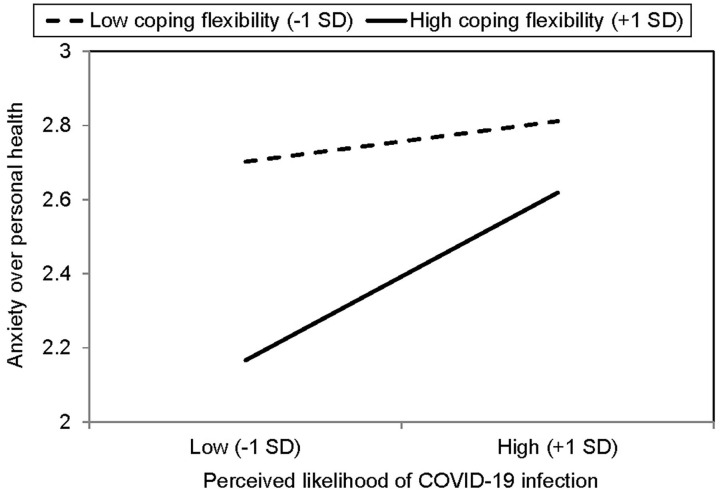
The Coronavirus Disease 2019 (COVID-19) pandemic is an unprecedented health crisis in terms of the scope of its impact on well-being. The sudden need to navigate this "new normal" has compromised the mental health of many people. Coping flexibility, defined as the astute deployment of coping strategies to meet specific situational demands, is proposed as an adaptive quality during this period of upheaval. The present study investigated the associations between coping flexibility and two common mental health problems: COVID-19 anxiety and depression. The respondents were 481 Hong Kong adults (41% men; mean age = 45.09) who took part in a population-based telephone survey conducted from April to May 2020. Self-report data were assessed with the Coping Flexibility Interview Schedule, COVID-19-Related Perception and Anxiety Scale, and Center for Epidemiological Studies Depression Scale. Slightly more than half (52%) of the sample met the criteria for probable depression. Four types of COVID-19 anxiety were identified: anxiety over personal health, others' reactions, societal health, and economic problems. The results consistently revealed coping flexibility to be inversely associated with depression and all four types of COVID-19 anxiety. More importantly, there was a significant interaction between perceived likelihood of COVID-19 infection and coping flexibility on COVID-19 anxiety over personal health. These findings shed light on the beneficial role of coping flexibility in adjusting to the "new normal" amid the COVID-19 pandemic.
2019冠状病毒病(COVID-19)大流行就其对健康影响的范围而言,是一场前所未有的健康危机。突然需要应对这种“新常态”,已经损害了许多人的心理健康。应对灵活性被定义为巧妙地运用应对策略以满足特定情境需求,被认为是在这一动荡时期的一种适应性特质。本研究调查了应对灵活性与两种常见心理健康问题之间的关联:COVID-19焦虑和抑郁。受访者为481名香港成年人(41%为男性;平均年龄 = 45.09岁),他们参与了2020年4月至5月进行的一项基于人群的电话调查。通过应对灵活性访谈量表、COVID-19相关认知与焦虑量表以及流行病学研究中心抑郁量表对自我报告数据进行评估。略超过一半(52%)的样本符合可能抑郁的标准。确定了四种类型的COVID-19焦虑:对个人健康、他人反应、社会健康和经济问题的焦虑。结果一致显示,应对灵活性与抑郁以及所有四种类型的COVID-19焦虑呈负相关。更重要的是,在个人健康方面,COVID-19感染的感知可能性与应对灵活性之间在COVID-19焦虑上存在显著交互作用。这些发现揭示了应对灵活性在COVID-19大流行期间适应“新常态”中的有益作用。