Baquero Fernando, Coque Teresa M, Galán Juan Carlos, Martinez Jose L
Division of Biology and Evolution of Microorganisms, Department of Microbiology, Ramón y Cajal Institute for Health Research (IRYCIS), Ramón y Cajal University Hospital, Madrid, Spain.
National Center for Biotechnology (CNB-CSIC), Madrid, Spain.
Front Microbiol. 2021 Mar 17;12:657986. doi: 10.3389/fmicb.2021.657986. eCollection 2021.
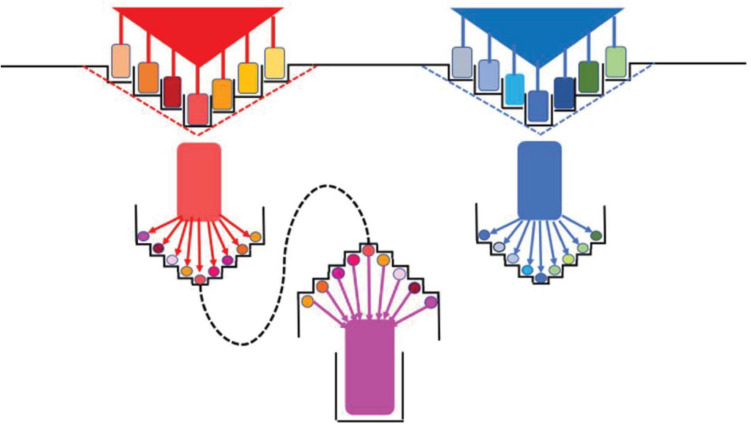
Niches are spaces for the biological units of selection, from cells to complex communities. In a broad sense, "species" are biological units of individuation. Niches do not exist without individual organisms, and every organism has a niche. We use "niche" in the Hutchinsonian sense as an abstraction of a multidimensional environmental space characterized by a variety of conditions, both biotic and abiotic, whose quantitative ranges determine the positive or negative growth rates of the microbial individual, typically a species, but also parts of the communities of species contained in this space. Microbial organisms ("species") constantly diversify, and such diversification (radiation) depends on the possibility of opening up unexploited or insufficiently exploited niches. Niche exploitation frequently implies "niche construction," as the colonized niche evolves with time, giving rise to new potential subniches, thereby influencing the selection of a series of new variants in the progeny. The evolution of niches and organisms is the result of reciprocal interacting processes that form a single unified process. Centrifugal microbial diversification expands the limits of the species' niches while a centripetal or cohesive process occurs simultaneously, mediated by horizontal gene transfers and recombinatorial events, condensing all of the information recovered during the diversifying specialization into "novel organisms" (possible future species), thereby creating a more complex niche, where the selfishness of the new organism(s) establishes a "homeostatic power" limiting the niche's variation. Once the niche's full carrying capacity has been reached, reproductive isolation occurs, as no foreign organisms can outcompete the established population/community, thereby facilitating speciation. In the case of individualization-speciation of the microbiota, its contribution to the animal' gut structure is a type of "niche construction," the result of crosstalk between the niche (host) and microorganism(s). Lastly, there is a parallelism between the hierarchy of niches and that of microbial individuals. The increasing anthropogenic effects on the biosphere (such as globalization) might reduce the diversity of niches and bacterial individuals, with the potential emergence of highly transmissible multispecialists (which are eventually deleterious) resulting from the homogenization of the microbiosphere, a possibility that should be explored and prevented.
生态位是从细胞到复杂群落等生物选择单位的生存空间。从广义上讲,“物种”是个体化的生物单位。没有个体生物就不存在生态位,而且每个生物都有一个生态位。我们采用哈钦森意义上的“生态位”,将其作为多维环境空间的一种抽象,该空间由各种生物和非生物条件所表征,其数量范围决定了微生物个体(通常是一个物种,但也包括该空间中物种群落的部分成员)的正增长或负增长率。微生物(“物种”)不断分化,而这种分化(辐射)取决于开拓未被利用或未充分利用的生态位的可能性。生态位利用常常意味着“生态位构建”,因为被定殖的生态位会随时间演变,产生新的潜在子生态位,从而影响后代中一系列新变体的选择。生态位和生物的进化是相互作用过程的结果,这些过程构成一个单一的统一过程。离心式的微生物分化扩展了物种生态位的界限,与此同时,由水平基因转移和重组事件介导的向心或凝聚过程也会发生,将分化特化过程中恢复的所有信息凝聚成“新生物”(可能的未来物种),从而创造出一个更复杂的生态位,其中新生物的自私性建立起一种“稳态力量”,限制生态位的变化。一旦生态位达到其全部承载能力,就会发生生殖隔离,因为没有外来生物能够胜过已建立的种群/群落,从而促进物种形成。就微生物群的个体化 - 物种形成而言,其对动物肠道结构的贡献是一种“生态位构建”,是生态位(宿主)与微生物之间相互作用的结果。最后,生态位层次结构与微生物个体层次结构之间存在平行关系。人类活动对生物圈的影响日益增加(如全球化)可能会减少生态位和细菌个体的多样性,由于微生物圈的同质化,有可能出现高传播性的多专长生物(最终是有害的),这种可能性应该进行探索并加以预防。