Baquero Fernando, Coque Teresa M, Martínez José-Luis, Aracil-Gisbert Sonia, Lanza Val F
Department of Microbiology, Ramón y Cajal University Hospital, Ramón y Cajal Institute for Health Research (IRYCIS), Madrid, Spain.
Centro Nacional de Biotecnología, Consejo Superior de Investigaciones Científicas (CSIC), Madrid, Spain.
Front Microbiol. 2019 Dec 17;10:2892. doi: 10.3389/fmicb.2019.02892. eCollection 2019.
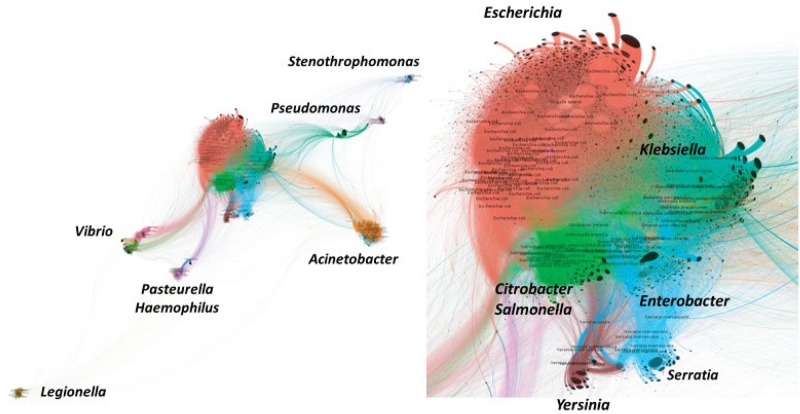
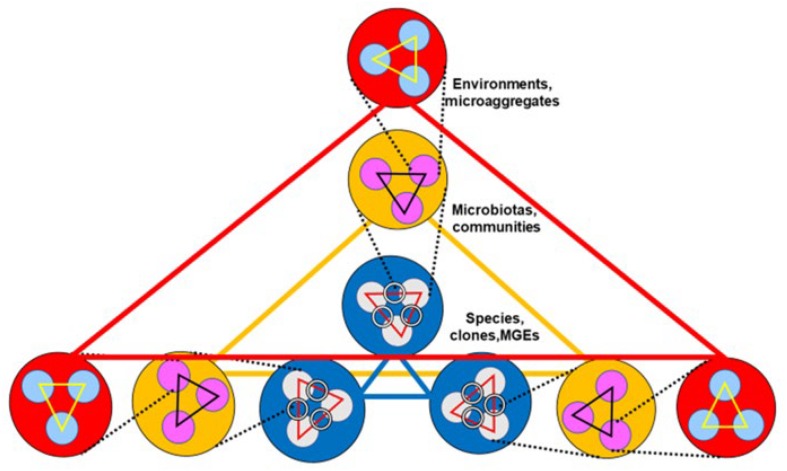
Antibiotic resistance is a field in which the concept of One Health can best be illustrated. One Health is based on the definition of communication spaces among diverse environments. Antibiotic resistance is encoded by genes, however, these genes are propagated in mobile genetic elements (MGEs), circulating among bacterial species and clones that are integrated into the multiple microbiotas of humans, animals, food, sewage, soil, and water environments, the One Health microbiosphere. The dynamics and evolution of antibiotic resistance depend on the communication networks linking all these ecological, biological, and genetic entities. These communications occur by environmental overlapping and merging, a critical issue in countries with poor sanitation, but also favored by the homogenizing power of globalization. The overwhelming increase in the population of highly uniform food animals has contributed to the parallel increase in the absolute size of their microbiotas, consequently enhancing the possibility of microbiome merging between humans and animals. Microbial communities coalescence might lead to shared microbiomes in which the spread of antibiotic resistance (of human, animal, or environmental origin) is facilitated. Intermicrobiome communication is exerted by shuttle bacterial species (or clones within species) belonging to generalist taxa, able to multiply in the microbiomes of various hosts, including humans, animals, and plants. Their integration into local genetic exchange communities fosters antibiotic resistance gene flow, following the channels of accessory genome exchange among bacterial species. These channels delineate a topology of gene circulation, including dense clusters of species with frequent historical and recent exchanges. The ecological compatibility of these species, sharing the same niches and environments, determines the exchange possibilities. In summary, the fertility of the One Health approach to antibiotic resistance depends on the progress of understanding multihierarchical systems, encompassing communications among environments (macro/microaggregates), among microbiotas (communities), among bacterial species (clones), and communications among MGEs.
抗生素耐药性是一个最能阐释“同一健康”概念的领域。“同一健康”基于对不同环境间交流空间的定义。抗生素耐药性由基因编码,然而,这些基因在移动遗传元件(MGEs)中传播,在整合到人类、动物、食物、污水、土壤和水环境(即“同一健康”微生物圈)的多种微生物群落的细菌物种和克隆之间循环。抗生素耐药性的动态变化和进化取决于连接所有这些生态、生物和遗传实体的通信网络。这些通信通过环境的重叠和融合发生,这在卫生条件差的国家是一个关键问题,但全球化的同质化力量也助长了这种情况。高度统一的食用动物数量的激增导致其微生物群落绝对规模的同步增加,从而增加了人类和动物之间微生物群落合并的可能性。微生物群落的合并可能导致共享微生物群落,从而促进抗生素耐药性(源自人类、动物或环境)的传播。微生物群落间的通信是由属于泛化分类群的穿梭细菌物种(或物种内的克隆)进行的,这些细菌能够在包括人类、动物和植物在内的各种宿主的微生物群落中繁殖。它们融入当地的基因交换群落促进了抗生素耐药基因的流动,遵循细菌物种间辅助基因组交换的途径。这些途径描绘了基因循环的拓扑结构,包括具有频繁历史和近期交换的密集物种簇。这些共享相同生态位和环境的物种的生态兼容性决定了交换的可能性。总之,“同一健康”方法在抗生素耐药性方面的成效取决于对多层次系统理解的进展,这些系统包括环境(宏观/微观聚集体)之间、微生物群落之间、细菌物种(克隆)之间以及移动遗传元件之间的通信。