Mariamenatu Abeba Haile, Abdu Emebet Mohammed
Department of Biotechnology, College of Natural and Computational Science, Debre Berhan University, P.O. Box 445, Debre Berhan, Ethiopia.
Department of Biology, College of Natural and Computational Science, Debre Berhan University, P.O. Box 445, Debre Berhan, Ethiopia.
J Lipids. 2021 Mar 17;2021:8848161. doi: 10.1155/2021/8848161. eCollection 2021.
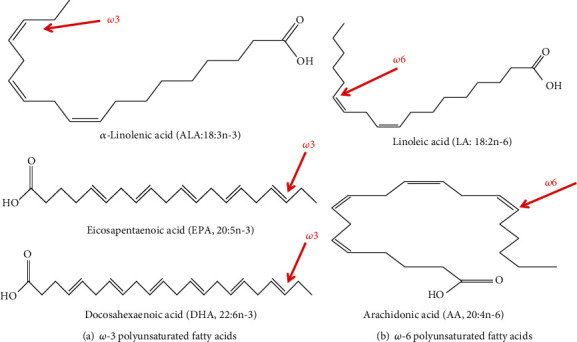
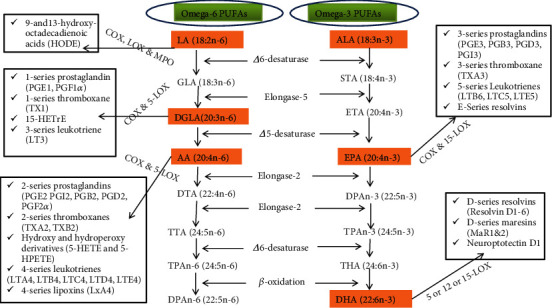
Polyunsaturated fatty acids (PUFAs) contain ≥2 double-bond desaturations within the acyl chain. Omega-3 (n-3) and Omega-6 (n-6) PUFAs are the two known important families in human health and nutrition. In both Omega families, many forms of PUFAs exist: -linolenic acid (ALA), eicosapentaenoic acid (EPA), and docosahexaenoic acid (DHA) from the n-3 family and linoleic acid (LA), dihomo--linolenic acid (DGLA), and arachidonic acid (AA) from the n-6 family are the important PUFAs for human health. Omega-3 and Omega-6 PUFAs are competitively metabolized by the same set of desaturation, elongation, and oxygenase enzymes. The lipid mediators produced from their oxidative metabolism perform opposing (antagonistic) functions in the human body. Except for DGLA, n-6 PUFA-derived lipid mediators enhance inflammation, platelet aggregation, and vasoconstriction, while those of n-3 inhibit inflammation and platelet aggregation and enhance vasodilation. Overconsumption of n-6 PUFAs with low intake of n-3 PUFAs is highly associated with the pathogenesis of many modern diet-related chronic diseases. The volume of n-6 PUFAs is largely exceeding the volume of n-3PUFAs. The current n-6/n-3 ratio is 20-50/1. Due to higher ratios of n-6/n-3 in modern diets, larger quantities of LA- and AA-derived lipid mediators are produced, becoming the main causes of the formation of thrombus and atheroma, the allergic and inflammatory disorders, and the proliferation of cells, as well as the hyperactive endocannabinoid system. Therefore, in order to reduce all of these risks which are due to overconsumption of n-6 PUFAs, individuals are required to take both PUFAs in the highly recommended n-6/n-3 ratio which is 4-5/1.
多不饱和脂肪酸(PUFAs)在酰基链内含有≥2个双键去饱和。ω-3(n-3)和ω-6(n-6)多不饱和脂肪酸是人类健康和营养方面两个已知的重要类别。在这两个ω类别中,存在多种形式的多不饱和脂肪酸:n-3类别的α-亚麻酸(ALA)、二十碳五烯酸(EPA)和二十二碳六烯酸(DHA),以及n-6类别的亚油酸(LA)、二高-γ-亚麻酸(DGLA)和花生四烯酸(AA)是对人类健康重要的多不饱和脂肪酸。ω-3和ω-6多不饱和脂肪酸由同一组去饱和、延长和加氧酶竞争性代谢。它们氧化代谢产生的脂质介质在人体中发挥相反(拮抗)的功能。除了DGLA,n-6多不饱和脂肪酸衍生的脂质介质会增强炎症、血小板聚集和血管收缩,而n-3多不饱和脂肪酸衍生的脂质介质则抑制炎症和血小板聚集并增强血管舒张。n-6多不饱和脂肪酸摄入过多而n-3多不饱和脂肪酸摄入量低与许多现代饮食相关慢性病的发病机制高度相关。n-6多不饱和脂肪酸的量大大超过n-3多不饱和脂肪酸的量。当前的n-6/n-3比例为20-50/1。由于现代饮食中n-6/n-3比例较高,会产生大量源自LA和AA的脂质介质,成为血栓和动脉粥样硬化形成、过敏和炎症性疾病、细胞增殖以及内源性大麻素系统过度活跃的主要原因。因此,为了降低所有这些因n-6多不饱和脂肪酸摄入过多而产生的风险,个人需要按照4-5/1的高度推荐n-6/n-3比例同时摄入这两种多不饱和脂肪酸。