Engin Ayse Basak, Engin Evren Doruk, Engin Atilla
Gazi University, Faculty of Pharmacy, Department of Toxicology, Ankara, Turkey.
Ankara University, Biotechnology Institute, Gumusdere Campus, Kecioren, Ankara, Turkey.
Curr Opin Toxicol. 2021 Mar;25:49-56. doi: 10.1016/j.cotox.2021.03.004. Epub 2021 Mar 29.
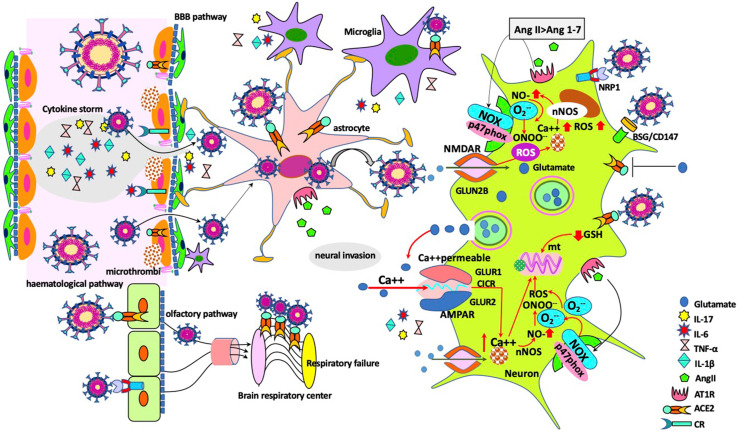
Neurological symptoms occur in approximately one-third of hospitalized patients with coronavirus disease 2019 (COVID-19). Among these symptoms, hypoxic encephalopathy develops in one-fifth of severe cases, while ischemic strokes due to thrombotic complications are common in one-third of COVID-19 intensive care patients. Brain involvement of severe acute respiratory syndrome-coronavirus-2 (SARS-CoV-2) is eventuated by several routes, including hematogenous spread, transsynaptic entry through infected neurons, olfactory nerve, ocular epithelium, vascular endothelium, and impaired blood-brain barrier. Besides the high angiotensin-converting enzyme-2 (ACE2) binding affinity, and FURIN preactivation, SARS-CoV-2 maintains efficient neuronal entry while evading immune surveillance by using basigin and neuropilin-1 receptors. However, the neurological manifestations and their pathogenic mechanisms are still debated in COVID-19 patients.
在大约三分之一的新型冠状病毒肺炎(COVID-19)住院患者中会出现神经系统症状。在这些症状中,五分之一的重症病例会发生缺氧性脑病,而在三分之一的COVID-19重症监护患者中,血栓性并发症导致的缺血性中风很常见。严重急性呼吸综合征冠状病毒2(SARS-CoV-2)累及脑部有多种途径,包括血行播散、通过感染的神经元经突触进入、嗅神经、眼上皮、血管内皮以及血脑屏障受损。除了高血管紧张素转换酶2(ACE2)结合亲和力和弗林蛋白酶预激活外,SARS-CoV-2利用基底细胞黏附分子和神经纤毛蛋白-1受体维持高效的神经元进入,同时逃避免疫监视。然而,COVID-19患者的神经表现及其致病机制仍存在争议。