Vindrola-Padros Cecilia, Sidhu Manbinder S, Georghiou Theo, Sherlaw-Johnson Chris, Singh Kelly E, Tomini Sonila M, Ellins Jo, Morris Steve, Fulop Naomi J
Department of Targeted Intervention, University College London (UCL), London, UK.
Health Services Management Centre, School of Social Policy, University of Birmingham, UK.
EClinicalMedicine. 2021 Apr;34:100799. doi: 10.1016/j.eclinm.2021.100799. Epub 2021 Mar 30.
There is a paucity of evidence for the implementation of remote home monitoring for COVID-19 infection. The aims of this study were to identify the key characteristics of remote home monitoring models for COVID-19 infection, explore the experiences of staff implementing these models, understand the use of data for monitoring progress against outcomes, and document variability in staffing and resource allocation.
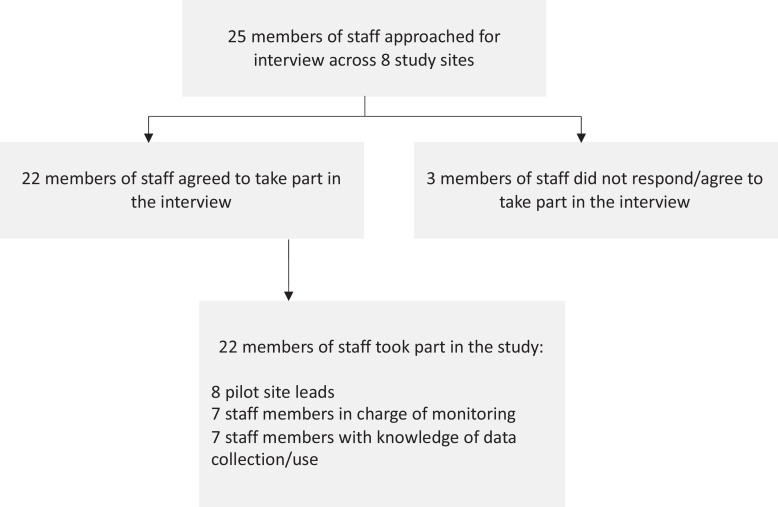
This was a multi-site mixed methods study conducted between July and August 2020 that combined qualitative and quantitative approaches to analyse the implementation and impact of remote home monitoring models developed during the first wave of the COVID-19 pandemic in England. The study combined interviews ( = 22) with staff delivering these models across eight sites in England with the collection and analysis of data on staffing models and resource allocation.
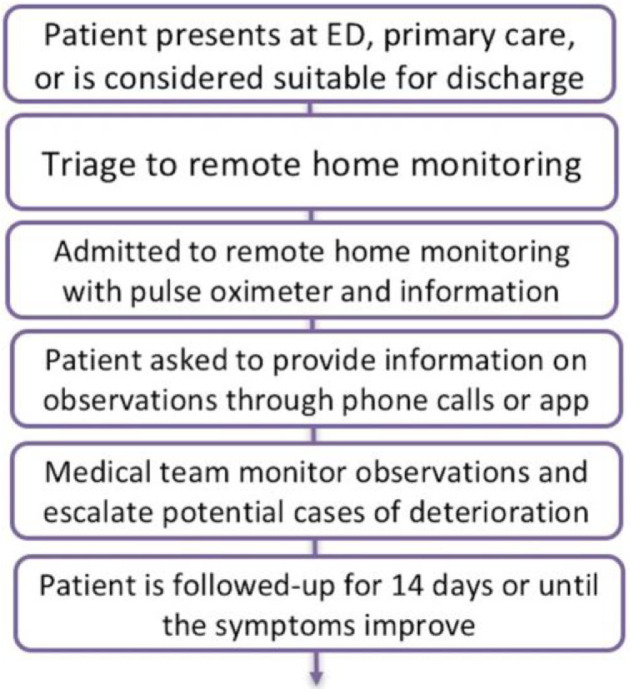
The models varied in relation to the healthcare settings and mechanisms used for patient triage, monitoring and escalation. Implementation was embedded in existing staff workloads and budgets. Good communication within clinical teams, culturally-appropriate information for patients/carers and the combination of multiple approaches for patient monitoring (app and paper-based) were considered facilitators in implementation. The mean cost per monitored patient varied from £400 to £553, depending on the model.
It is necessary to provide the means for evaluating the effectiveness of these models, for example, by establishing comparator data. Future research should also focus on the sustainability of the models and patient experience (considering the extent to which some of the models exacerbate existing inequalities in access to care).
关于实施新冠病毒感染远程居家监测的证据不足。本研究的目的是确定新冠病毒感染远程居家监测模式的关键特征,探索实施这些模式的工作人员的经验,了解如何利用数据监测结果进展,并记录人员配备和资源分配的差异。
这是一项于2020年7月至8月进行的多地点混合方法研究,结合定性和定量方法,分析在英国第一波新冠疫情期间开发的远程居家监测模式的实施情况和影响。该研究将对英格兰八个地点实施这些模式的工作人员进行的访谈(n = 22)与人员配备模式和资源分配数据的收集及分析相结合。
这些模式在用于患者分诊、监测和升级的医疗环境及机制方面存在差异。实施工作嵌入到现有的工作人员工作量和预算中。临床团队内部良好的沟通、为患者/护理人员提供符合文化背景的信息以及多种患者监测方法(应用程序和纸质)的结合被认为是实施工作的促进因素。根据模式不同,每名受监测患者的平均成本在400英镑至553英镑之间。
有必要提供评估这些模式有效性的方法,例如通过建立对照数据。未来的研究还应关注这些模式的可持续性以及患者体验(考虑到某些模式在多大程度上加剧了现有医疗服务获取方面的不平等)。