
卢旺达居家护理项目中基于短信的数字健康干预措施用于新冠病例及接触者的远程管理:一项关于可持续性和可扩展性的定性研究
SMS-based digital health intervention in Rwanda's home-based care program for remote management of COVID-19 cases and contacts: A qualitative study of sustainability and scalability.
作者信息
Babili Abdulaa, Nsanzimana Sabin, Rwagasore Edson, Lester Richard T
机构信息
Faculty of Public Health and Policy, London School of Hygiene and Tropical Medicine, London, United Kingdom.
Central Administration, Rwanda Biomedical Center, Kigali, Rwanda.
出版信息
Front Digit Health. 2023 Jan 9;4:1071790. doi: 10.3389/fdgth.2022.1071790. eCollection 2022.
BACKGROUND
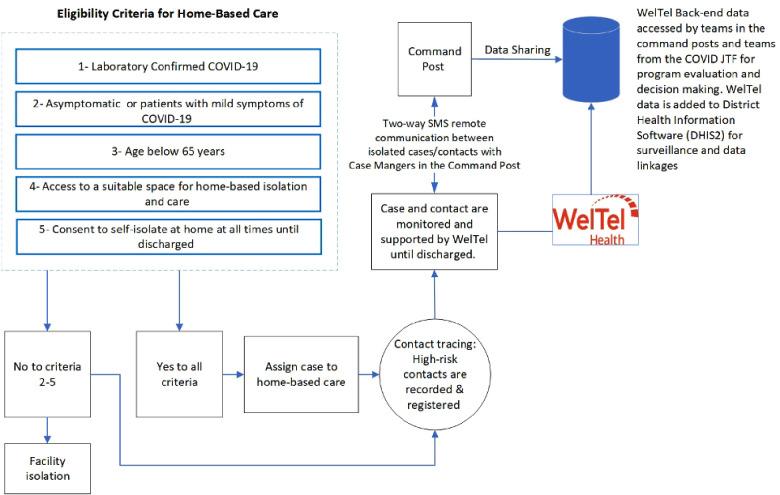
COVID-19 pandemic resulted in unprecedented global health challenges. Rwanda identified its first COVID-19 case on March 14, 2020 and subsequently introduced Home-Base Care (HBC) Program in August 2020 following community transmission of the virus and to alleviate logistical and financial strain on the healthcare system. Cases and contacts eligible for HBC were remotely supported by WelTel, an SMS-based mHealth intervention that was successfully implemented before for HIV epidemic in Rwanda. Enrolled cases and contacts were supported and monitored daily their cell and/or mobile phones until they complete isolation/quarantine period. This study explored the rationale, perspectives, and experiences of key informants (KIs) during the implementation WelTel's mHealth tool for HBC in Rwanda.
METHODS
Semi-structured one-on-one virtual interviews were conducted with KIs in this qualitative study. The KIs were classified into 2 major categories: (A) Senior staff including policymakers, directors, and senior managers; (B) Technical teams including case managers, and other staff supporting the implementation of WelTel (e.g., IT staff). Interviews were audio-recorded, transcribed, and analyzed in NVivo. Thematic analysis was conducted using a hybrid approach. A topic guide was developed using the Modified Consolidated Framework for Implementation Research and feedback from local stakeholders.
RESULTS
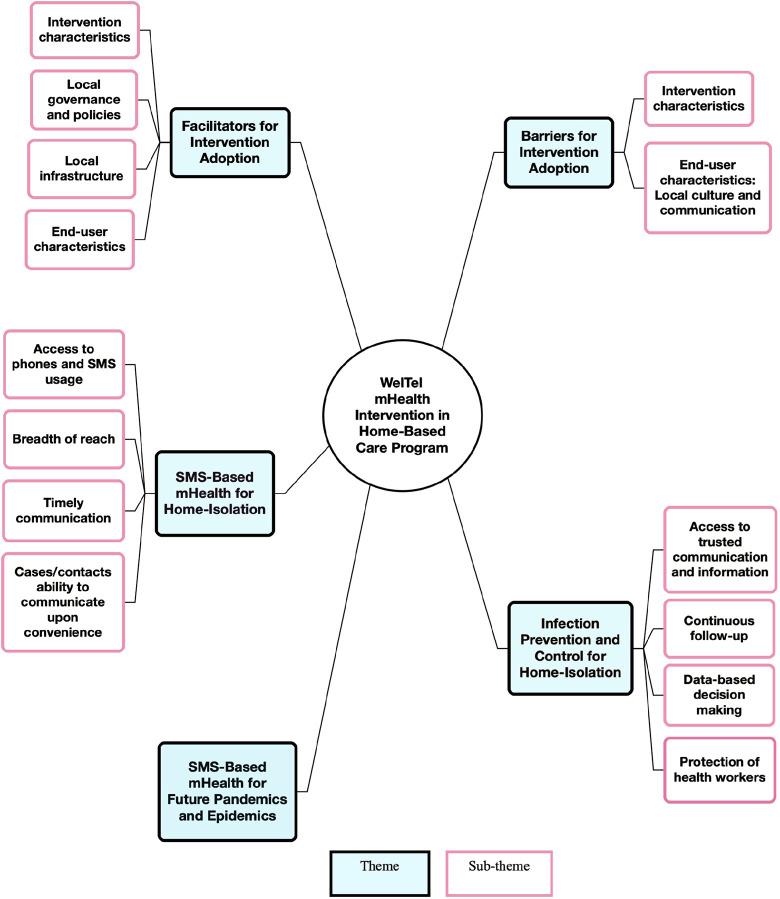
7 KIs were interviewed. Five themes emerged following thematic analysis including: SMS-Based mHealth for Home-Isolation; Facilitators for Intervention Adoption; Barriers for Intervention Adoption; Infection prevention and control for Home-Isolation; and SMS-Based mHealth for Future Pandemics and Epidemics. Based on interviews, strong political commitment and advanced digital infrastructure were major facilitators for adopting WelTel for HBC. A major barrier to adopting WelTel was identified as technical-based issues. This was followed by local communication culture. All participates agreed on the significance of using WelTel to improve access and adherence to infection prevention and control measures, understand transmission dynamics, and inform public health decision-making regarding HBC.
CONCLUSIONS
Rwanda successfully adopted WelTel for supporting and monitoring COVID-19 cases and contacts in home-isolation and the implementation was instrumental to the country's effort to manage the pandemic. Experiences and perspectives of cases and contacts enrolled into WelTel must be explored to understand the appropriateness and effectiveness of the intervention.
背景
新冠疫情带来了前所未有的全球健康挑战。卢旺达于2020年3月14日确诊首例新冠病例,随后在2020年8月,随着病毒在社区传播,为缓解医疗系统的后勤和资金压力,推出了居家照护(HBC)项目。符合HBC条件的病例和密切接触者由WelTel提供远程支持,WelTel是一种基于短信的移动健康干预措施,此前已在卢旺达成功用于应对艾滋疫情。登记在册的病例和密切接触者通过手机和/或移动电话接受每日支持和监测,直至其完成隔离/检疫期。本研究探讨了关键信息提供者(KIs)在卢旺达实施WelTel用于HBC的移动健康工具期间的基本原理、观点和经验。
方法
在这项定性研究中,对关键信息提供者进行了半结构化一对一虚拟访谈。关键信息提供者分为两大类:(A)高级工作人员,包括政策制定者、主任和高级管理人员;(B)技术团队,包括病例管理人员和其他支持WelTel实施的工作人员(如信息技术人员)。访谈进行了录音、转录,并在NVivo中进行分析。采用混合方法进行主题分析。利用改进的实施研究综合框架和当地利益相关者的反馈制定了主题指南。
结果
访谈了7名关键信息提供者。主题分析后出现了五个主题,包括:基于短信的移动健康用于居家隔离;干预措施采用的促进因素;干预措施采用的障碍;居家隔离的感染预防与控制;以及基于短信的移动健康用于未来大流行和疫情。根据访谈,强有力的政治承诺和先进的数字基础设施是采用WelTel进行HBC的主要促进因素。采用WelTel的一个主要障碍被确定为技术问题。其次是当地的沟通文化。所有参与者都认同使用WelTel对于改善感染预防与控制措施的可及性和依从性、了解传播动态以及为有关HBC的公共卫生决策提供信息的重要性。
结论
卢旺达成功采用WelTel支持和监测居家隔离的新冠病例和密切接触者,该实施对该国应对疫情的努力起到了推动作用。必须探索参与WelTel的病例和密切接触者的经验和观点,以了解干预措施的适当性和有效性。
 Zotero 插件