Institute of Health Informatics, University College London, 222 Euston Road, London, NW1 2DA, UK.
Health Data Research UK, University College London, London, UK.
BMC Med. 2021 Apr 6;19(1):85. doi: 10.1186/s12916-021-01940-7.
Machine learning (ML) is increasingly used in research for subtype definition and risk prediction, particularly in cardiovascular diseases. No existing ML models are routinely used for cardiovascular disease management, and their phase of clinical utility is unknown, partly due to a lack of clear criteria. We evaluated ML for subtype definition and risk prediction in heart failure (HF), acute coronary syndromes (ACS) and atrial fibrillation (AF).
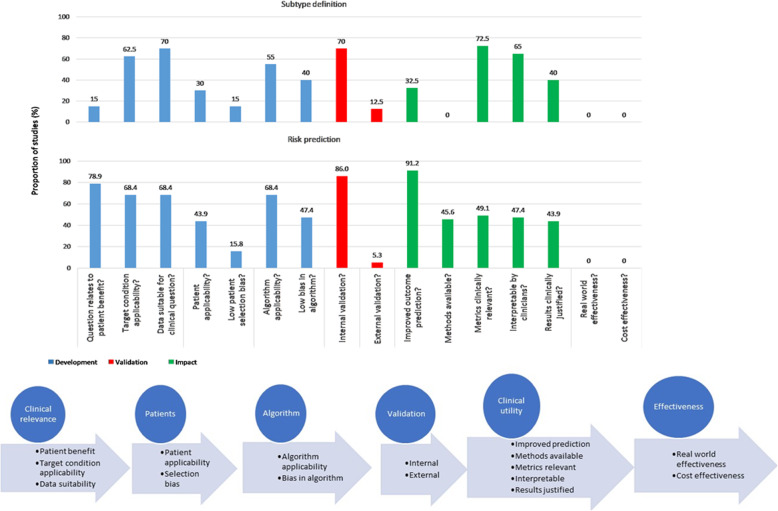
For ML studies of subtype definition and risk prediction, we conducted a systematic review in HF, ACS and AF, using PubMed, MEDLINE and Web of Science from January 2000 until December 2019. By adapting published criteria for diagnostic and prognostic studies, we developed a seven-domain, ML-specific checklist.
Of 5918 studies identified, 97 were included. Across studies for subtype definition (n = 40) and risk prediction (n = 57), there was variation in data source, population size (median 606 and median 6769), clinical setting (outpatient, inpatient, different departments), number of covariates (median 19 and median 48) and ML methods. All studies were single disease, most were North American (n = 61/97) and only 14 studies combined definition and risk prediction. Subtype definition and risk prediction studies respectively had limitations in development (e.g. 15.0% and 78.9% of studies related to patient benefit; 15.0% and 15.8% had low patient selection bias), validation (12.5% and 5.3% externally validated) and impact (32.5% and 91.2% improved outcome prediction; no effectiveness or cost-effectiveness evaluations).
Studies of ML in HF, ACS and AF are limited by number and type of included covariates, ML methods, population size, country, clinical setting and focus on single diseases, not overlap or multimorbidity. Clinical utility and implementation rely on improvements in development, validation and impact, facilitated by simple checklists. We provide clear steps prior to safe implementation of machine learning in clinical practice for cardiovascular diseases and other disease areas.
机器学习(ML)越来越多地用于亚组定义和风险预测的研究,尤其是在心血管疾病中。目前尚无常规用于心血管疾病管理的 ML 模型,其临床应用阶段尚不清楚,部分原因是缺乏明确的标准。我们评估了 ML 在心力衰竭(HF)、急性冠状动脉综合征(ACS)和心房颤动(AF)中的亚组定义和风险预测。
对于 HF、ACS 和 AF 中的亚组定义和风险预测的 ML 研究,我们使用 PubMed、MEDLINE 和 Web of Science 从 2000 年 1 月至 2019 年 12 月进行了系统评价。通过采用已发表的诊断和预后研究标准,我们制定了一个七域、ML 专用检查表。
在 5918 项研究中,有 97 项被纳入。在亚组定义(n=40)和风险预测(n=57)研究中,数据来源、人群规模(中位数 606 和中位数 6769)、临床环境(门诊、住院、不同科室)、协变量数量(中位数 19 和中位数 48)和 ML 方法存在差异。所有研究均为单一疾病,大多数为北美(n=61/97),只有 14 项研究同时进行了定义和风险预测。亚组定义和风险预测研究分别在开发方面存在局限性(例如,与患者获益相关的研究分别为 15.0%和 78.9%;低患者选择偏倚的研究分别为 15.0%和 15.8%)、验证(分别为 12.5%和 5.3%的外部验证)和影响(分别为 32.5%和 91.2%改善结局预测;无有效性或成本效益评估)。
HF、ACS 和 AF 中 ML 研究受到纳入协变量的数量和类型、ML 方法、人群规模、国家、临床环境和单一疾病的关注的限制,而非重叠或合并症。临床实用性和实施依赖于开发、验证和影响的改进,这得益于简单的检查表。我们在临床实践中为心血管疾病和其他疾病领域的机器学习提供了明确的实施步骤。