Hunan Normal University School of Medicine, Changsha, Hunan, China (mainland).
Department of Pediatrics, The Third Xiangya Hospital, Central South University, Changsha, Hunan, China (mainland).
Med Sci Monit. 2021 Apr 6;27:e930032. doi: 10.12659/MSM.930032.
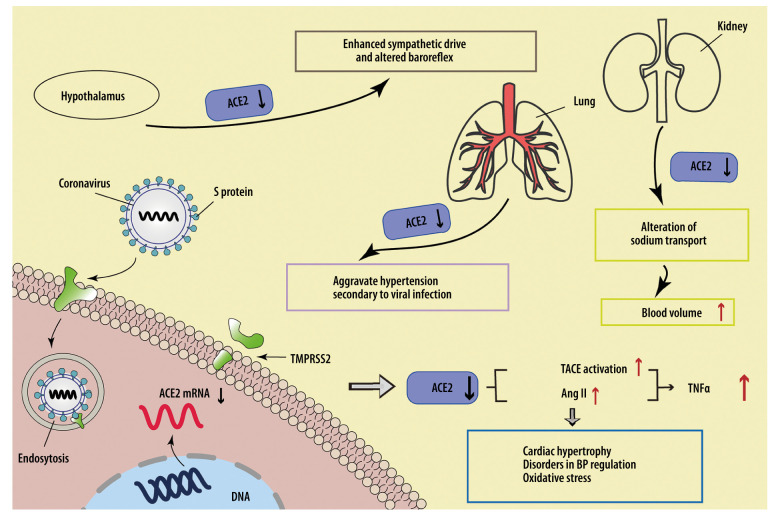
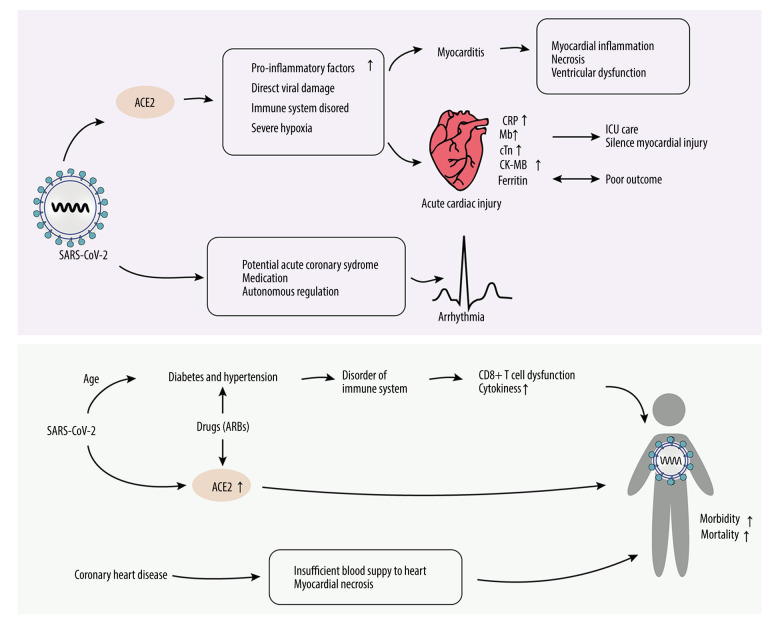
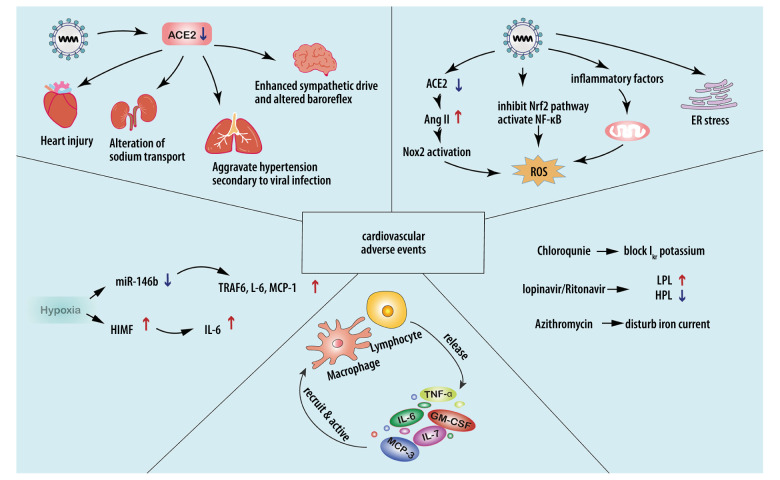
In December 2019, pneumonia of unknown cause broke out, and currently more than 150 countries around the world have been affected. Globally, as of 5: 46 pm CET, 6 November 2020, the World Health Organization (WHO) had reported 48 534 508 confirmed cases of COVID-19, including 1 231 017 deaths. The novel coronavirus disease (COVID-19) outbreak, caused by the SARS-CoV-2 virus, is the most important medical challenge in decades. Previous research mainly focused on the exploration of lung changes. However, with development of the disease and deepening research, more and more patients showed cardiovascular diseases, even in those without respiratory symptoms, and some researchers have found that underlying cardiovascular diseases increase the risk of infection. Although the related mechanism is not thoroughly studied, based on existing research, we speculate that the interaction between the virus and its receptor, inflammatory factors, various forms of the stress response, hypoxic environment, and drug administration could all induce the development of cardiac adverse events. Interventions to control these pathogenic factors may effectively reduce the occurrence of cardiovascular complications. This review summarizes the latest research on the relationship between COVID-19 and its associated cardiovascular complications, and we also explore possible mechanisms and treatments.
2019 年 12 月,不明原因肺炎爆发,目前全球已有超过 150 个国家受到影响。截至 2020 年 11 月 6 日下午 5 点 46 分(CET),世界卫生组织(WHO)已报告 48534508 例 COVID-19 确诊病例,包括 1231017 例死亡病例。由 SARS-CoV-2 病毒引起的新型冠状病毒病(COVID-19)疫情是几十年来最重要的医学挑战。既往研究主要集中于对肺部变化的探索。然而,随着疾病的发展和研究的深入,越来越多的患者出现心血管疾病,甚至在那些没有呼吸道症状的患者中也是如此,一些研究人员发现潜在的心血管疾病会增加感染的风险。尽管相关机制尚未得到深入研究,但基于现有研究,我们推测病毒与其受体、炎症因子、各种形式的应激反应、缺氧环境和药物治疗之间的相互作用可能会导致心脏不良事件的发生。控制这些致病因素的干预措施可能会有效减少心血管并发症的发生。本综述总结了 COVID-19 及其相关心血管并发症的最新研究,并探讨了可能的机制和治疗方法。