Centre for Infectious Disease Control, National Institute for Public Health and the Environment, Bilthoven, The Netherlands.
Clin Infect Dis. 2022 Jan 7;74(1):52-58. doi: 10.1093/cid/ciab237.
Indoor environments are considered one of the main settings for transmission of severe acute respiratory syndrome coronavirus 2 (SARS-CoV-2). Households in particular represent a close-contact environment with high probability of transmission between persons of different ages and roles in society.
Households with a laboratory-confirmed SARS-CoV-2 positive case in the Netherlands (March-May 2020) were included. At least 3 home visits were performed during 4-6 weeks of follow-up, collecting naso- and oropharyngeal swabs, oral fluid, feces and blood samples from all household members for molecular and serological analyses. Symptoms were recorded from 2 weeks before the first visit through to the final visit. Infection secondary attack rates (SAR) were estimated with logistic regression. A transmission model was used to assess household transmission routes.
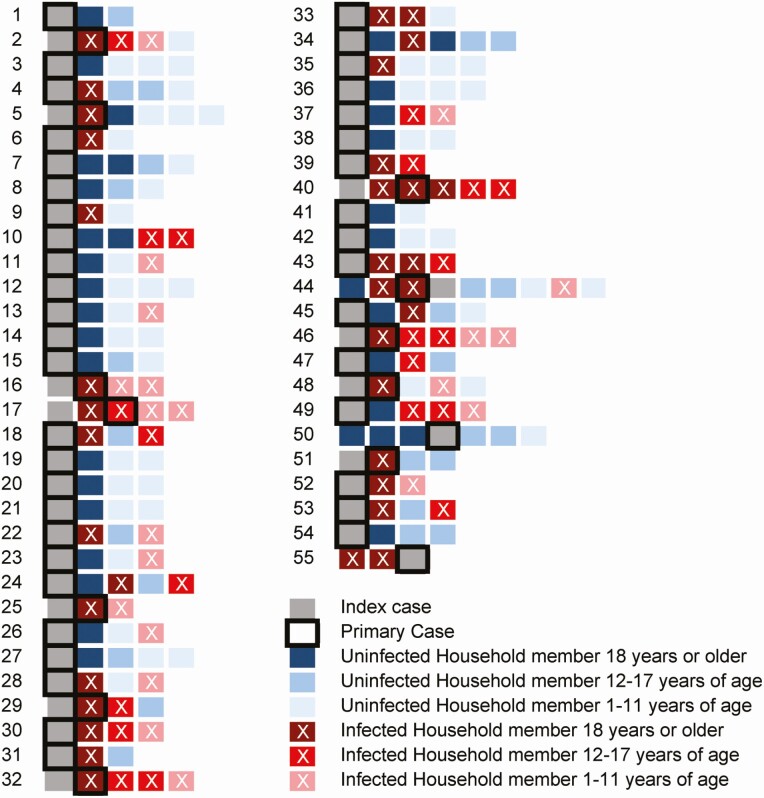
A total of 55 households with 187 household contacts were included. In 17 households no transmission took place; in 11 households all persons were infected. Estimated infection SARs were high, ranging from 35% (95% confidence interval [CI], 24%-46%) in children to 51% (95% CI, 39%-63%) in adults. Estimated transmission rates in the household were high, with reduced susceptibility of children compared with adolescents and adults (0.67; 95% CI, .40-1.1).
Estimated infection SARs were higher than reported in earlier household studies, presumably owing to our dense sampling protocol. Children were shown to be less susceptible than adults, but the estimated infection SAR in children was still high. Our results reinforce the role of households as one of the main multipliers of SARS-CoV-2 infection in the population.
室内环境被认为是严重急性呼吸综合征冠状病毒 2(SARS-CoV-2)传播的主要场所之一。家庭尤其代表了一个密切接触的环境,不同年龄和社会角色的人之间有很高的传播概率。
本研究纳入了荷兰(2020 年 3 月至 5 月)实验室确诊的 SARS-CoV-2 阳性病例的家庭。在 4-6 周的随访期间,至少进行了 3 次家庭访问,从所有家庭成员中采集鼻咽和口咽拭子、口腔液、粪便和血液样本,进行分子和血清学分析。从第一次访问前 2 周到最后一次访问,记录症状。使用逻辑回归估计感染二级攻击率(SAR)。使用传播模型评估家庭传播途径。
共纳入 55 户家庭的 187 名家庭接触者。在 17 个家庭中未发生传播,在 11 个家庭中所有成员均被感染。估计的感染 SAR 较高,范围从儿童的 35%(95%置信区间[CI],24%-46%)到成人的 51%(95% CI,39%-63%)。家庭内的估计传播率较高,儿童的易感性低于青少年和成人(0.67;95% CI,0.40-1.1)。
与早期家庭研究相比,估计的感染 SAR 较高,可能是由于我们密集的采样方案。与成人相比,儿童的易感性较低,但儿童的估计感染 SAR 仍然较高。我们的研究结果强化了家庭在人群中作为 SARS-CoV-2 感染主要传播媒介之一的作用。