Department of Physiology, Faculty of Medicine, University of Colombo, Colombo, Sri Lanka; School of Exercise & Nutrition Sciences, Queensland University of Technology, Brisbane, Queensland, Australia.
Health and Wellness Unit, Faculty of Medicine, University of Colombo, Colombo, Sri Lanka; Department of Biosystems Technology, Faculty of Technology, Sabaragamuwa University of Sri Lanka, Sri Lanka.
Diabetes Metab Syndr. 2021 May-Jun;15(3):757-764. doi: 10.1016/j.dsx.2021.03.006. Epub 2021 Mar 13.
COVID-19 is a pandemic that has affected beyond 100 million and caused nearly 3 million deaths globally. Vitamin D is a known risk factor for COVID-19. Therefore, we aimed to investigate the association of prevalence of vitamin D deficiency and mean vitamin D level with COVID-19 infection and mortality in Asia, predicting with other confounding factors such as median age, obesity, and diabetes.
COVID-19 infections and mortalities among the Asian countries were retrieved from the Worldometer website. Information on prevalence of vitamin D deficiency and mean vitamin D values in each Asian country was retrieved through literature searching on PubMed® and Google scholar. The associations between COVID-19 infections and mortalities with prevalence of vitamin D deficiency and mean vitamin D level were explored with correlation coefficients. As a predictive analysis, multiple linear regression was carried out with all confounders.
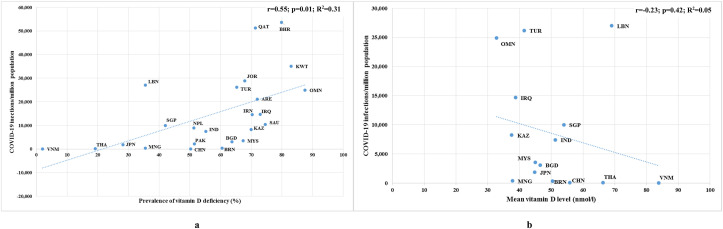
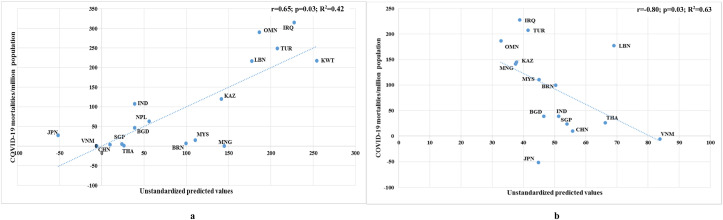
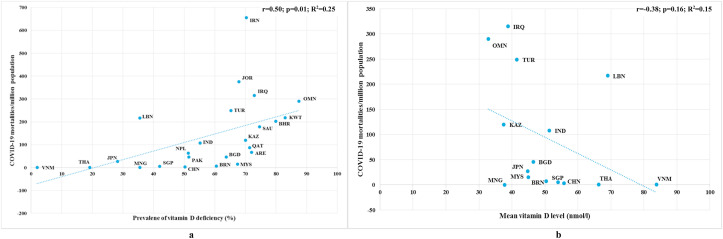
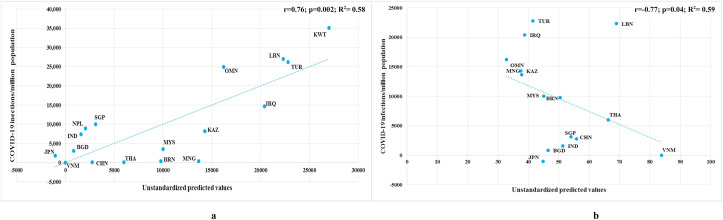
Positive correlations were observed for prevalence of vitamin D deficiency with COVID-19 infections (r = 0.55; p = 0.01; R = 0.31) and mortalities (r = 0.50; p = 0.01; R = 0.25). Moreover, the associations for the COVID-19 infections and mortalities improved to r = 0.76 (p = 0.002; R = 0.58) and r = 0.65 (p = 0.03; R = 0.42), respectively, after predicting with confounding factors. Similarly, mean vitamin D level had a significant negative correlation with COVID-19 infections (r = -0.77; p = 0.04; R = 0.59) and mortalities (r = -0.80; p = 0.03; R = 0.63) when combining with confounders.
Prevalence of vitamin D deficiency is significantly positively associated whereas the mean vitamin D level is significantly negatively associated with both infection and mortality rate of COVID-19 among Asian countries upon predicting with all confounders.
COVID-19 是一种大流行疾病,已在全球范围内影响超过 1 亿人,并导致近 300 万人死亡。维生素 D 是 COVID-19 的已知危险因素。因此,我们旨在调查亚洲地区维生素 D 缺乏症的患病率和平均维生素 D 水平与 COVID-19 感染和死亡率之间的关系,并预测中位数年龄、肥胖和糖尿病等其他混杂因素的影响。
从 Worldometer 网站检索亚洲国家的 COVID-19 感染和死亡率数据。通过在 PubMed®和 Google Scholar 上检索文献,获取亚洲各国维生素 D 缺乏症的患病率和平均维生素 D 值的信息。用相关系数探讨 COVID-19 感染和死亡率与维生素 D 缺乏症的患病率和平均维生素 D 水平之间的关系。作为预测分析,使用所有混杂因素进行多元线性回归。
维生素 D 缺乏症的患病率与 COVID-19 感染(r = 0.55;p = 0.01;R² = 0.31)和死亡率(r = 0.50;p = 0.01;R² = 0.25)呈正相关。此外,在预测混杂因素后,COVID-19 感染和死亡率的相关性分别提高到 r = 0.76(p = 0.002;R² = 0.58)和 r = 0.65(p = 0.03;R² = 0.42)。同样,平均维生素 D 水平与 COVID-19 感染(r = -0.77;p = 0.04;R² = 0.59)和死亡率(r = -0.80;p = 0.03;R² = 0.63)呈显著负相关,在结合混杂因素后。
在预测所有混杂因素后,亚洲国家的维生素 D 缺乏症的患病率与 COVID-19 的感染和死亡率呈显著正相关,而平均维生素 D 水平与 COVID-19 的感染和死亡率呈显著负相关。