Brandt Eric J, Rosenberg Julia, Waselewski Marika E, Amaro Xochitl, Wasag Jacob, Chang Tammy
Institute for Healthcare Policy and Innovation, University of Michigan, Ann Arbor, Michigan; Division of Cardiovascular Medicine, Department of Internal Medicine, University of Michigan, Ann Arbor, Michigan.
Section of General Pediatrics, Department of Pediatrics, Yale University School of Medicine, New Haven, Connecticut.
J Adolesc Health. 2021 May;68(5):869-872. doi: 10.1016/j.jadohealth.2021.02.013. Epub 2021 Apr 3.
This study aimed to understand the potential barriers and facilitators to COVID-19 vaccination among youth.
Open-ended questions regarding COVID-19 vaccination were posed to a national cohort of 14- to 24-year-olds (October 30, 2020). Responses were coded through qualitative thematic analysis. Multivariable logistic regression tested the association of demographic characteristics with vaccination unwillingness.
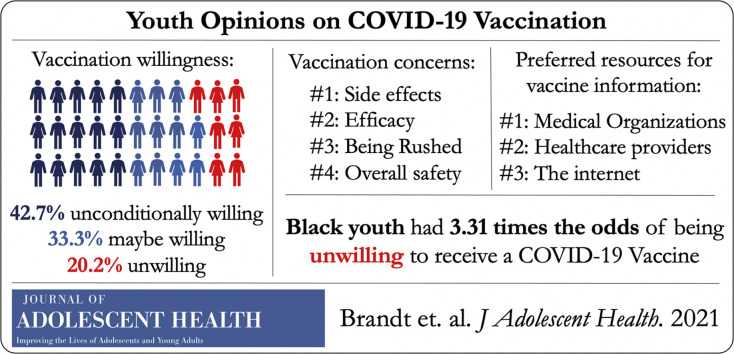
Among 911 respondents (response rate = 79.4%), 75.9% reported willingness to receive a COVID-19 vaccine, 42.7% had unconditional willingness, and 33.3% were conditionally willing, of which the majority (80.7%) were willing if experts deemed vaccination safe and recommended. Preferred vaccine information sources were medical organizations (42.3%; CDC, WHO) and health care professionals (31.7%). Frequent concerns with vaccination included side effects (36.2%) and efficacy (20.1%). Race predicted vaccination unwillingness (Black: odds ratio = 3.31; and Asian: odds ratio = .46, compared with white, p < .001).
Most youth in our national sample were willing to receive a COVID-19 vaccine when they believe it is safe and recommended. Public health experts and organizations must generate youth-centered materials that directly address their vaccination concerns.
本研究旨在了解青少年接种新冠疫苗的潜在障碍和促进因素。
向一个全国性的14至24岁队列(2020年10月30日)提出了关于新冠疫苗接种的开放式问题。通过定性主题分析对回答进行编码。多变量逻辑回归检验了人口统计学特征与接种意愿的关联。
在911名受访者中(回复率 = 79.4%),75.9%的人表示愿意接种新冠疫苗,42.7%的人无条件愿意,33.3%的人有条件愿意,其中大多数人(80.7%)在专家认为疫苗安全并推荐的情况下愿意接种。首选的疫苗信息来源是医学组织(42.3%;疾病控制与预防中心、世界卫生组织)和医疗保健专业人员(31.7%)。对疫苗接种的常见担忧包括副作用(36.2%)和有效性(20.1%)。种族可预测接种意愿(黑人:比值比 = 3.31;亚洲人:比值比 = 0.46,与白人相比,p <.001)。
在我们的全国样本中,大多数青少年在认为疫苗安全且被推荐时愿意接种新冠疫苗。公共卫生专家和组织必须制作以青少年为中心的材料,直接解决他们对接种疫苗的担忧。