South China Research Center for Acupuncture and Moxibustion, Medical College of Acu-Moxi and Rehabilitation, Guangzhou University of Chinese Medicine, Guangzhou, 510006, China.
School of Pharmaceutical Sciences, Guangzhou University of Chinese Medicine, Guangzhou, 510006, China.
Oxid Med Cell Longev. 2021 Mar 20;2021:6628957. doi: 10.1155/2021/6628957. eCollection 2021.
Doxorubicin (DOX) is a commonly used chemotherapeutic drug but is limited in clinical applications by its cardiotoxicity. acupoint (PC6) is a well-recognized acupoint for the treatment of cardiothoracic disease. However, whether acupuncture at PC6 could be effective in preventing DOX-induced cardiotoxicity is still unknown.
A set of experiments were performed with myocardial cells, wild type, inducible nitric oxide synthase knockout (iNOS-/-), and myocardial-specific ablation arginase 2 (Myh6-ARG 2-/-) mice. We investigated the protective effect and the underlying mechanisms for electroacupuncture (EA) against DOX-induced cardiotoxicity by echocardiography, immunostaining, biochemical analysis, and molecular biotechnology in vivo and in vitro analysis.
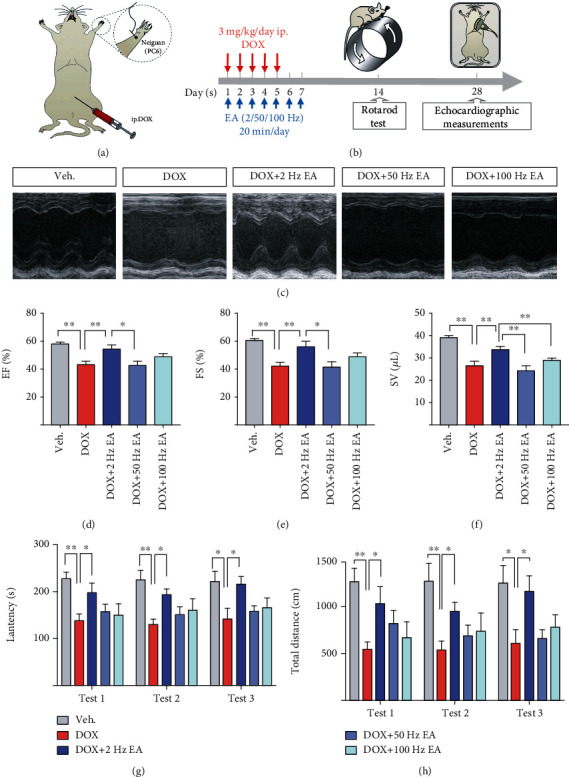
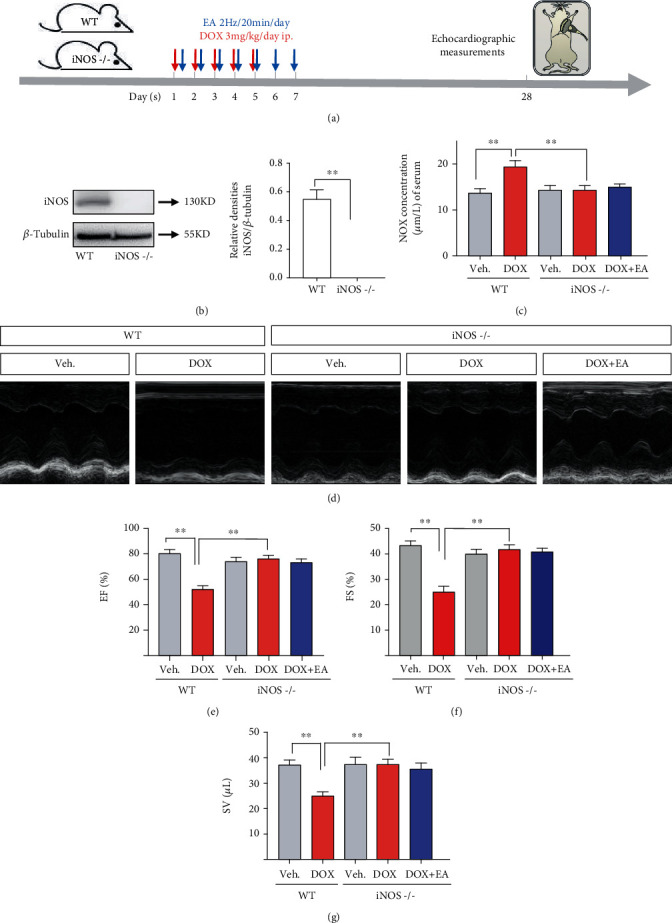
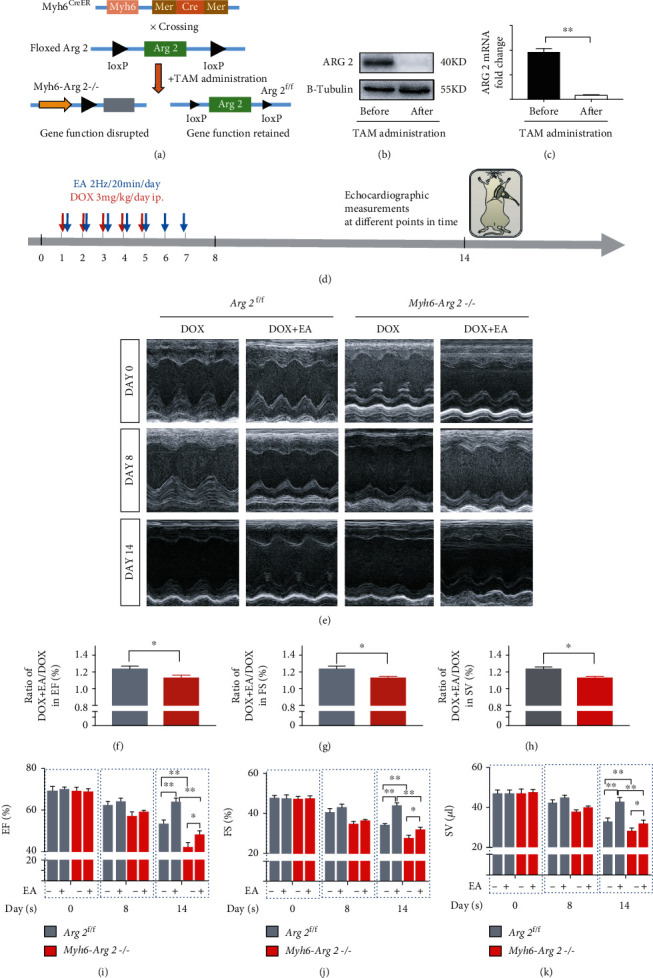
We found that DOX-mediated nitric oxide (NO) production was positively correlated with the iNOS level but has a negative correlation with the arginase 2 (ARG 2) level in both myocardial cells and tissues. Meanwhile, EA at PC6 alleviated cardiac dysfunction and cardiac hypertrophy in DOX-treated mice. EA at PC6 blocked the upregulation of NO production in accompanied with the downregulated iNOS and upregulated ARG 2 levels in myocardial tissue induced by DOX. Furthermore, knockout iNOS prevented cardiotoxicity and EA treatment did not cause the further improvement of cardiac function in iNOS-/- mice treated by DOX. In contrast, deficiency of myocardial ARG 2 aggravated DOX-induced cardiotoxicity and reduced EA protective effect.
These results suggest that EA treatment at PC6 can prevent DOX-induced cardiotoxicity through modulating NO production by modulating the iNOS/ARG 2 balance in myocardial cells.
阿霉素(DOX)是一种常用的化疗药物,但由于其心脏毒性,在临床应用中受到限制。 穴位(PC6)是治疗心胸疾病的公认穴位。然而,针刺 PC6 是否能有效预防 DOX 诱导的心脏毒性尚不清楚。
用心肌细胞、野生型、诱导型一氧化氮合酶敲除(iNOS-/-)和心肌特异性缺失精氨酸酶 2(Myh6-ARG 2-/-)小鼠进行了一系列实验。我们通过超声心动图、免疫染色、生化分析和分子生物技术,在体内和体外分析中研究了电针(EA)对 DOX 诱导的心脏毒性的保护作用及其潜在机制。
我们发现 DOX 介导的一氧化氮(NO)产生与 iNOS 水平呈正相关,但与心肌细胞和组织中的精氨酸酶 2(ARG 2)水平呈负相关。同时,PC6 处的 EA 缓解了 DOX 处理小鼠的心脏功能障碍和心脏肥大。PC6 处的 EA 阻断了 DOX 诱导的心肌组织中 NO 产生的上调,同时下调了 iNOS 和上调了 ARG 2 水平。此外,iNOS 敲除可预防心脏毒性,而 EA 治疗并未导致 DOX 处理的 iNOS-/-小鼠的心脏功能进一步改善。相反,心肌 ARG 2 的缺乏加重了 DOX 诱导的心脏毒性,并降低了 EA 的保护作用。
这些结果表明,PC6 处的 EA 治疗可通过调节心肌细胞中 iNOS/ARG 2 平衡来调节 NO 产生,从而预防 DOX 诱导的心脏毒性。