Organismal and Evolutionary Biology, Viikki Plant Science Center (ViPS), Faculty of Biological and Environmental Sciences, University of Helsinki, 00014 Helsinki, Finland.
School of Science and Technology, The Life Science Center-Biology, Örebro University, SE-70182 Örebro, Sweden.
Plant Physiol. 2021 Jul 6;186(3):1382-1396. doi: 10.1093/plphys/kiab162.
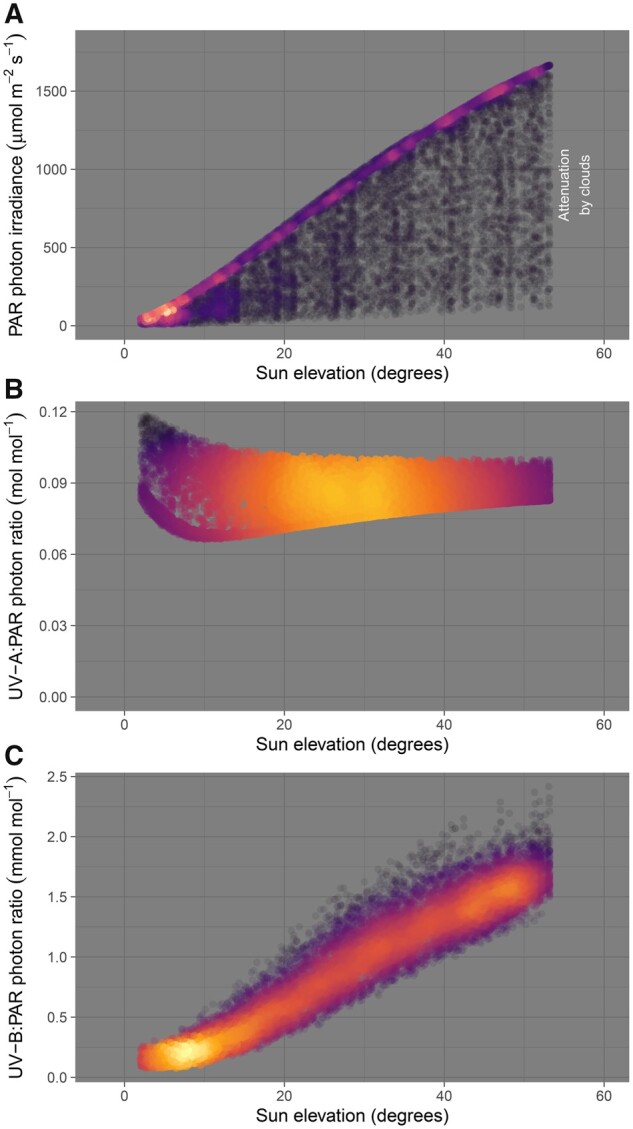
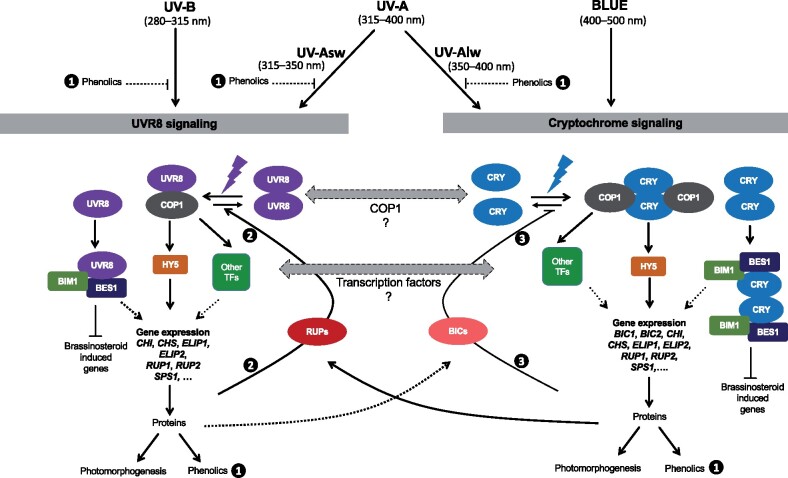
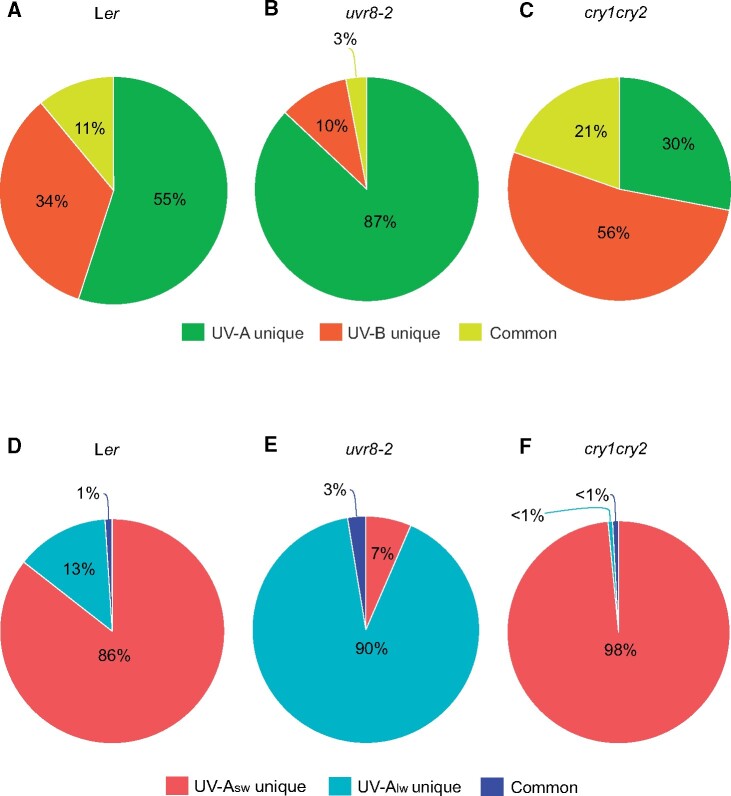
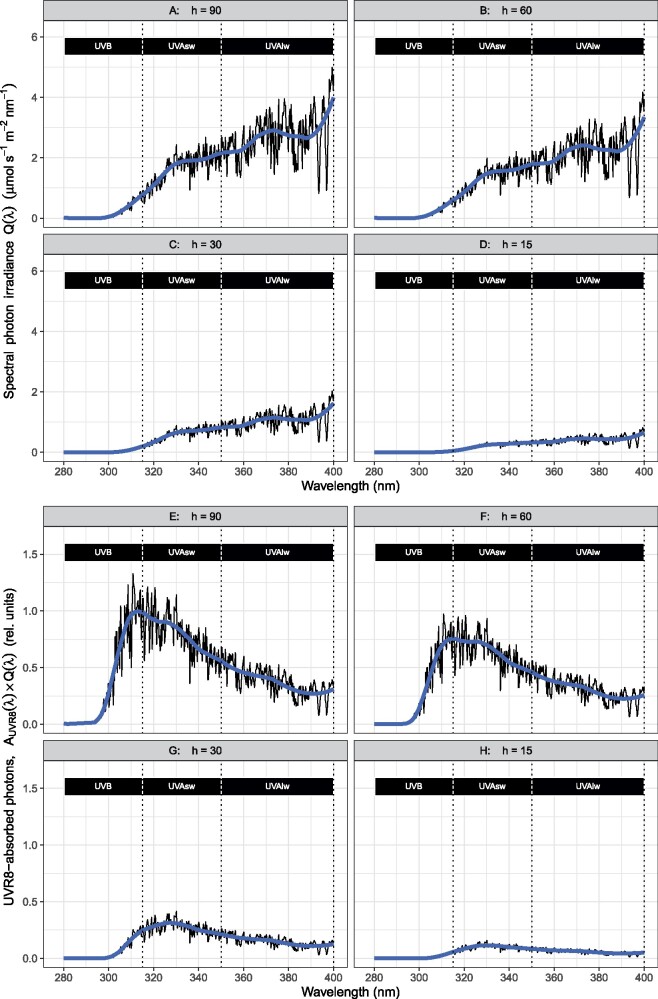
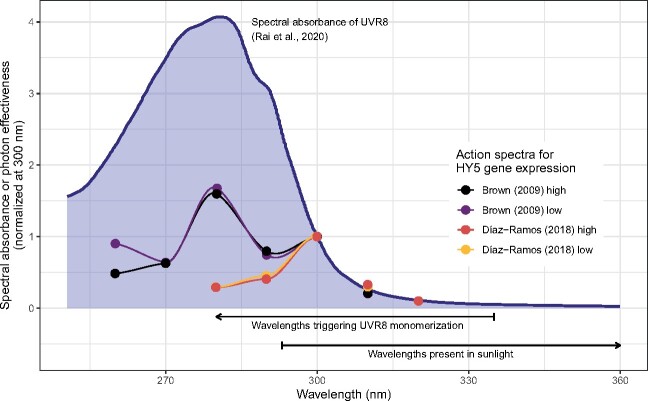
About 95% of the ultraviolet (UV) photons reaching the Earth's surface are UV-A (315-400 nm) photons. Plant responses to UV-A radiation have been less frequently studied than those to UV-B (280-315 nm) radiation. Most previous studies on UV-A radiation have used an unrealistic balance between UV-A, UV-B, and photosynthetically active radiation (PAR). Consequently, results from these studies are difficult to interpret from an ecological perspective, leaving an important gap in our understanding of the perception of solar UV radiation by plants. Previously, it was assumed UV-A/blue photoreceptors, cryptochromes and phototropins mediated photomorphogenic responses to UV-A radiation and "UV-B photoreceptor" UV RESISTANCE LOCUS 8 (UVR8) to UV-B radiation. However, our understanding of how UV-A radiation is perceived by plants has recently improved. Experiments using a realistic balance between UV-B, UV-A, and PAR have demonstrated that UVR8 can play a major role in the perception of both UV-B and short-wavelength UV-A (UV-Asw, 315 to ∼350 nm) radiation. These experiments also showed that UVR8 and cryptochromes jointly regulate gene expression through interactions that alter the relative sensitivity to UV-B, UV-A, and blue wavelengths. Negative feedback loops on the action of these photoreceptors can arise from gene expression, signaling crosstalk, and absorption of UV photons by phenolic metabolites. These interactions explain why exposure to blue light modulates photomorphogenic responses to UV-B and UV-Asw radiation. Future studies will need to distinguish between short and long wavelengths of UV-A radiation and to consider UVR8's role as a UV-B/UV-Asw photoreceptor in sunlight.
到达地球表面的紫外线(UV)光子中,约有 95%是 UV-A(315-400nm)光子。与 UV-B(280-315nm)辐射相比,植物对 UV-A 辐射的反应研究得较少。大多数先前关于 UV-A 辐射的研究都采用了 UV-A、UV-B 和光合有效辐射(PAR)之间不切实际的平衡。因此,这些研究的结果从生态学角度来看很难解释,这使得我们对植物感知太阳 UV 辐射的理解存在一个重要的空白。以前,人们认为 UV-A/蓝光受体、隐花色素和向光素介导了植物对 UV-A 辐射的光形态建成反应,以及“UV-B 受体”UV 抵抗基因 8(UVR8)对 UV-B 辐射的反应。然而,我们对植物如何感知 UV-A 辐射的理解最近有所提高。使用 UV-B、UV-A 和 PAR 之间实际平衡的实验表明,UVR8 在感知 UV-B 和短波长 UV-A(UV-Asw,315 至~350nm)辐射方面可以发挥重要作用。这些实验还表明,UVR8 和隐花色素通过改变对 UV-B、UV-A 和蓝光波长的相对敏感性的相互作用,共同调节基因表达。这些光受体作用的负反馈回路可以来自基因表达、信号串扰和酚类代谢物对 UV 光子的吸收。这些相互作用解释了为什么暴露在蓝光下会调节植物对 UV-B 和 UV-Asw 辐射的光形态建成反应。未来的研究需要区分 UV-A 辐射的短波长和长波长,并考虑 UVR8 在阳光中作为 UV-B/UV-Asw 受体的作用。