IGeneX Inc, 556 Gibraltar Drive, Milpitas, CA, 95035, USA.
ID-FISH Technology Inc, 556 Gibraltar Drive, Milpitas, CA, 95035, USA.
BMC Infect Dis. 2021 Apr 7;21(1):325. doi: 10.1186/s12879-021-06031-9.
Rapid and simple serological assays for characterizing antibody responses are important in the current COVID-19 pandemic caused by SARS-CoV-2. Multiplex immunoblot (IB) assays termed COVID-19 IB assays were developed for detecting IgG and IgM antibodies to SARS-CoV-2 virus proteins in COVID-19 patients.
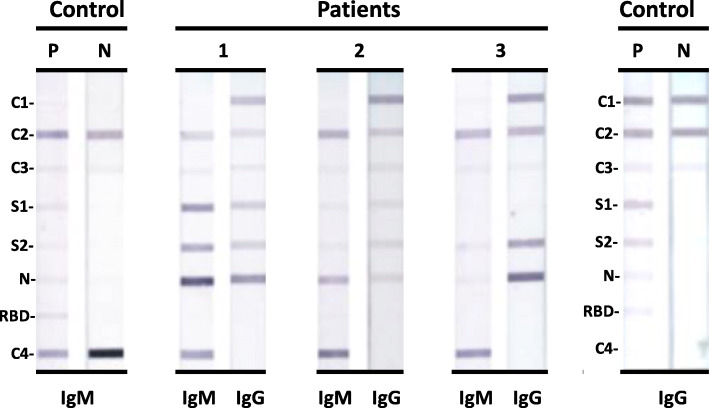
Recombinant nucleocapsid protein and the S1, S2 and receptor binding domain (RBD) of the spike protein of SARS-CoV-2 were used as target antigens in the COVID-19 IBs. Specificity of the IB assay was established with 231 sera from persons with allergy, unrelated viral infections, autoimmune conditions and suspected tick-borne diseases, and 32 goat antisera to human influenza proteins. IgG and IgM COVID-19 IBs assays were performed on 84 sera obtained at different times after a positive RT-qPCR test from 37 COVID-19 patients with mild symptoms.
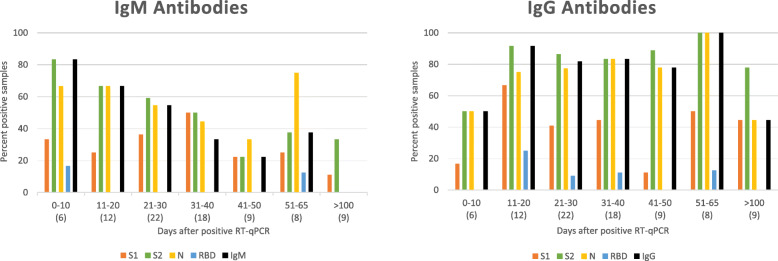
Criteria for determining overall IgG and IgM antibody positivity using the four SARS-CoV-2 proteins were developed by optimizing specificity and sensitivity in the COVID-19 IgG and IgM IB assays. The estimated sensitivities and specificities of the COVID-19 IgG and IgM IBs for IgG and IgM antibodies individually or for either IgG or IgM antibodies meet the US recommendations for laboratory serological diagnostic tests. The proportion of IgM-positive sera from the COVID-19 patients following an RT-qPCR positive test was maximal at 83% before 10 days and decreased to 0% after 100 days, while the proportions of IgG-positive sera tended to plateau between days 11 and 65 at 78-100% and fall to 44% after 100 days. Detection of either IgG or IgM antibodies was better than IgG or IgM alone for assessing seroconversion in COVID-19. Both IgG and IgM antibodies detected RBD less frequently than S1, S2 and N proteins.
The multiplex COVID-19 IB assays offer many advantages for simultaneously evaluating antibody responses to different SARS-CoV-2 proteins in COVID-19 patients.
在当前由 SARS-CoV-2 引起的 COVID-19 大流行中,快速而简单的血清学检测对于描述抗体反应非常重要。已经开发了称为 COVID-19 IB 检测的多重免疫印迹(IB)检测,用于检测 COVID-19 患者中针对 SARS-CoV-2 病毒蛋白的 IgG 和 IgM 抗体。
在 COVID-19 IB 中,使用重组核衣壳蛋白和 SARS-CoV-2 的 S1、S2 和受体结合域(RBD)作为靶抗原。用 231 份来自过敏、无关病毒感染、自身免疫性疾病和疑似蜱传疾病患者的血清以及 32 份抗人类流感蛋白的山羊抗血清对 IB 检测的特异性进行了评估。对 37 例症状轻微的 COVID-19 患者在 RT-qPCR 阳性检测后不同时间获得的 84 份血清进行了 IgG 和 IgM COVID-19 IB 检测。
通过优化 COVID-19 IgG 和 IgM IB 检测的特异性和敏感性,制定了使用四种 SARS-CoV-2 蛋白确定总体 IgG 和 IgM 抗体阳性的标准。COVID-19 IgG 和 IgM IB 检测用于 IgG 和 IgM 抗体的单独检测或用于 IgG 或 IgM 抗体的检测的估计敏感性和特异性均符合美国实验室血清学诊断检测的建议。在 RT-qPCR 阳性检测后,COVID-19 患者血清 IgM 阳性的比例在 10 天前最大为 83%,在 100 天后降至 0%,而 IgG 阳性的比例在 11 至 65 天之间趋于稳定在 78-100%,在 100 天后降至 44%。与 IgG 或 IgM 单独检测相比,检测 IgG 或 IgM 对评估 COVID-19 中的血清转化更好。IgG 和 IgM 抗体检测 RBD 的频率均低于 S1、S2 和 N 蛋白。
多重 COVID-19 IB 检测为同时评估 COVID-19 患者中针对不同 SARS-CoV-2 蛋白的抗体反应提供了许多优势。