Belaunzarán-Zamudio Pablo F, Ortega-Villa Ana M, Mimenza-Alvarado Alberto J, Guerra-De-Blas Paola Del Carmen, Aguilar-Navarro Sara G, Sepúlveda-Delgado Jesús, Hunsberger Sally, Salgado Raydel Valdés, Ramos-Castañeda José, Rincón León Héctor Armando, Rodríguez de La Rosa Paul, Nájera Cancino José Gabriel, Beigel John, Caballero Sosa Sandra, Ruiz Hernández Emilia, Powers John H, Ruiz-Palacios Guillermo M, Lane Clifford
Departamento de Infectología, Instituto Nacional de Ciencias Médicas y Nutrición Salvador Zubirán, Mexico City, Mexico.
National Institute of Allergy and Infectious Diseases, National Institutes of Health, Bethesda, MD, United States.
Front Neurol. 2021 Mar 22;12:631801. doi: 10.3389/fneur.2021.631801. eCollection 2021.
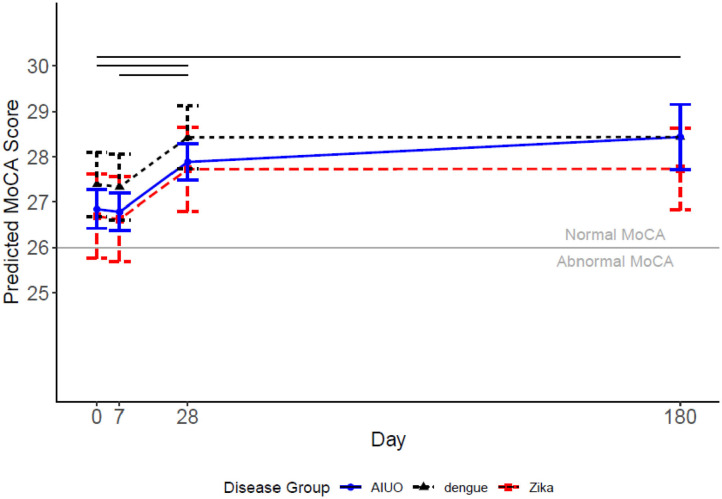
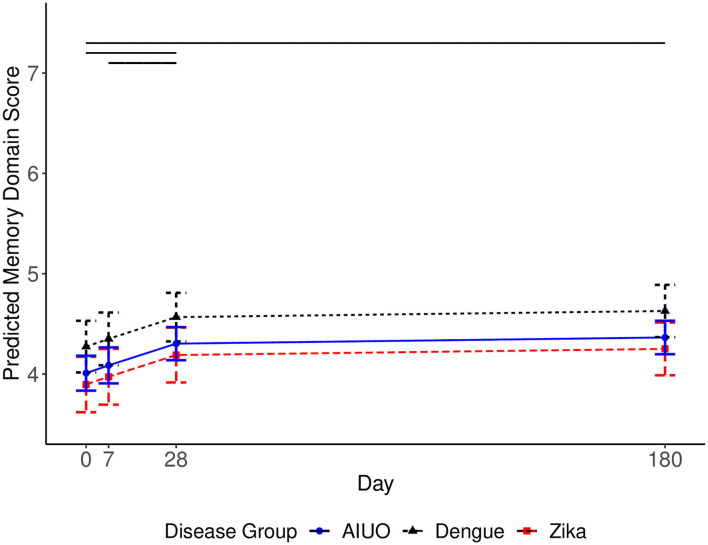
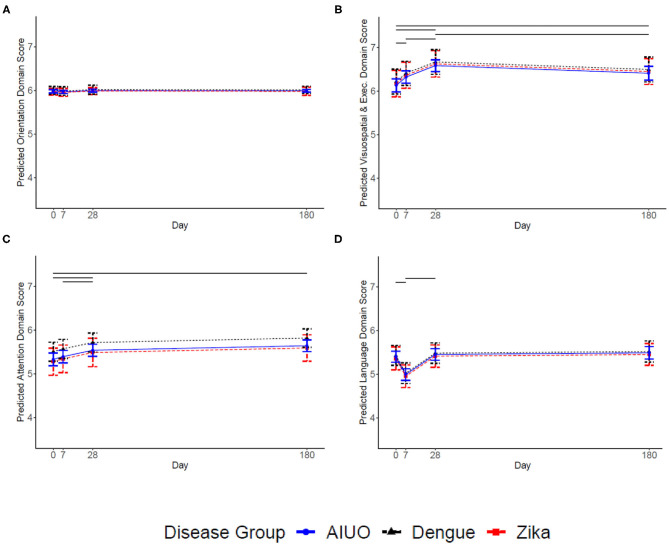
Zika has been associated with a variety of severe neurologic manifestations including meningitis and encephalitis. We hypothesized that it may also cause mild to subclinical neurocognitive alterations during acute infection or over the long term. In this observational cohort study, we explored whether Zika cause subclinical or mild neurocognitive alterations, estimate its frequency and duration, and compare it to other acute illnesses in a cohort of people with suspected Zika infection, in the region of Tapachula in Chiapas, Mexico during 2016-2018. We enrolled patients who were at least 12 years old with suspected Zika virus infection and followed them up for 6 months. During each visit participants underwent a complete clinical exam, including a screening test for neurocognitive dysfunction (Montreal Cognitive Assessment score). We enrolled 406 patients [37 with Zika, 73 with dengue and 296 with other acute illnesses of unidentified origin (AIUO)]. We observed a mild and transient impact over cognitive functions in patients with Zika, dengue and with other AIUO. The probability of having an abnormal MoCA score (<26 points) was significantly higher in patients with Zika and AIUO than in those with dengue. Patients with Zika and AIUO had lower memory scores than patients with dengue (Zika vs. Dengue: -0.378, 95% CI-0.678 to -0.078; = 0.014: Zika vs. AIUO 0.264, 95% CI 0.059, 0.469; = 0.012). The low memory performance in patients with Zika and AIUO accounts for most of the differences in the overall MoCA score when compared with patients with dengue. Our results show a decrease in cognitive function during acute illness and provides no evidence to support the hypothesis that Zika might cause neurocognitive alterations longer than the period of acute infection or different to other infectious diseases. While effects on memory or perhaps other cognitive functions over the long term are possible, larger studies using more refined tools for neurocognitive functioning assessment are needed to identify these. NCT02831699.
寨卡病毒已与包括脑膜炎和脑炎在内的多种严重神经表现相关联。我们推测,在急性感染期间或长期内,它也可能导致轻度至亚临床神经认知改变。在这项观察性队列研究中,我们探讨了寨卡病毒是否会引起亚临床或轻度神经认知改变,估计其发生频率和持续时间,并在2016 - 2018年墨西哥恰帕斯州塔帕丘拉地区的一组疑似寨卡病毒感染人群中,将其与其他急性疾病进行比较。我们纳入了至少12岁的疑似寨卡病毒感染患者,并对他们进行了6个月的随访。在每次就诊时,参与者都接受了全面的临床检查,包括神经认知功能障碍筛查测试(蒙特利尔认知评估评分)。我们纳入了406名患者[37名寨卡病毒感染患者、73名登革热患者和296名其他不明原因急性疾病(AIUO)患者]。我们观察到寨卡病毒感染患者、登革热患者和其他AIUO患者的认知功能受到轻度和短暂的影响。寨卡病毒感染患者和AIUO患者的蒙特利尔认知评估(MoCA)评分异常(<26分)的概率显著高于登革热患者。寨卡病毒感染患者和AIUO患者的记忆评分低于登革热患者(寨卡病毒感染患者与登革热患者比较:-0.378,95%置信区间-0.678至-0.078;P = 0.014;寨卡病毒感染患者与AIUO患者比较:0.264,95%置信区间0.059,0.469;P = 0.012)。与登革热患者相比,寨卡病毒感染患者和AIUO患者的低记忆表现是总体MoCA评分差异的主要原因。我们的结果显示急性疾病期间认知功能下降,并且没有证据支持寨卡病毒可能导致比急性感染期更长或与其他传染病不同的神经认知改变这一假设。虽然长期对记忆或其他认知功能可能有影响,但需要使用更精细的神经认知功能评估工具进行更大规模的研究来确定这些影响。 临床试验注册号:NCT02831699。