Departamento de Infectología, Instituto Nacional de Ciencias Médicas y Nutrición Salvador Zubirán, Mexico City, Mexico.
National Institute of Allergy and Infectious Diseases, Bethesda, MD, USA.
BMC Infect Dis. 2021 Aug 28;21(1):881. doi: 10.1186/s12879-021-06520-x.
The introduction of Zika and chikungunya to dengue hyperendemic regions increased interest in better understanding characteristics of these infections. We conducted a cohort study in Mexico to evaluate the natural history of Zika infection. We describe here the frequency of Zika, chikungunya and dengue virus infections immediately after Zika introduction in Mexico, and baseline characteristics of participants for each type of infection.
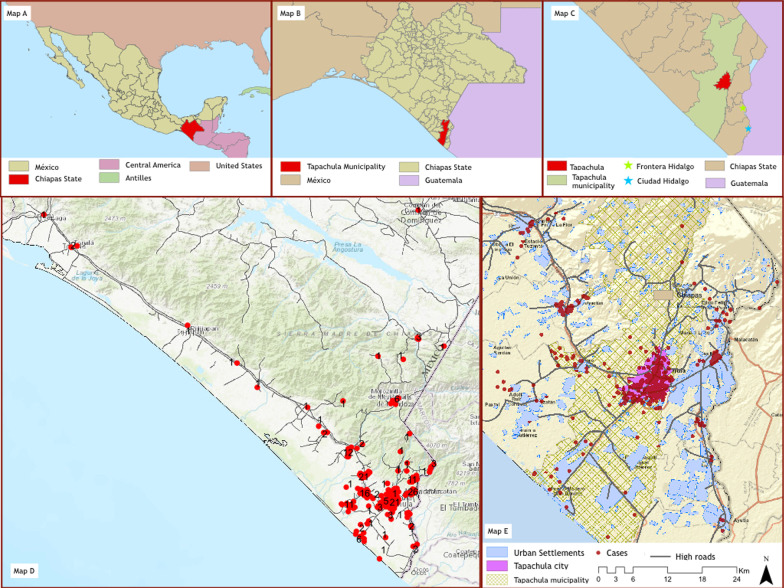
Prospective, observational cohort evaluating the natural history of Zika virus infection in the Mexico-Guatemala border area. Patients with fever, rash or both, meeting the modified criteria of PAHO for probable Zika cases were enrolled (June 2016-July 2018) and followed-up for 6 months. We collected data on sociodemographic, environmental exposure, clinical and laboratory characteristics. Diagnosis was established based on viral RNA identification in serum and urine samples using RT-PCR for Zika, chikungunya, and dengue. We describe the baseline sociodemographic and environmental exposure characteristics of participants according to diagnosis, and the frequency of these infections over a two-year period immediately after Zika introduction in Mexico.
We enrolled 427 participants. Most patients (n = 307, 65.7%) had an acute illness episode with no identified pathogen (UIE), 37 (8%) Zika, 82 (17.6%) dengue, and 1 (0.2%) chikungunya. In 2016 Zika predominated, declined in 2017 and disappeared in 2018; while dengue increased after 2017. Patients with dengue were more likely to be men, younger, and with lower education than those with Zika and UIE. They also reported closer contact with water sources, and with other people diagnosed with dengue. Participants with Zika reported sexual exposure more frequently than people with dengue and UIE. Zika was more likely to be identified in urine while dengue was more likely found in blood in the first seven days of symptoms; but PCR results for both were similar at day 7-14 after symptom onset.
During the first 2 years of Zika introduction to this dengue hyper-endemic region, frequency of Zika peaked and fell over a two-year period; while dengue progressively increased with a predominance in 2018. Different epidemiologic patterns between Zika, dengue and UIE were observed. Trial registration Clinical.Trials.gov (NCT02831699).
寨卡和基孔肯雅热病毒传入登革热高度流行地区,促使人们更深入地了解这些感染的特征。我们在墨西哥开展了一项队列研究,以评估寨卡病毒感染的自然史。我们在此描述寨卡病毒、基孔肯雅热病毒和登革热病毒感染在墨西哥引入后的即刻情况,以及每一种感染的参与者的基线特征。
前瞻性观察性队列研究评估了墨西哥-危地马拉边境地区寨卡病毒感染的自然史。符合泛美卫生组织(PAHO)修订的疑似寨卡病例标准、有发热、皮疹或两者兼有表现的患者(2016 年 6 月至 2018 年 7 月)入选并随访 6 个月。我们收集了社会人口学、环境暴露、临床和实验室特征的数据。基于血清和尿液样本中寨卡、基孔肯雅热和登革热病毒的逆转录聚合酶链反应(RT-PCR)鉴定,确定诊断。根据诊断情况,我们描述了参与者的基线社会人口学和环境暴露特征,以及寨卡病毒在墨西哥引入后两年内的感染频率。
我们纳入了 427 名参与者。大多数患者(n=307,65.7%)有急性疾病发作,无明确病原体(UIE),37 例(8%)为寨卡病毒,82 例(17.6%)为登革热,1 例(0.2%)为基孔肯雅热。2016 年寨卡病毒占主导地位,2017 年下降,2018 年消失;而登革热则在 2017 年后增加。登革热患者更可能为男性、年轻和受教育程度较低,与寨卡病毒和 UIE 患者相比。他们还报告与水源和其他确诊为登革热的人有更密切的接触。与登革热和 UIE 患者相比,寨卡病毒患者更有可能有性接触。寨卡病毒在症状出现的头 7 天更有可能在尿液中检出,而登革热病毒更有可能在血液中检出,但在症状出现后第 7-14 天的 PCR 结果相似。
在寨卡病毒引入该登革热高度流行地区的头 2 年中,寨卡病毒的流行率呈双峰型,在两年内呈下降趋势;而登革热则逐渐增加,2018 年占主导地位。寨卡病毒、登革热病毒和 UIE 之间观察到不同的流行病学模式。
Clinical.Trials.gov(NCT02831699)。