NYU College of Global Public Health, New York University, New York, New York, United States of America.
New York University Health Sciences Library, NYU School of Medicine, NYU Langone Medical Center, New York, New York, United States of America.
PLoS Negl Trop Dis. 2019 Aug 26;13(8):e0007622. doi: 10.1371/journal.pntd.0007622. eCollection 2019 Aug.
A severe neurological disorder, Guillain-Barré syndrome (GBS) is the leading cause of acute flaccid paralysis. Enhanced surveillance of GBS in Latin America and the Caribbean (LAC) following the 2015-2016 Zika virus (ZIKV) epidemic presents an opportunity to estimate, for the first time, the regional incidence of GBS.
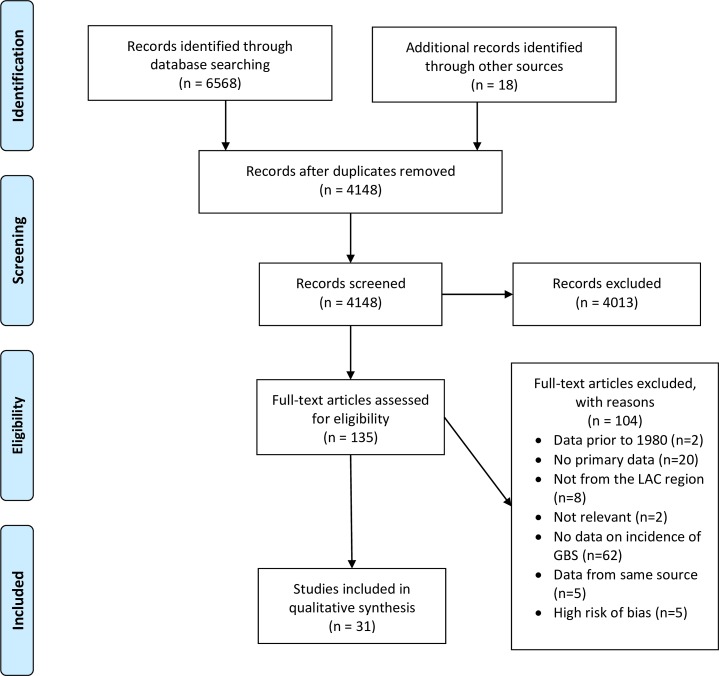
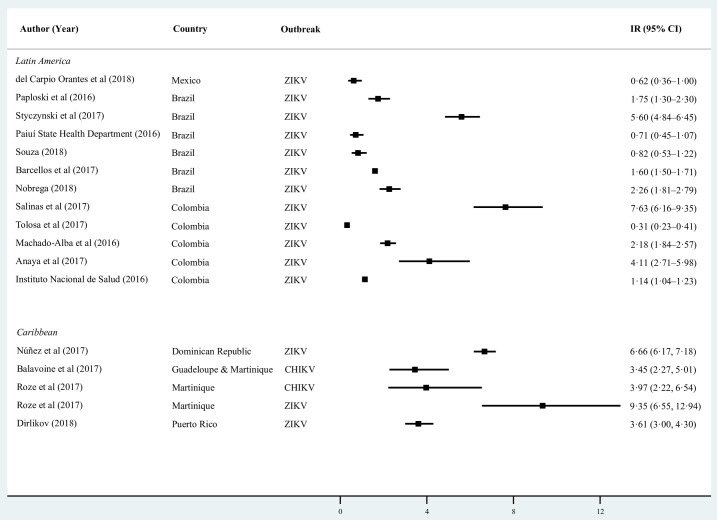
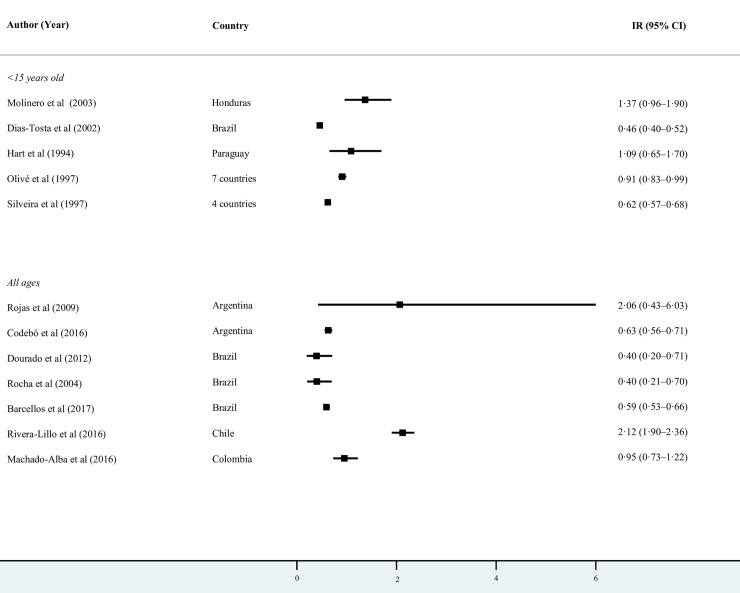
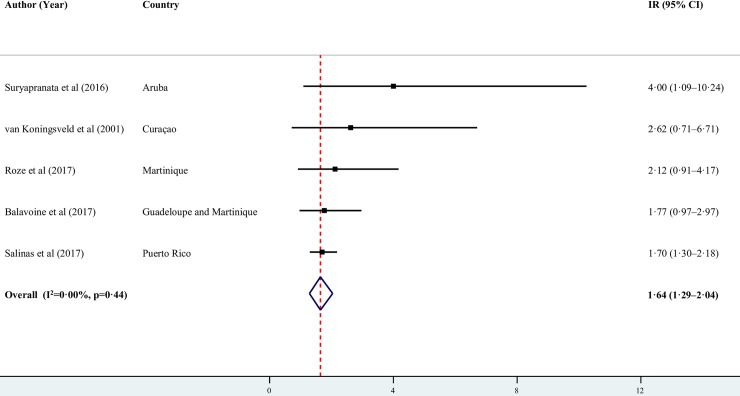
For this systematic review and meta-analysis, we searched nine scientific databases and grey literature from January 1, 1980 to October 1, 2018. Sources with primary data on incident GBS cases in LAC within a well-defined population and timeframe, published in English, Spanish, Portuguese, or French, were included. We calculated the annual GBS incidence rates (IRs) and 95% confidence intervals (CIs) for each source based on published data. Following an assessment of heterogeneity, we used random-effects meta-analysis to calculate the pooled annual IR of GBS. The study is registered with PROSPERO, number CRD42018086659. Of the 6568 initial citation hits, 31 were eligible for inclusion. Background annual GBS IRs in Latin America ranged from 0.40 in Brazil to 2.12/100,000 in Chile. The pooled annual IR in the Caribbean was 1.64 (95% CI 1.29-2.12, I2<0.01, p = 0.44). During the ZIKV epidemic, GBS IRs ranged from 0.62 in Mexico to 9.35/100,000 in Martinique. GBS increased 2.6 (95% CI 2.3-2.9) times during ZIKV and 1.9 (95% CI 1.1-3.4) times during chikungunya outbreaks over background rates. A limitation of this review is that the studies included employed different methodologies to find and ascertain cases of GBS, which could contribute to IR heterogeneity. In addition, it is important to consider that data on GBS are lacking for many countries in the region.
Background IRs of GBS appear to peak during arboviral disease outbreaks. The current review contributes to an understanding of the epidemiology of GBS in the LAC region, which can inform healthcare system planning and preparedness, particularly during arboviral epidemics.
Registered with PROSPERO: CRD42018086659.
吉兰-巴雷综合征(GBS)是一种严重的神经疾病,是急性弛缓性瘫痪的主要原因。在 2015-2016 年寨卡病毒(ZIKV)流行之后,拉丁美洲和加勒比地区(LAC)对 GBS 进行了更严密的监测,这为首次估计该地区 GBS 的发病率提供了机会。
在这项系统评价和荟萃分析中,我们从 1980 年 1 月 1 日至 2018 年 10 月 1 日检索了九个科学数据库和灰色文献。纳入了在明确界定的人群和时间范围内报告 LAC 内 GBS 发病情况的原始数据来源,这些文献以英文、西班牙语、葡萄牙语或法语发表。我们根据已发表的数据计算了每个来源的年度 GBS 发病率(IR)和 95%置信区间(CI)。在评估异质性后,我们使用随机效应荟萃分析计算了 GBS 的汇总年度 IR。该研究在 PROSPERO 注册,编号为 CRD42018086659。在最初的 6568 个引用记录中,有 31 个符合纳入标准。拉丁美洲的背景年度 GBS IR 范围为巴西的 0.40 至智利的 2.12/100,000。加勒比地区的汇总年度 IR 为 1.64(95%CI 1.29-2.12,I2<0.01,p=0.44)。在 ZIKV 流行期间,GBS IR 范围为墨西哥的 0.62 至马提尼克岛的 9.35/100,000。与背景率相比,ZIKV 期间 GBS IR 增加了 2.6 倍(95%CI 2.3-2.9),而在基孔肯雅热爆发期间增加了 1.9 倍(95%CI 1.1-3.4)。本综述的一个局限性是,纳入的研究采用了不同的方法来发现和确定 GBS 病例,这可能导致 IR 异质性。此外,值得注意的是,该地区许多国家都缺乏 GBS 数据。
GBS 的背景发病率似乎在虫媒病毒病暴发期间达到高峰。本综述有助于了解拉丁美洲和加勒比地区 GBS 的流行病学,这可以为医疗保健系统规划和准备提供信息,特别是在虫媒病毒流行期间。
在 PROSPERO 注册:CRD42018086659。