Gao Fan, Guo Fanfan, Zhang Yidan, Yuan Yufei, Chen Dunjin, Bai Guiqin
Clinical Research Center, The First Affiliated Hospital of Xi'an Jiaotong University, Xi'an, China.
Department of Gynecology and Obstetrics, The First Affiliated Hospital of Xi'an Jiaotong University, Xi'an, China.
Front Nutr. 2021 Mar 22;8:628902. doi: 10.3389/fnut.2021.628902. eCollection 2021.
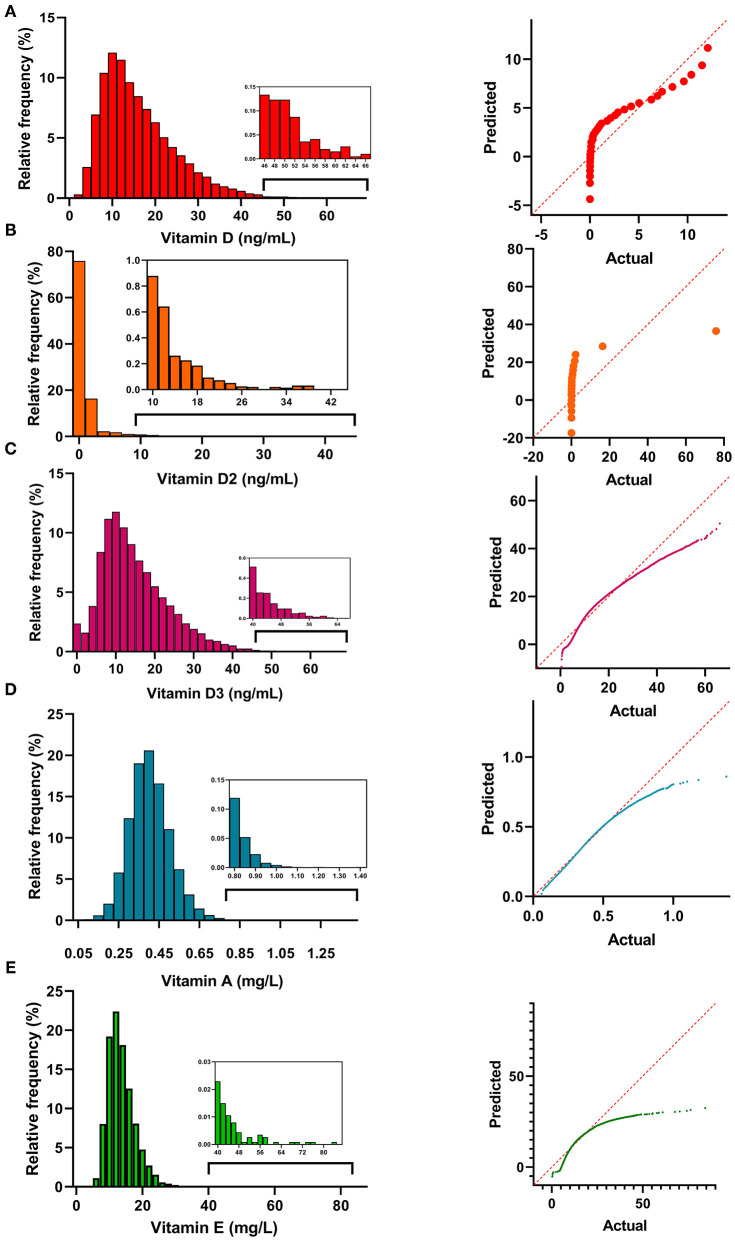
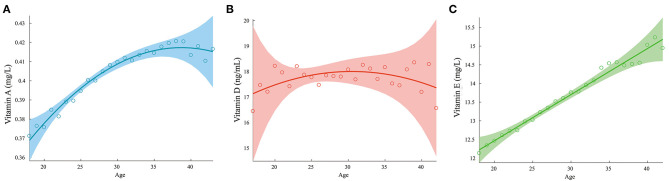
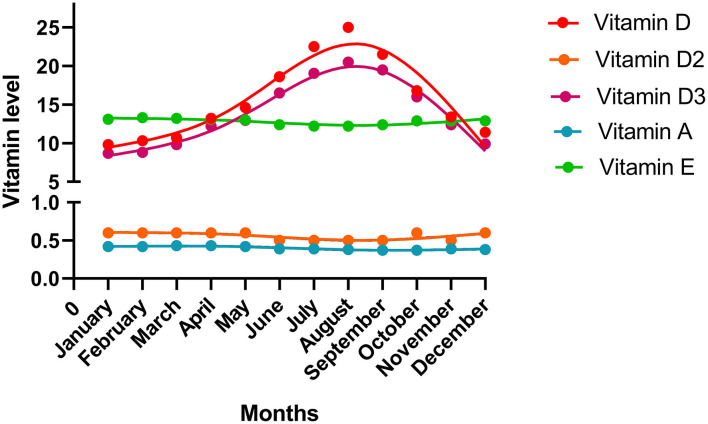
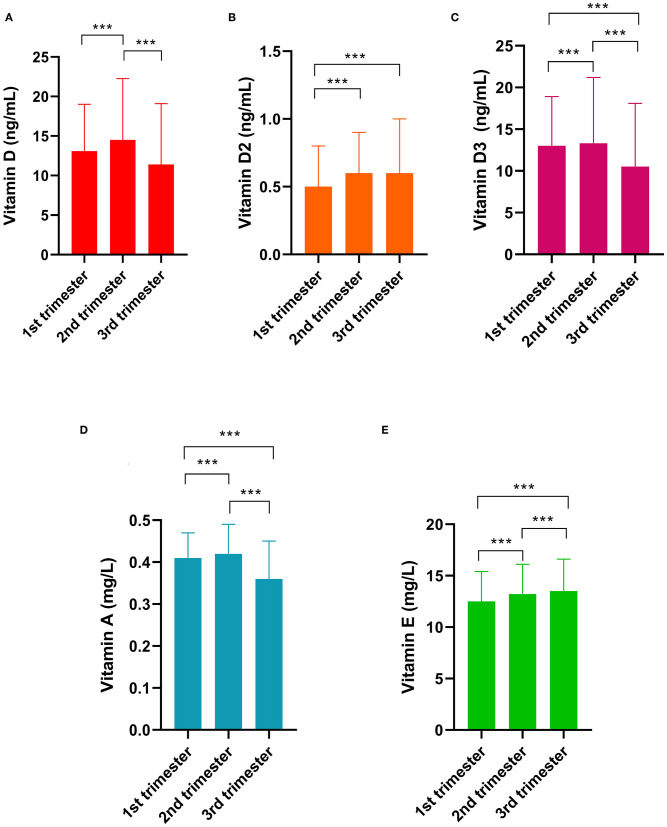
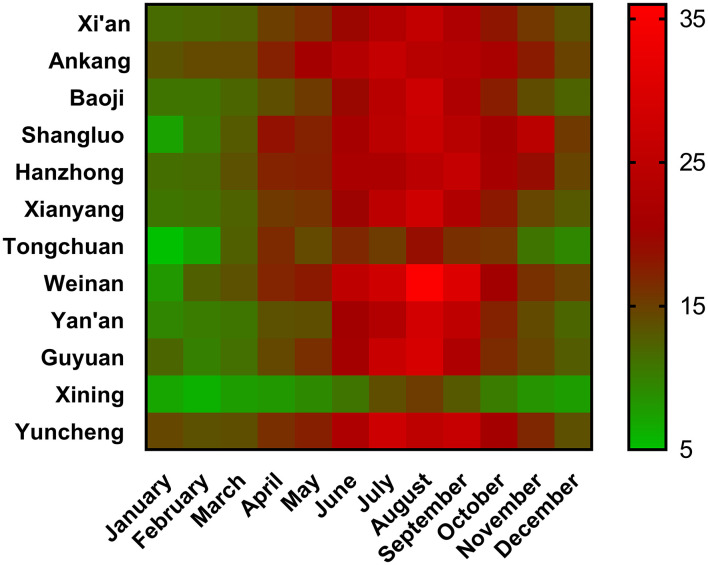
Pregnancy-specific vitamin reference ranges are currently not available for maternal vitamin management during pregnancy. This study aimed to propose pregnancy-specific vitamin reference ranges and to investigate the factors influencing vitamin levels during pregnancy. A cross-sectional study that included pregnant women from 17 cities in 4 provinces in western China was conducted from 2017 to 2019. A total of 119,286 subjects were enrolled in the study. Serum vitamin A, vitamin D, and vitamin E levels were measured. A multivariable linear regression model and restricted cubic spline function were used to analyze the factors related to vitamin levels. The reference ranges for vitamin A, D, and E levels were 0.22-0.62 mg/L, 5-43 ng/mL, and 7.4-23.5 mg/L, respectively. A linear relationship was found between vitamin E level and age (β = 0.004; 95% confidence interval [CI], 0.0037-0.0042; < 0.001), and a nonlinear relationship was found between vitamin D ( nonlinear = 0.033) and vitamin A levels and age ( nonlinear < 0.001). Season, gestational trimester, and regions were related to the levels of the three vitamins in the multivariable models ( < 0.05). The lower limit of vitamin A during pregnancy was the same as the reference value currently used for the general population. The reference ranges of vitamins D and E during pregnancy were lower and higher, respectively, than the currently used criteria for the general population. Vitamin A, D, and E levels differed according to age, season, gestational trimester, and region.
目前尚无针对孕期母体维生素管理的特定孕期维生素参考范围。本研究旨在提出特定孕期维生素参考范围,并调查孕期影响维生素水平的因素。2017年至2019年进行了一项横断面研究,纳入了中国西部4个省份17个城市的孕妇。共有119286名受试者参与了该研究。测量了血清维生素A、维生素D和维生素E水平。采用多变量线性回归模型和受限立方样条函数分析与维生素水平相关的因素。维生素A、D和E水平的参考范围分别为0.22 - 0.62mg/L、5 - 43ng/mL和7.4 - 23.5mg/L。发现维生素E水平与年龄呈线性关系(β = 0.004;95%置信区间[CI],0.0037 - 0.0042;P < 0.001),维生素D(非线性 = 0.033)和维生素A水平与年龄呈非线性关系(非线性P < 0.001)。在多变量模型中,季节、孕周和地区与这三种维生素的水平相关(P < 0.05)。孕期维生素A的下限与目前用于一般人群的参考值相同。孕期维生素D和E的参考范围分别低于和高于目前用于一般人群的标准。维生素A、D和E水平因年龄、季节、孕周和地区而异。