Department of Inorganic and Analytical Chemistry, University of Debrecen, Egyetem tér 1, 4032, Debrecen, Hungary.
ChemistryOpen. 2021 Apr;10(4):451-463. doi: 10.1002/open.202000304.
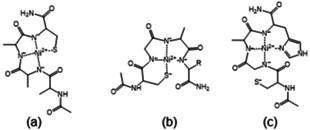
The Cd(II)-, Pb(II)-, Ni(II)- and Zn(II)-complexes of small terminally protected peptides containing CXXX, XXXC, XCCX, CX C (n=1-3) sequences have been studied with potentiometric, UV/Vis and CD spectroscopic techniques. The cysteine thiolate group is the primary binding site for all studied metal ions, but the presence of a histidyl or aspartyl side chain in the molecule contributes to the stability of the complexes. For two-cysteine containing peptides the (S ,S ) coordinated species are formed in the physiological pH range and the stability increases in the Ni(II)<Zn(II)<Pb(II)<Cd(II) order. As a conclusion, the inserting of -CXXC- sequence into the peptide makes the synthesis of peptides with high selectivity to toxic Cd(II) or Pb(II) ion possible. In addition, the spectroscopic characterization of these complexes can contribute to the discovery of the exact binding site and binding mode of longer peptides mimicking the biologically important proteins.
采用电位法、紫外/可见分光光度法和圆二色光谱法研究了末端保护的含有 CXXX、XXXC、XCCX、CX C(n=1-3)序列的小肽的 Cd(II)、Pb(II)、Ni(II) 和 Zn(II) 配合物。巯基半胱氨酸是所有研究金属离子的主要结合位点,但分子中存在组氨酸或天冬氨酸侧链有助于配合物的稳定性。对于含有两个半胱氨酸的肽,(S,S)配位物种在生理 pH 范围内形成,稳定性按 Ni(II)<Zn(II)<Pb(II)<Cd(II)的顺序增加。总之,将-CXXC-序列插入到肽中使得合成对有毒 Cd(II)或 Pb(II)离子具有高选择性的肽成为可能。此外,这些配合物的光谱表征有助于发现模拟生物重要蛋白质的更长肽的精确结合位点和结合模式。