School of Public Health, The Key Laboratory of Environmental Pollution Monitoring and Disease Control, Ministry of Education, Guizhou Medical University, Guiyang, 550025, Guizhou, China.
The First People's Hospital of Guiyang, Guiyang, 550001, Guizhou, China.
Sci Rep. 2021 Apr 8;11(1):7706. doi: 10.1038/s41598-021-86994-6.
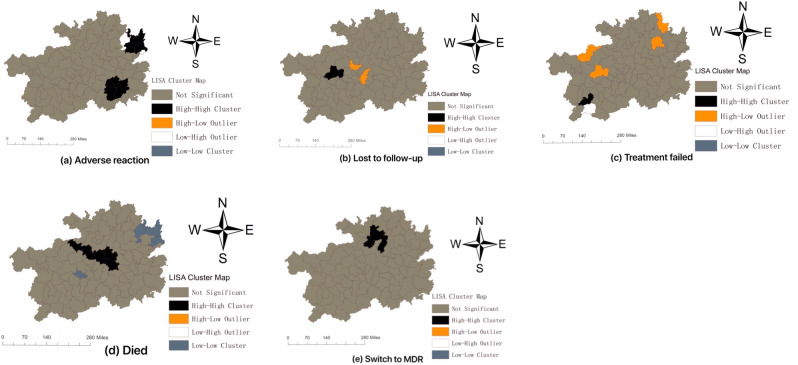
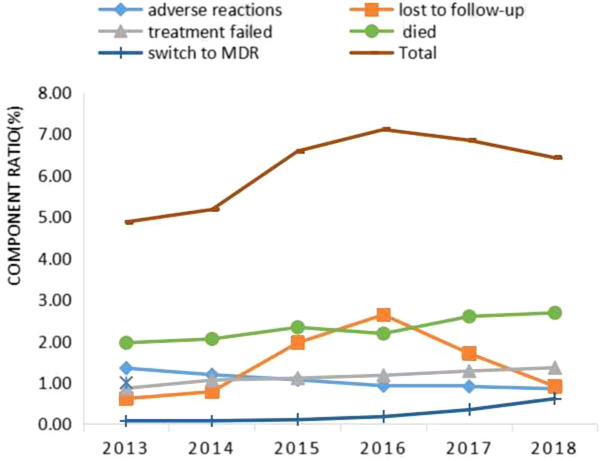
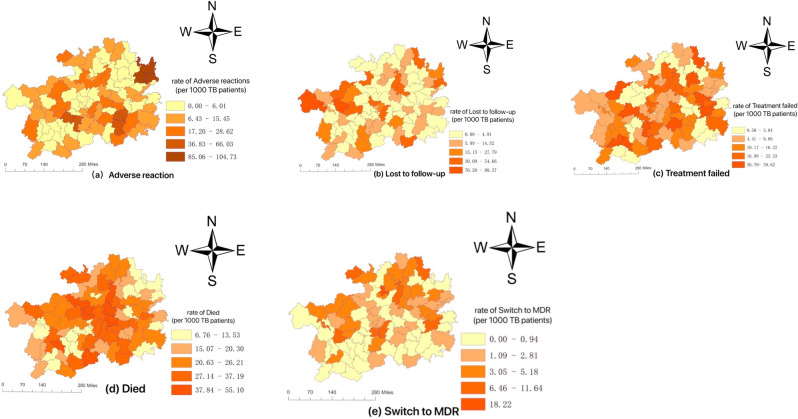
The incidence of Tuberculosis (TB) in Guizhou province has ranked to be the top four among the 31 China provinces. The spatial distribution and influencing factors of adverse outcomes of TB in Guizhou are unclear. In our study, the cases information of TB in Guizhou province from 2013 to 2018 was collected, we analyzed the spatial distribution and clusters of five adverse outcomes of TB with ArcMap10.2 software, used logistics regression analysis to assessed risk factors and used Chi-square analysis to analyze variation trend of the five adverse outcomes. A total of 237, 806 cases information of TB were collected. The proportion of adverse outcomes in TB patients was 6.18%, among which adverse reactions accounted for 1.05%, lost to follow-up accounted for 1.44%, treatment failed accounted for 1.15%, died accounted for 2.31%, switch to MDR accounted for 0.24%. The component ratio of adverse outcomes showed an upward trend (P < 0.05).Regional clustering existed in each of adverse outcomes (P < 0.05). There were high-risk minorities, gender, age, occupation, type of diagnosis, Therapeutic category existed in adverse outcomes of TB. Miao and Dong had a higher risk in adverse reaction of TB compared with Han. Women had a higher risk in adverse reactions than men, and a lower risk of lost to follow-up, failed, and died. Retreated patients had a higher risk of adverse outcomes. Timely monitoring and active intervention should be carried out for some high-risk areas and groups, including middle-aged and elderly patients, rural patients, floating patients, severe patients and retreated patients during the process of patient diagnosis and treatment.
贵州省的结核病(TB)发病率在中国 31 个省份中排名前四。贵州省结核病不良结局的空间分布和影响因素尚不清楚。在本研究中,我们收集了 2013 年至 2018 年贵州省结核病的病例信息,使用 ArcMap10.2 软件分析了结核病五种不良结局的空间分布和聚集性,采用逻辑回归分析评估了危险因素,并采用卡方分析分析了五种不良结局的变化趋势。共收集了 237806 例结核病病例信息。结核病患者的不良结局比例为 6.18%,其中不良反应占 1.05%,失访占 1.44%,治疗失败占 1.15%,死亡占 2.31%,转为耐多药占 0.24%。不良结局的构成比呈上升趋势(P<0.05)。各不良结局均存在区域聚集性(P<0.05)。结核病不良结局存在高危少数民族、性别、年龄、职业、诊断类型、治疗类别差异。与汉族相比,苗族和侗族结核病不良反应的风险更高。女性不良反应的风险高于男性,失访、失败和死亡的风险较低。复治患者不良结局的风险更高。在患者诊断和治疗过程中,应针对一些高危地区和人群,包括中老年患者、农村患者、流动人口、重症患者和复治患者,进行及时监测和积极干预。