Laboratory of Clinical Investigation, Intramural Research Program, National Institute on Aging, National Institutes of Health, Baltimore, MD, USA.
Laboratory of Molecular Biology & Immunology, Intramural Research Program, National Institute on Aging, National Institutes of Health, Baltimore, MD, USA.
Aging Cell. 2021 May;20(5):e13354. doi: 10.1111/acel.13354. Epub 2021 Apr 9.
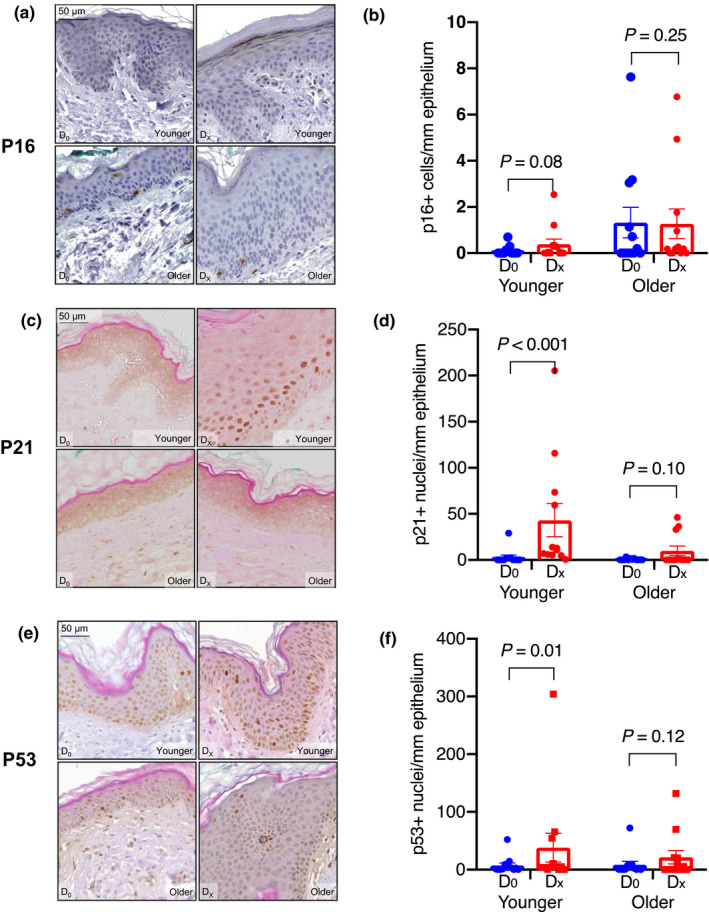
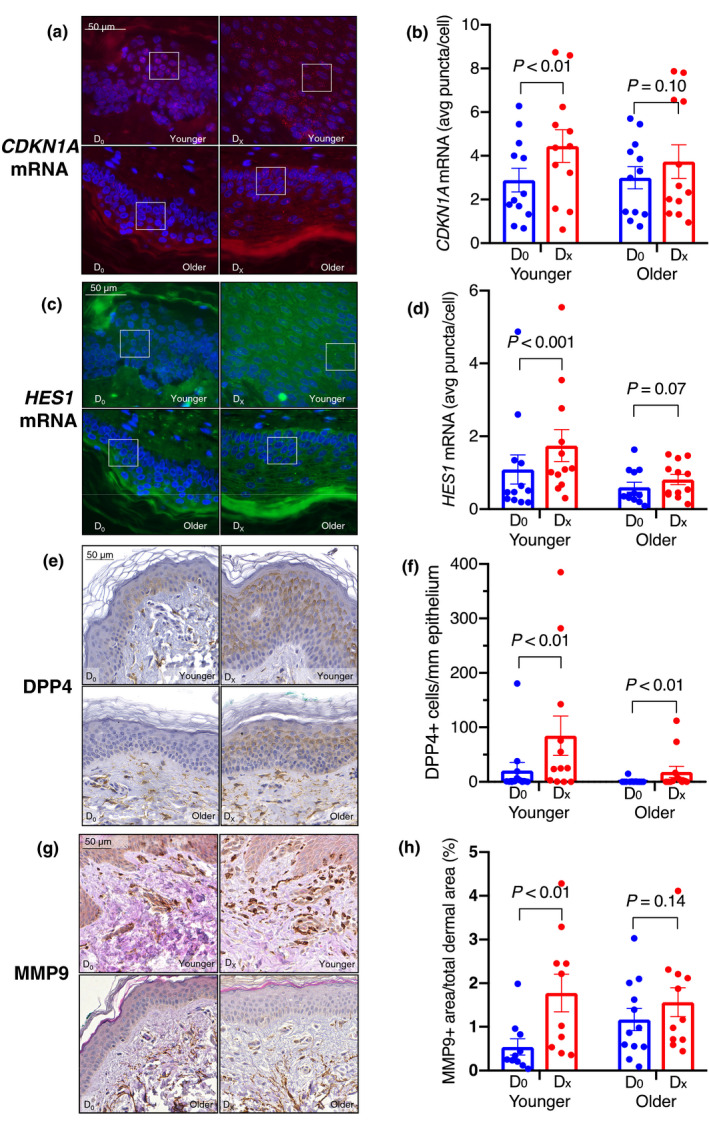
In mice, cellular senescence and senescence-associated secretory phenotype (SASP) positively contribute to cutaneous wound healing. In this proof-of-concept study, we investigated the expressions of p16, p21, and other senescence-associated biomarkers during human wound healing in 24 healthy subjects using a double-biopsy experimental design. The first punch biopsy created the wound and established the baseline. The second biopsy, concentric to the first and taken several days after wounding, was used to probe for expression of biomarkers by immunohistochemistry and RNA FISH. To assess the effects of age, we recruited 12 sex-matched younger (30.2 ± 1.3 years) and 12 sex-matched older (75.6 ± 1.8 years) subjects. We found that p21 and p53, but not p16, were induced during healing in younger, but not older subjects. A role for Notch signaling in p21 expression was inferred from the inducible activation of HES1. Further, other SASP biomarkers such as dipeptidyl peptidase-4 (DPP4) were significantly induced upon wounding in both younger and older groups, whereas matrix metallopeptidase 9 (MMP9) was induced only in the younger group. Senescence-associated β-galactosidase (SA-β-gal) was not detectable before or after wounding. This pilot study suggests the possibility that human cutaneous wound healing is characterized by differential expression of p21 and p53 between younger and older subjects.
在小鼠中,细胞衰老和衰老相关分泌表型 (SASP) 积极促进皮肤伤口愈合。在这项概念验证研究中,我们使用双活检实验设计,在 24 名健康受试者中研究了人伤口愈合过程中 p16、p21 和其他衰老相关生物标志物的表达。第一次打孔活检创建伤口并建立基线。第二次活检与第一次活检同心,在受伤后几天进行,用于通过免疫组织化学和 RNA FISH 探测生物标志物的表达。为了评估年龄的影响,我们招募了 12 名年龄匹配的年轻(30.2±1.3 岁)和 12 名年龄匹配的年老(75.6±1.8 岁)受试者。我们发现,p21 和 p53,但不是 p16,在年轻受试者的愈合过程中被诱导,但在年老受试者中没有。从 HES1 的可诱导激活推断出 Notch 信号在 p21 表达中的作用。此外,其他 SASP 生物标志物,如二肽基肽酶-4 (DPP4),在年轻和年老组中均显著诱导,而基质金属蛋白酶 9 (MMP9) 仅在年轻组中诱导。衰老相关β-半乳糖苷酶 (SA-β-gal) 在受伤前后均不可检测。这项初步研究表明,人类皮肤伤口愈合的特征可能是年轻和年老受试者之间 p21 和 p53 的表达存在差异。