• 文献检索
  • 文档翻译
  • 深度研究
  • 学术资讯
  • Suppr Zotero 插件Zotero 插件
  • 邀请有礼
  • 套餐&价格
  • 历史记录
应用&插件
Suppr Zotero 插件Zotero 插件浏览器插件Mac 客户端Windows 客户端微信小程序
定价
高级版会员购买积分包购买API积分包
服务
文献检索文档翻译深度研究API 文档MCP 服务
关于我们
关于 Suppr公司介绍联系我们用户协议隐私条款
关注我们

Suppr 超能文献

核心技术专利:CN118964589B侵权必究
粤ICP备2023148730 号-1Suppr @ 2026

文献检索

告别复杂PubMed语法,用中文像聊天一样搜索,搜遍4000万医学文献。AI智能推荐,让科研检索更轻松。

立即免费搜索

文件翻译

保留排版,准确专业,支持PDF/Word/PPT等文件格式,支持 12+语言互译。

免费翻译文档

深度研究

AI帮你快速写综述,25分钟生成高质量综述,智能提取关键信息,辅助科研写作。

立即免费体验

新型冠状病毒肺炎住院患者主观和客观化学感觉功能障碍的病程:6个月随访

The course of subjective and objective chemosensory dysfunction in hospitalized patients with COVID-19: a 6-month follow-up.

作者信息

Bertlich Mattis, Stihl Clemens, Lüsebrink Enzo, Hellmuth Johannes C, Scherer Clemens, Freytag Saskia, Spiegel Jennifer Lee, Stoycheva Ivelina, Canis Martin, Weiss Bernhard G, Ihler Friedrich, Haubner Frank

机构信息

Department of Otorhinolaryngology, University Hospital, Head and Neck Surgery, Ludwig-Maximilians University of Munich, Marchioninistr. 15, 81377, Munich, Germany.

Medizinische Klinik und Poliklinik I, University Hospital, Ludwig-Maximilians-University of Munich, Marchioninistr. 15, 81377, Munich, Germany.

出版信息

Eur Arch Otorhinolaryngol. 2021 Dec;278(12):4855-4861. doi: 10.1007/s00405-021-06796-4. Epub 2021 Apr 10.

DOI:10.1007/s00405-021-06796-4
PMID:33837835
原文链接:https://pmc.ncbi.nlm.nih.gov/articles/PMC8035606/
Abstract

PURPOSE

It has been established that the infection with SARS-CoV-2 may cause an impairment of chemosensory function. However, there is little data on the long-term effects of SARS-CoV-2 infection on chemosensory function.

METHODS

Twenty three SARS-CoV-2-positive patients diagnosed in spring 2020 with subjective hyposmia (out of 57 positive patients, 40.3%) were compared to SARS-CoV-2-positive patients without hyposmia (n = 19) and SARS-CoV-2-negative patients (n = 14). Chemosensory function was assessed by the Brief Smell Identification Test (BSIT), Taste Strips (TS), Visual Analogue Scales (VAS), and the SNOT-22. The initial cohort with hyposmia were also examined at 8 weeks and 6 months after initial examination.

RESULTS

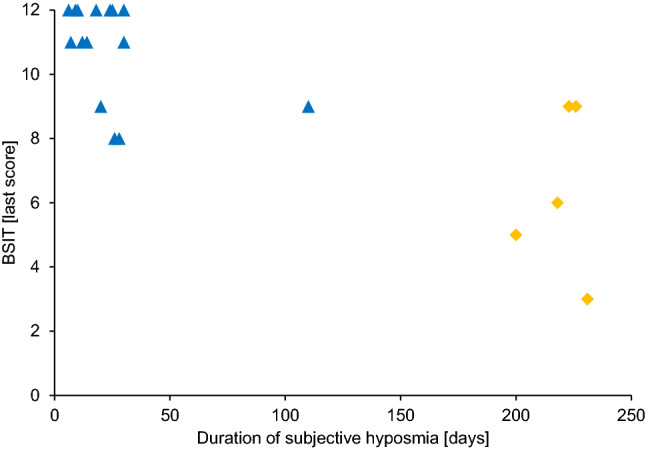
There were no differences between the SARS-CoV-2-positive cohort without hyposmia and negative controls in terms of BSIT (8.5 ± 2.6 vs. 10.2 ± 1.8), TS (3.4 ± 0.6 vs. 3.9 ± 0.3) or VAS (2.1 ± 1.3 vs. 1.1 ± 0.5); yet the SNOT-22 was significantly elevated (27.7 ± 11.2 vs. 16.4 ± 10.8). The SARS-CoV-2-positive group with hyposmia performed significantly poorer in BSIT (4.0 ± 1.7 vs. 8.5 ± 2.6/10.2 ± 1.8), TS (2.6 ± 1.3 vs. 3.4 ± 0.6/3.9 ± 0.3), and VAS (7.9 ± 2.2 vs. 2.1 ± 1.3/1.1 ± 0.5) compared to both control groups. At week 8 and month 6 control, six and five patients, respectively, still suffered from subjectively and objectively impaired chemosensory function. The other patients had recovered in both respects.

CONCLUSION

SARS-CoV-2 patients with subjectively impaired chemosensory function regularly perform poorly in objective measurements. About 70% of patients suffering from olfactory dysfunction in SARS-CoV-2 quickly recover-the rest still suffers from considerable impairment 6 months after infection.

摘要

目的

已证实感染严重急性呼吸综合征冠状病毒2(SARS-CoV-2)可能导致化学感觉功能受损。然而,关于SARS-CoV-2感染对化学感觉功能的长期影响的数据很少。

方法

将2020年春季诊断出的23例主观嗅觉减退的SARS-CoV-2阳性患者(57例阳性患者中的40.3%)与无嗅觉减退的SARS-CoV-2阳性患者(n = 19)和SARS-CoV-2阴性患者(n = 14)进行比较。通过简易嗅觉识别测试(BSIT)、味觉试纸(TS)、视觉模拟量表(VAS)和鼻窦症状评估测试-22(SNOT-22)评估化学感觉功能。最初有嗅觉减退的队列在初次检查后的8周和6个月也进行了检查。

结果

无嗅觉减退的SARS-CoV-2阳性队列与阴性对照组在BSIT(8.5±2.6对10.2±1.8)、TS(3.4±0.6对3.9±0.3)或VAS(2.1±1.3对1.1±0.5)方面没有差异;但SNOT-22显著升高(27.7±11.2对16.4±10.8)。与两个对照组相比,有嗅觉减退的SARS-CoV-2阳性组在BSIT(4.0±1.7对8.5±2.6/10.2±1.8)、TS(2.6±1.3对3.4±0.6/3.9±0.3)和VAS(7.9±2.2对2.1±1.3/1.1±0.5)方面表现明显较差。在第8周和第6个月的对照中,分别有6例和5例患者在主观和客观上仍存在化学感觉功能受损。其他患者在两方面均已恢复。

结论

主观化学感觉功能受损的SARS-CoV-2患者在客观测量中通常表现较差。SARS-CoV-2感染导致嗅觉功能障碍的患者中约70%迅速恢复,其余患者在感染6个月后仍有相当程度的功能受损。
https://cdn.ncbi.nlm.nih.gov/pmc/blobs/41a1/8553690/264fd8478dd8/405_2021_6796_Fig1_HTML.jpg

相似文献

1
The course of subjective and objective chemosensory dysfunction in hospitalized patients with COVID-19: a 6-month follow-up.新型冠状病毒肺炎住院患者主观和客观化学感觉功能障碍的病程:6个月随访
Eur Arch Otorhinolaryngol. 2021 Dec;278(12):4855-4861. doi: 10.1007/s00405-021-06796-4. Epub 2021 Apr 10.
2
Assessment of patient recognition of coronavirus disease 2019 (COVID-19)-associated olfactory loss and recovery: a longitudinal study.评估患者对 2019 冠状病毒病(COVID-19)相关嗅觉丧失和恢复的认知:一项纵向研究。
Int Forum Allergy Rhinol. 2021 Nov;11(11):1529-1537. doi: 10.1002/alr.22820. Epub 2021 Jun 6.
3
Long-Term Subjective and Objective Assessment of Smell and Taste in COVID-19.COVID-19 患者嗅觉和味觉的长期主观和客观评估
Cells. 2022 Feb 24;11(5):788. doi: 10.3390/cells11050788.
4
Psychophysical assessment of olfactory and gustatory function in post-mild COVID-19 patients: A matched case-control study with 2-year follow-up.轻度新冠康复患者嗅觉和味觉功能的心理物理学评估:一项为期2年随访的配对病例对照研究。
Int Forum Allergy Rhinol. 2023 Oct;13(10):1864-1875. doi: 10.1002/alr.23148. Epub 2023 Mar 15.
5
Evaluating long-term smell or taste dysfunction in mildly symptomatic COVID-19 patients: a 3-year follow-up study.评估轻度症状COVID-19患者的长期嗅觉或味觉功能障碍:一项3年随访研究。
Eur Arch Otorhinolaryngol. 2023 Dec;280(12):5625-5630. doi: 10.1007/s00405-023-08227-y. Epub 2023 Sep 16.
6
Distorted chemosensory perception and female sex associate with persistent smell and/or taste loss in people with SARS-CoV-2 antibodies: a community based cohort study investigating clinical course and resolution of acute smell and/or taste loss in people with and without SARS-CoV-2 antibodies in London, UK.嗅觉和味觉障碍与女性性别相关,并与 SARS-CoV-2 抗体阳性者的持续性嗅觉和/或味觉丧失有关:一项基于社区的队列研究,在英国伦敦调查了 SARS-CoV-2 抗体阳性和阴性者急性嗅觉和/或味觉丧失的临床过程和恢复情况。
BMC Infect Dis. 2021 Feb 25;21(1):221. doi: 10.1186/s12879-021-05927-w.
7
Long-lasting olfactory dysfunction in COVID-19 patients.新冠病毒感染患者的持久嗅觉功能障碍。
Eur Arch Otorhinolaryngol. 2022 Jul;279(7):3485-3492. doi: 10.1007/s00405-021-07153-1. Epub 2021 Nov 10.
8
Six-Month Psychophysical Evaluation of Olfactory Dysfunction in Patients with COVID-19.COVID-19 患者嗅觉功能障碍的六个月心理物理学评估。
Chem Senses. 2021 Jan 1;46. doi: 10.1093/chemse/bjab006.
9
Chemosensory dysfunction in COVID-19 out-patients.COVID-19 门诊患者的嗅觉味觉障碍。
Eur Arch Otorhinolaryngol. 2021 Mar;278(3):695-702. doi: 10.1007/s00405-020-06266-3. Epub 2020 Aug 25.
10
Persisting chemosensory dysfunction in COVID-19 - a cross-sectional population-based survey.新冠病毒感染后持续存在的化学感觉功能障碍——一项基于人群的横断面调查。
Rhinology. 2023 Feb 1;61(1):12-23. doi: 10.4193/Rhin22.176.

引用本文的文献

1
Evaluation of Clinical Features and Olfactory Functions in COVID-19: A Multicentre Study.新冠病毒病的临床特征与嗅觉功能评估:一项多中心研究
Cureus. 2023 Jun 6;15(6):e40027. doi: 10.7759/cureus.40027. eCollection 2023 Jun.
2
Loss of Sour Taste Is the Striking Feature among Four Basic Taste Qualities in Tunisian COVID-19 Patients.味觉丧失是突尼斯新冠肺炎患者四种基本味觉中的显著特征。
J Clin Med. 2023 Jan 11;12(2):597. doi: 10.3390/jcm12020597.
3
Chemosensory Dysfunction in Long-Term COVID-19 Assessed by Self-Reported and Direct Psychophysical Methods.

本文引用的文献

1
COVID-19: Recovery from Chemosensory Dysfunction. A Multicentre study on Smell and Taste.COVID-19:化学感觉功能障碍的恢复。一项关于嗅觉和味觉的多中心研究。
Laryngoscope. 2021 May;131(5):1095-1100. doi: 10.1002/lary.29383. Epub 2021 Jan 15.
2
Objective Sensory Testing Methods Reveal a Higher Prevalence of Olfactory Loss in COVID-19-Positive Patients Compared to Subjective Methods: A Systematic Review and Meta-Analysis.目的:与主观方法相比,客观感觉测试方法显示 COVID-19 阳性患者的嗅觉丧失发生率更高:系统评价和荟萃分析。
Chem Senses. 2020 Dec 5;45(9):865-874. doi: 10.1093/chemse/bjaa064.
3
The coronavirus disease 2019: the prevalence, prognosis, and recovery from olfactory dysfunction (OD).
通过自我报告和直接心理物理学方法评估的长期新冠病毒感染后的化学感觉功能障碍
Life (Basel). 2022 Sep 25;12(10):1487. doi: 10.3390/life12101487.
4
Olfactory and Gustatory Outcomes Including Health-Related Quality of Life 3-6 and 12 Months after Severe-to-Critical COVID-19: A SECURe Prospective Cohort Study.重症至危重症新冠病毒病感染3至6个月及12个月后的嗅觉和味觉结果,包括与健康相关的生活质量:一项SECURe前瞻性队列研究
J Clin Med. 2022 Oct 12;11(20):6025. doi: 10.3390/jcm11206025.
5
Smell and Taste Function and Their Disturbances in Sjögren's Syndrome.干燥综合征的嗅觉和味觉功能及其障碍。
Int J Environ Res Public Health. 2022 Sep 30;19(19):12472. doi: 10.3390/ijerph191912472.
6
The prevalence of sensory changes in post-COVID syndrome: A systematic review and meta-analysis.新冠后综合征中感觉变化的患病率:一项系统评价和荟萃分析。
Front Med (Lausanne). 2022 Aug 25;9:980253. doi: 10.3389/fmed.2022.980253. eCollection 2022.
7
Analysis of Prevalence and Predictive Factors of Long-Lasting Olfactory and Gustatory Dysfunction in COVID-19 Patients.新冠病毒感染患者长期嗅觉和味觉功能障碍的患病率及预测因素分析
Life (Basel). 2022 Aug 17;12(8):1256. doi: 10.3390/life12081256.
8
Kampo Medicine Promotes Early Recovery From Coronavirus Disease 2019-Related Olfactory Dysfunction: A Retrospective Observational Study.汉方医学促进新型冠状病毒肺炎相关嗅觉功能障碍的早期恢复:一项回顾性观察研究。
Front Pharmacol. 2022 Mar 30;13:844072. doi: 10.3389/fphar.2022.844072. eCollection 2022.
9
Long-Term Subjective and Objective Assessment of Smell and Taste in COVID-19.COVID-19 患者嗅觉和味觉的长期主观和客观评估
Cells. 2022 Feb 24;11(5):788. doi: 10.3390/cells11050788.
10
Exploring the Clinical Utility of Gustatory Dysfunction (GD) as a Triage Symptom Prior to Reverse Transcription Polymerase Chain Reaction (RT-PCR) in the Diagnosis of COVID-19: A Meta-Analysis and Systematic Review.探索味觉功能障碍(GD)作为新冠病毒疾病(COVID-19)诊断中逆转录聚合酶链反应(RT-PCR)之前的分诊症状的临床效用:一项荟萃分析和系统评价。
Life (Basel). 2021 Nov 29;11(12):1315. doi: 10.3390/life11121315.
2019 年冠状病毒病:嗅觉功能障碍(OD)的流行、预后和恢复。
Acta Otolaryngol. 2021 Feb;141(2):171-180. doi: 10.1080/00016489.2020.1836397. Epub 2020 Nov 11.
4
Attributes of dysgeusia and anosmia of coronavirus disease 2019 (COVID-19) in hospitalized patients.COVID-19 住院患者味觉障碍和嗅觉障碍的特征。
Oral Dis. 2022 Apr;28 Suppl 1:891-898. doi: 10.1111/odi.13713. Epub 2020 Nov 28.
5
Comparison of COVID-19 and common cold chemosensory dysfunction.新冠病毒与普通感冒的嗅觉味觉障碍比较。
Rhinology. 2020 Dec 1;58(6):623-625. doi: 10.4193/Rhin20.251.
6
Prevalence and reversibility of smell dysfunction measured psychophysically in a cohort of COVID-19 patients.通过心理生理学方法测量的 COVID-19 患者队列中嗅觉功能障碍的流行率和可逆转性。
Int Forum Allergy Rhinol. 2020 Oct;10(10):1127-1135. doi: 10.1002/alr.22680. Epub 2020 Aug 19.
7
Olfactory Dysfunction in COVID-19 Patients: Prevalence and Prognosis for Recovering Sense of Smell.新型冠状病毒肺炎患者嗅觉障碍:嗅觉恢复的患病率和预后。
Otolaryngol Head Neck Surg. 2021 Jan;164(1):82-86. doi: 10.1177/0194599820943530. Epub 2020 Jul 14.
8
Olfactory Dysfunction in COVID-19: Diagnosis and Management.新冠病毒感染中的嗅觉功能障碍:诊断与管理
JAMA. 2020 Jun 23;323(24):2512-2514. doi: 10.1001/jama.2020.8391.
9
Smell dysfunction: a biomarker for COVID-19.嗅觉功能障碍:COVID-19 的生物标志物。
Int Forum Allergy Rhinol. 2020 Aug;10(8):944-950. doi: 10.1002/alr.22587. Epub 2020 Jun 18.
10
Sudden and Complete Olfactory Loss of Function as a Possible Symptom of COVID-19.突发且完全丧失嗅觉功能作为新冠病毒病的一种可能症状
JAMA Otolaryngol Head Neck Surg. 2020 Jul 1;146(7):674-675. doi: 10.1001/jamaoto.2020.0832.