Department of Otorhinolaryngology, Head and Neck Surgery, Medical University of Vienna, Vienna General Hospital, 1090, Vienna, Austria.
Institute of Experimental and Clinical Pharmacology and Toxicology, Friedrich-Alexander Universität Erlangen-Nürnberg, Erlangen, Germany.
Eur Arch Otorhinolaryngol. 2022 Jul;279(7):3485-3492. doi: 10.1007/s00405-021-07153-1. Epub 2021 Nov 10.
Olfactory dysfunction (OD) is a common symptom of Coronavirus Disease 2019 (COVID-19). Although many patients have been reported to regain olfactory function within the first month, long-term observation reports vary. Therefore, we aimed to assess the course of chemosensory function in patients diagnosed with COVID-19 within 3-15 months after the infection.
One hundred and two patients (71 females and 31 males; mean age 38.8 years) diagnosed with laboratory-confirmed COVID-19 and subjective OD participated in this single-center study 111-457 days after onset of OD. Patients first performed chemosensory tests at home, followed by psychophysical testing (Sniffin' Sticks (TDI), 27-item Candy Smell Test (CST), Taste Strips Test (TST)) in the clinic. Questionnaires regarding importance of olfaction (IOQ) and olfactory-specific quality of life (QOD) were applied at both timepoints.
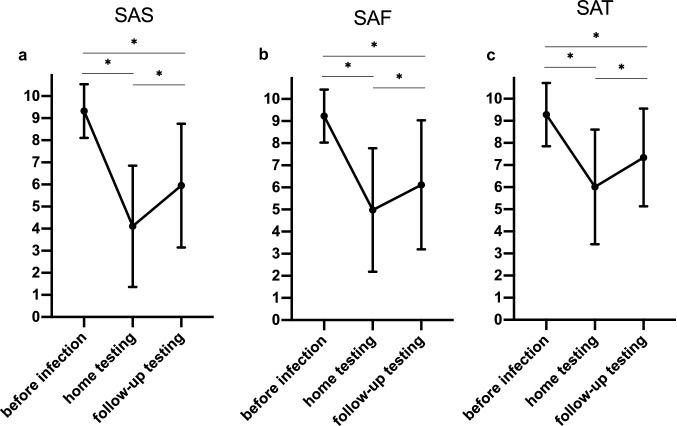
After a mean 216 days (SD 73; range 111-457) between OD onset and follow-up testing, the mean Sniffin' Sticks (TDI) score was 27.1 points (SD 5.8; range 4.25-38.5): 4.0% were anosmic, 72.5% hyposmic, and 23.5% normosmic. At follow-up testing, 73.5% of patients reported improvement, 5.9% deterioration, and 20.6% no change in OD. Moreover, full recovery of self-perceived smell, flavor, and taste was not observed. According to questionnaires, the individual importance of smell did not change, but participants showed improvement in OD-related quality of life (p < 0.001) and had increased parosmia scores (p = 0.014) at follow-up.
Our results show that long-lasting OD after SARS-CoV-2 infection is a common symptom. The majority of patients had OD in the range of hyposmia, which was confirmed by comprehensive smell tests.
嗅觉功能障碍(OD)是 2019 年冠状病毒病(COVID-19)的常见症状。尽管许多患者报告在第一个月内恢复了嗅觉功能,但长期观察报告却有所不同。因此,我们旨在评估感染后 3-15 个月内诊断为 COVID-19 的患者的化学感觉功能的过程。
102 名患者(71 名女性和 31 名男性;平均年龄 38.8 岁)在出现 OD 后 111-457 天内接受了这项单中心研究,这些患者被诊断为实验室确诊的 COVID-19 和主观 OD。患者首先在家中进行化学感觉测试,然后在诊所进行心理物理学测试(Sniffin' Sticks(TDI)、27 项糖果嗅觉测试(CST)、味觉条测试(TST))。在这两个时间点都应用了关于嗅觉重要性(IOQ)和嗅觉特异性生活质量(QOD)的问卷。
OD 发作和随访测试之间的平均时间为 216 天(SD 73;范围 111-457)后,平均 Sniffin' Sticks(TDI)评分为 27.1 分(SD 5.8;范围 4.25-38.5):4.0%为失嗅,72.5%为嗅觉减退,23.5%为嗅觉正常。在随访测试中,73.5%的患者报告 OD 改善,5.9%恶化,20.6%无变化。此外,自我感知的嗅觉、味道和味觉的完全恢复并未观察到。根据问卷,嗅觉的个体重要性没有改变,但参与者在 OD 相关生活质量方面表现出改善(p<0.001),并且在随访时出现了更高的幻嗅评分(p=0.014)。
我们的结果表明,SARS-CoV-2 感染后的长期 OD 是一种常见症状。大多数患者的 OD 处于嗅觉减退的范围内,这通过综合嗅觉测试得到了证实。