Graduate School of Health and Sport Science, Nippon Sport Science University.
Yokohama Sports Medical Center.
J Epidemiol. 2022 Dec 5;32(12):543-550. doi: 10.2188/jea.JE20200581. Epub 2021 Sep 17.
Knee extensor muscle strength and cardiorespiratory fitness (CRF) are major components of physical fitness. Because the interactive association of knee extensor muscle strength and CRF with bone health remains unclear, we aimed to investigate such association in Japanese adults.
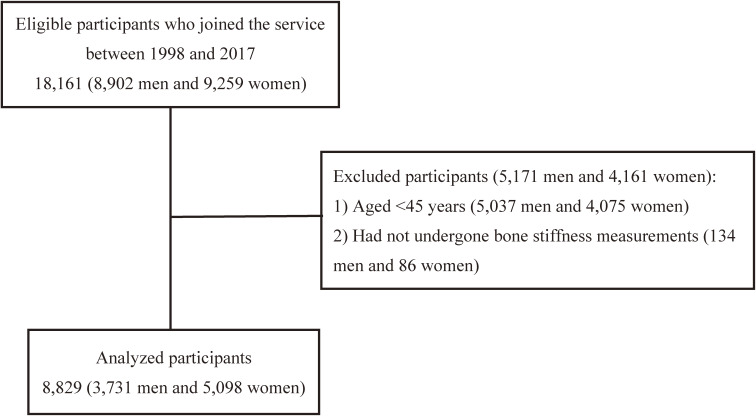
Altogether, 8,829 Japanese adults (3,731 men and 5,098 women) aged ≥45 years completed the maximum voluntary knee extension test, submaximal exercise test, medical examination, and a questionnaire on lifestyle habits. Using an osteo-sono assessment index, low bone stiffness tendency was defined as 80% under the young-adults mean. Multivariable odds ratios (ORs) and 95% confidence intervals (CIs) were calculated after confounder adjustment.
Overall, 542 men (14.5%) and 978 women (19.2%) had low bone stiffness tendency. We observed an inverse association between muscle strength and low bone stiffness tendency after adjustment for CRF in both sexes (P for linear trend <0.001). Compared with the lowest CRF, the multivariable ORs for low bone stiffness tendency in the highest CRF were 0.47 (95% CI, 0.36-0.62) for men and 1.05 (95% CI, 0.82-1.35) for post-menopausal women (P < 0.001 and P = 0.704, respectively). No interactive association between muscle strength and CRF for low bone stiffness tendency existed in both sexes and irrespective of menopausal status.
Knee extensor muscle strength and CRF were associated additively, not synergistically, with bone health. Maintaining high levels of both physical fitness components may improve musculoskeletal health in the cohort. The relationship between physical fitness and bone status should be longitudinally investigated in the future.
膝关节伸肌力量和心肺适能(CRF)是身体机能的主要组成部分。由于膝关节伸肌力量和 CRF 与骨骼健康的相互关联尚不清楚,我们旨在调查日本成年人中这种关联。
共有 8829 名年龄≥45 岁的日本成年人(3731 名男性和 5098 名女性)完成了最大自主膝关节伸展测试、亚最大运动测试、体检和生活方式习惯问卷。使用骨声评估指数,将骨刚度趋势低定义为低于年轻人平均值的 80%。调整混杂因素后,计算多变量比值比(OR)和 95%置信区间(CI)。
总体而言,542 名男性(14.5%)和 978 名女性(19.2%)存在骨刚度趋势低的情况。我们观察到,在调整了男女两性的 CRF 后,肌肉力量与低骨刚度趋势之间呈负相关(P 趋势<0.001)。与最低 CRF 相比,最高 CRF 中低骨刚度趋势的多变量 OR 分别为男性 0.47(95%CI,0.36-0.62)和绝经后女性 1.05(95%CI,0.82-1.35)(P<0.001 和 P=0.704)。无论绝经状态如何,男女两性之间均不存在肌肉力量和 CRF 与低骨刚度趋势之间的交互关联。
膝关节伸肌力量和 CRF 与骨骼健康呈相加而非协同关系。保持高水平的这两种体能成分可能会改善队列中的肌肉骨骼健康。未来应进行前瞻性研究,以调查体能与骨骼状况之间的关系。