Colombani Thibault, Rogers Zachary J, Eggermont Loek J, Bencherif Sidi A
Department of Chemical Engineering, Northeastern University, Boston, MA 02115 USA.
Department of Bioengineering, Northeastern University, Boston, MA 02115 USA.
Emergent Mater. 2021;4(1):9-18. doi: 10.1007/s42247-021-00171-z. Epub 2021 Apr 6.
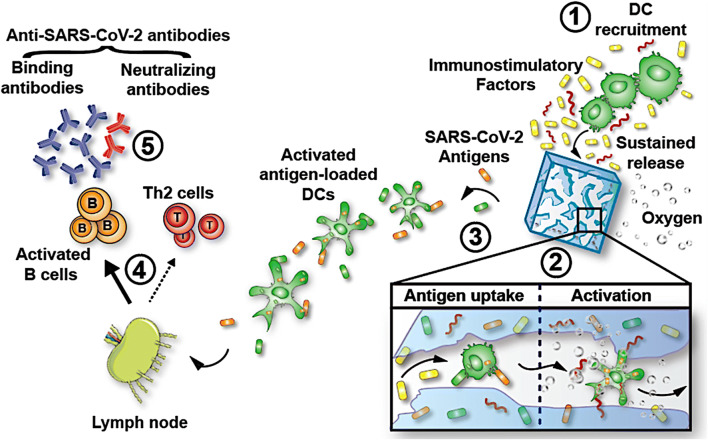
With the emergence of the coronavirus disease 2019 (COVID-19), the world is experiencing a profound human health crisis. The number of infections and deaths due to the severe acute respiratory syndrome coronavirus 2 (SARS-CoV-2) continues to increase every minute, pinpointing major shortcomings in our ability to prevent viral outbreaks. Although several COVID-19 vaccines have been recently approved for emergency use, therapeutic options remain limited, and their long-term potency has yet to be validated. Biomaterials science has a pivotal role to play in pushing the boundaries of emerging technologies for antiviral research and treatment. In this perspective, we discuss how biomaterials can be harnessed to develop accurate COVID-19 infection models, enhance antiviral drug delivery, foster new antiviral strategies, and boost vaccine efficacy. These efforts will not only contribute to stop or mitigate the current pandemic but will also provide unorthodox platforms to understand, prevent, and protect us from future viral outbreaks.
随着2019年冠状病毒病(COVID-19)的出现,世界正经历一场深刻的人类健康危机。严重急性呼吸综合征冠状病毒2(SARS-CoV-2)导致的感染和死亡人数每分钟都在持续增加,凸显出我们在预防病毒爆发能力方面的重大缺陷。尽管最近有几种COVID-19疫苗已获批紧急使用,但治疗选择仍然有限,而且它们的长期效力尚未得到验证。生物材料科学在推动抗病毒研究和治疗新兴技术的边界方面可发挥关键作用。从这个角度出发,我们讨论了如何利用生物材料来开发准确的COVID-19感染模型、增强抗病毒药物递送、促进新的抗病毒策略以及提高疫苗效力。这些努力不仅将有助于阻止或缓解当前的大流行,还将提供非传统平台来理解、预防和保护我们免受未来的病毒爆发。