Guo Yaqiong, Luo Ronghua, Wang Yaqing, Deng Pengwei, Song Tianzhang, Zhang Min, Wang Peng, Zhang Xu, Cui Kangli, Tao Tingting, Li Zhongyu, Chen Wenwen, Zheng Yongtang, Qin Jianhua
CAS Key Laboratory of SSAC, Division of Biotechnology, Dalian Institute of Chemical Physics, Chinese Academy of Sciences, Dalian 116023, China.
University of Chinese Academy of Sciences, Beijing 100049, China.
Sci Bull (Beijing). 2021 Apr 30;66(8):783-793. doi: 10.1016/j.scib.2020.11.015. Epub 2020 Dec 1.
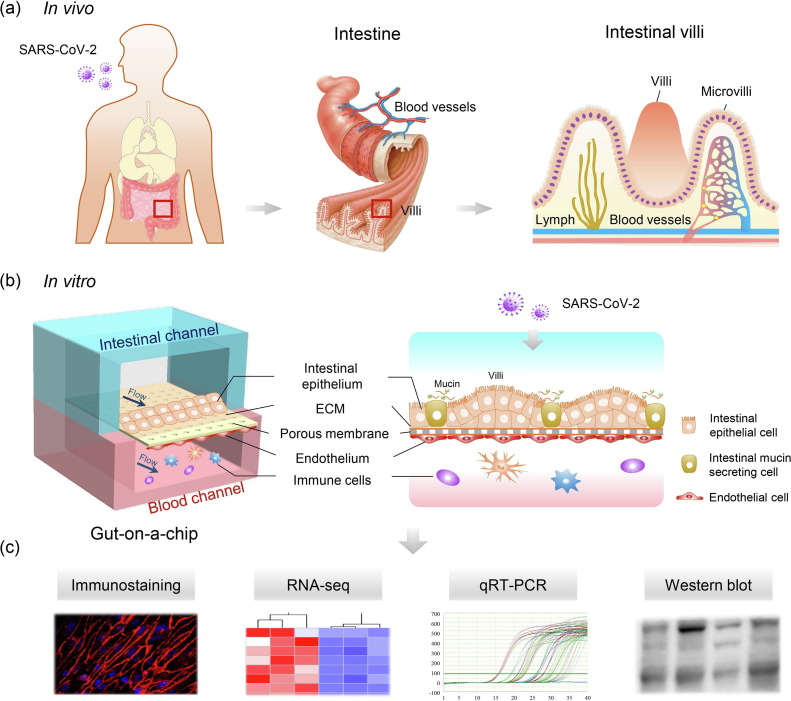
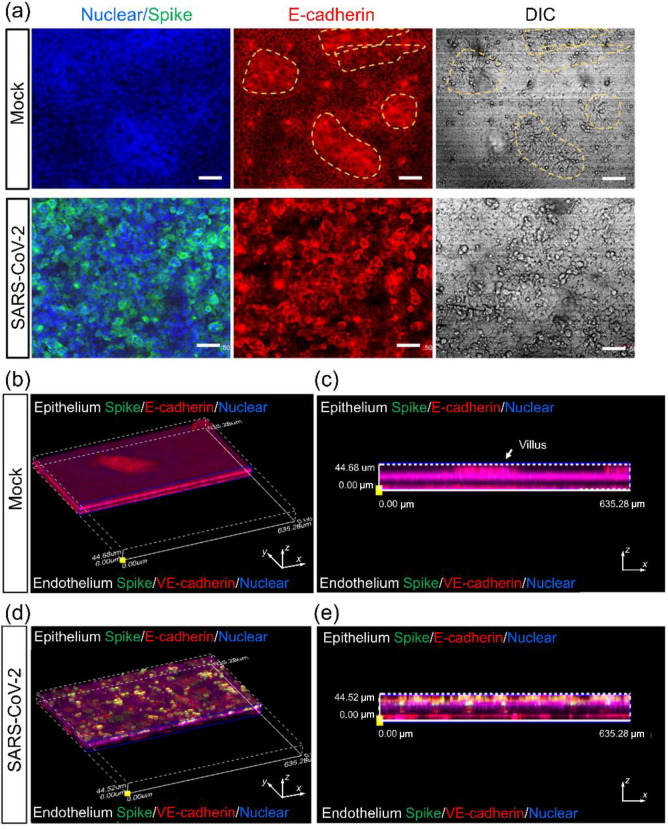
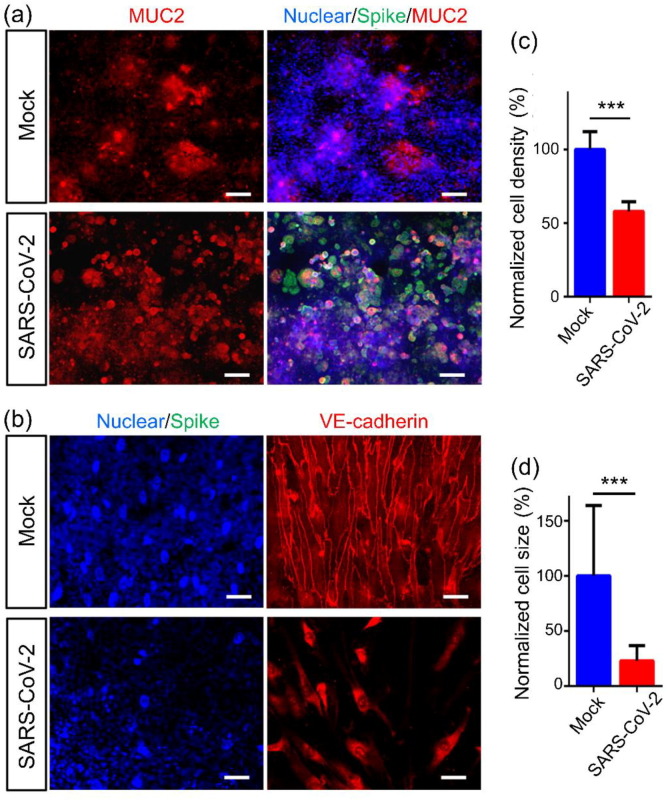
Coronavirus disease 2019 (COVID-19), caused by severe acute respiratory syndrome coronavirus 2 (SARS-CoV-2), has become a global pandemic. Clinical evidence suggests that the intestine is another high-risk organ for SARS-CoV-2 infection besides the lungs. However, a model that can accurately reflect the response of the human intestine to the virus is still lacking. Here, we created an intestinal infection model on a chip that allows the recapitulation of human relevant intestinal pathophysiology induced by SARS-CoV-2 at organ level. This microengineered gut-on-chip reconstitutes the key features of the intestinal epithelium-vascular endothelium barrier through the three-dimensional (3D) co-culture of human intestinal epithelial, mucin-secreting, and vascular endothelial cells under physiological fluid flow. The intestinal epithelium showed permissiveness for viral infection and obvious morphological changes with injury of intestinal villi, dispersed distribution of mucus-secreting cells, and reduced expression of tight junction (E-cadherin), indicating the destruction of the intestinal barrier integrity caused by virus. Moreover, the vascular endothelium exhibited abnormal cell morphology, with disrupted adherent junctions. Transcriptional analysis revealed abnormal RNA and protein metabolism, as well as activated immune responses in both epithelial and endothelial cells after viral infection (e.g., upregulated cytokine genes), which may contribute to the injury of the intestinal barrier associated with gastrointestinal symptoms. This human organ system can partially mirror intestinal barrier injury and the human response to viral infection, which is not possible in existing culture models. It provides a unique and rapid platform to accelerate COVID-19 research and develop novel therapies.
2019冠状病毒病(COVID-19)由严重急性呼吸综合征冠状病毒2(SARS-CoV-2)引起,已成为全球大流行疾病。临床证据表明,除肺部外,肠道是SARS-CoV-2感染的另一个高风险器官。然而,目前仍缺乏能够准确反映人类肠道对该病毒反应的模型。在此,我们构建了一种芯片上的肠道感染模型,该模型能够在器官水平上重现由SARS-CoV-2诱导的与人类相关的肠道病理生理学过程。这种微工程化的芯片肠道通过在生理流体流动条件下对人肠道上皮细胞、粘蛋白分泌细胞和血管内皮细胞进行三维(3D)共培养,重建了肠道上皮-血管内皮屏障的关键特征。肠道上皮细胞对病毒感染表现出易感性,并出现明显的形态学变化,如肠绒毛损伤、粘液分泌细胞分布分散以及紧密连接(E-钙粘蛋白)表达降低,这表明病毒导致了肠道屏障完整性的破坏。此外,血管内皮细胞呈现出异常的细胞形态,粘附连接被破坏。转录分析显示,病毒感染后上皮细胞和内皮细胞中均出现RNA和蛋白质代谢异常以及免疫反应激活(如细胞因子基因上调),这可能导致与胃肠道症状相关的肠道屏障损伤。这种人体器官系统能够部分反映肠道屏障损伤以及人体对病毒感染的反应,这在现有的培养模型中是无法实现的。它为加速COVID-19研究和开发新疗法提供了一个独特且快速的平台。