Department of Biomedical Engineering, Faculty of Fundamental Problems of Technology, Wroclaw University of Science and Technology, Wroclaw, Poland.
Brain Physics Laboratory, Division of Neurosurgery, Department of Clinical Neurosciences, Addenbrooke's Hospital, University of Cambridge, Cambridge, UK.
Acta Neurochir (Wien). 2021 Jul;163(7):1979-1989. doi: 10.1007/s00701-021-04834-y. Epub 2021 Apr 14.
Cerebrospinal compliance describes the ability of the cerebrospinal space to buffer changes in volume. Diminished compliance is associated with increased risk of potentially threatening increases in intracranial pressure (ICP) when changes in cerebrospinal volume occur. However, despite various methods of estimation proposed so far, compliance is seldom used in clinical practice. This study aimed to compare three measures of cerebrospinal compliance.
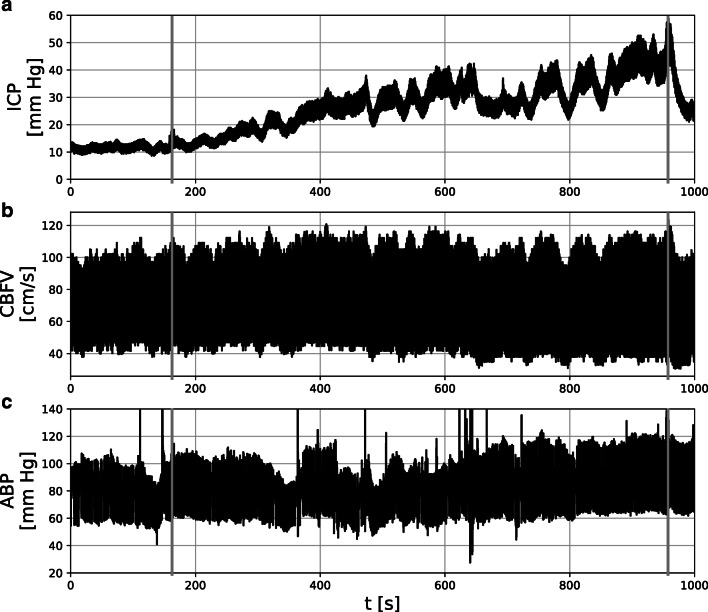
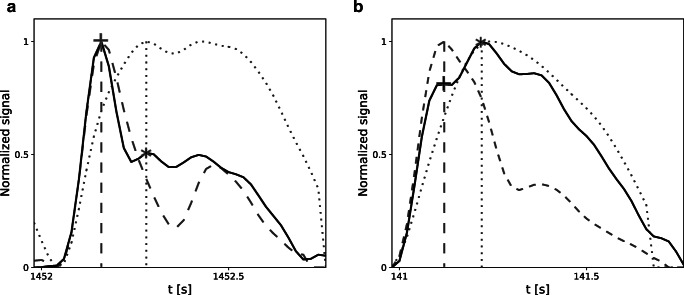
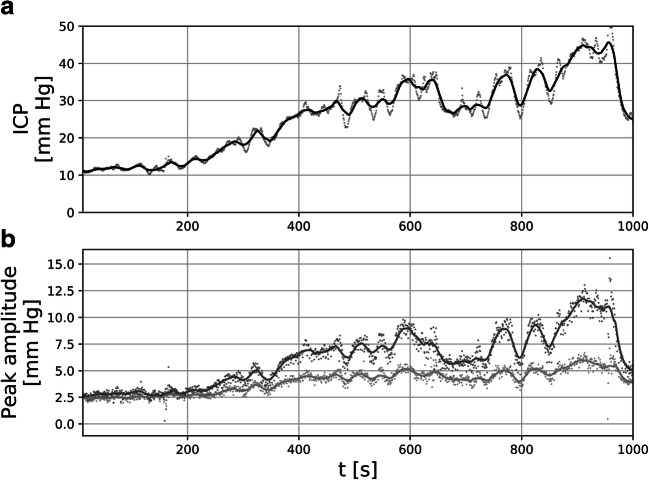
ICP recordings from 36 normal-pressure hydrocephalus patients who underwent infusion tests with parallel recording of transcranial Doppler blood flow velocity were retrospectively analysed. Three methods were used to calculate compliance estimates during changes in the mean ICP induced by infusion of fluid into the cerebrospinal fluid space: (a) based on Marmarou's model of cerebrospinal fluid dynamics (C), (b) based on the evaluation of changes in cerebral arterial blood volume (C), and (c) based on the amplitudes of peaks P1 and P2 of ICP pulse waveform (C).
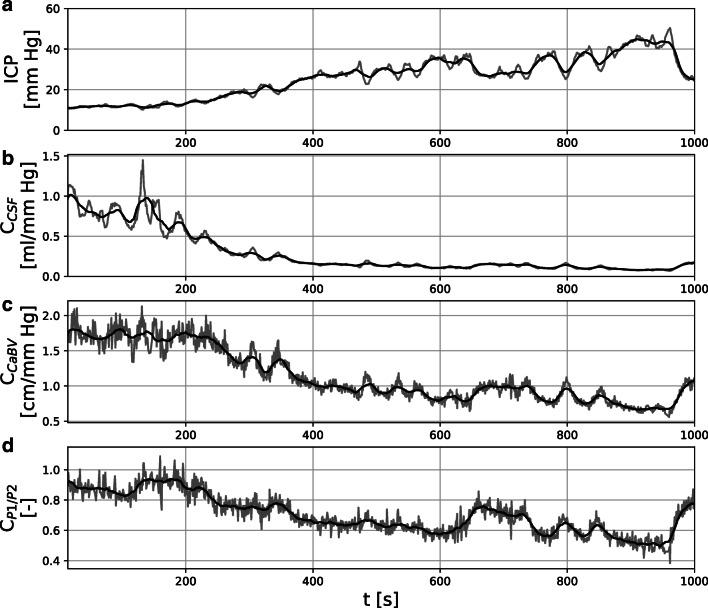
Increase in ICP caused a significant decrease in all compliance estimates (p < 0.0001). Time courses of compliance estimators were strongly positively correlated with each other (group-averaged Spearman correlation coefficients: 0.94 [0.88-0.97] for C vs. C, 0.77 [0.63-0.91] for C vs. C, and 0.68 [0.48-0.91] for C vs. C).
Indirect methods, C and C, allow for the assessment of relative changes in cerebrospinal compliance and produce results exhibiting good correlation with the direct method of volumetric manipulation. This opens the possibility of monitoring relative changes in compliance continuously.
脑脊髓顺应性描述了脑脊髓空间缓冲容积变化的能力。顺应性降低与脑脊液容积变化时颅内压(ICP)潜在威胁性增加的风险增加相关。然而,尽管迄今为止已经提出了各种估计方法,但顺应性在临床实践中很少使用。本研究旨在比较三种脑脊髓顺应性测量方法。
回顾性分析了 36 例接受平行记录经颅多普勒血流速度的脑室内输注试验的正常压力脑积水患者的 ICP 记录。使用三种方法在通过向脑脊液空间输注液体引起的平均 ICP 变化期间计算顺应性估计值:(a)基于脑脊髓液动力学的 Marmarou 模型(C),(b)基于脑动脉血容量变化的评估(C),和(c)基于 ICP 脉搏波形的峰 P1 和 P2 幅度(C)。
ICP 的增加导致所有顺应性估计值显著降低(p<0.0001)。顺应性估计值的时间过程彼此之间呈强烈正相关(组平均 Spearman 相关系数:0.94 [0.88-0.97] 对于 C 与 C,0.77 [0.63-0.91] 对于 C 与 C,和 0.68 [0.48-0.91] 对于 C 与 C)。
间接方法 C 和 C 允许评估脑脊髓顺应性的相对变化,并产生与容积操作的直接方法具有良好相关性的结果。这为连续监测顺应性的相对变化开辟了可能性。