Duke Institute for Brain Sciences, Duke University, Durham, North Carolina.
Center for Cognitive Neuroscience, Duke University, Durham, North Carolina.
J Neurophysiol. 2021 Jul 1;126(1):82-94. doi: 10.1152/jn.00385.2020. Epub 2021 Apr 14.
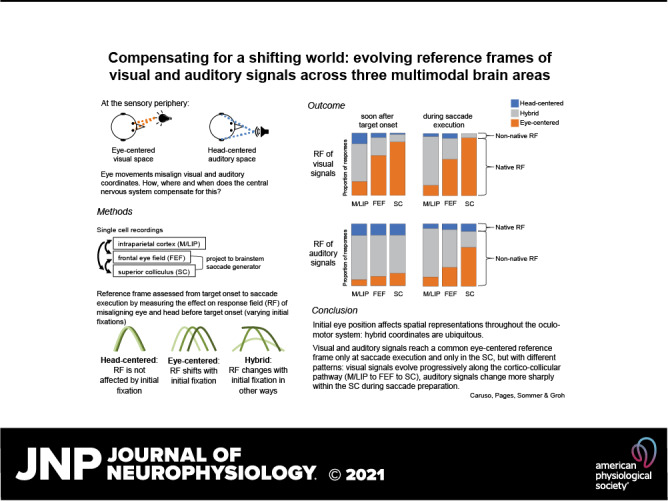
Stimulus locations are detected differently by different sensory systems, but ultimately they yield similar percepts and behavioral responses. How the brain transcends initial differences to compute similar codes is unclear. We quantitatively compared the reference frames of two sensory modalities, vision and audition, across three interconnected brain areas involved in generating saccades, namely the frontal eye fields (FEF), lateral and medial parietal cortex (M/LIP), and superior colliculus (SC). We recorded from single neurons in head-restrained monkeys performing auditory- and visually guided saccades from variable initial fixation locations and evaluated whether their receptive fields were better described as eye-centered, head-centered, or hybrid (i.e. not anchored uniquely to head- or eye-orientation). We found a progression of reference frames across areas and across time, with considerable hybrid-ness and persistent differences between modalities during most epochs/brain regions. For both modalities, the SC was more eye-centered than the FEF, which in turn was more eye-centered than the predominantly hybrid M/LIP. In all three areas and temporal epochs from stimulus onset to movement, visual signals were more eye-centered than auditory signals. In the SC and FEF, auditory signals became more eye-centered at the time of the saccade than they were initially after stimulus onset, but only in the SC at the time of the saccade did the auditory signals become "predominantly" eye-centered. The results indicate that visual and auditory signals both undergo transformations, ultimately reaching the same final reference frame but via different dynamics across brain regions and time. Models for visual-auditory integration posit that visual signals are eye-centered throughout the brain, whereas auditory signals are converted from head-centered to eye-centered coordinates. We show instead that both modalities largely employ hybrid reference frames: neither fully head- nor eye-centered. Across three hubs of the oculomotor network (intraparietal cortex, frontal eye field, and superior colliculus) visual and auditory signals evolve from hybrid to a common eye-centered format via different dynamics across brain areas and time.
不同的感觉系统以不同的方式检测刺激位置,但最终它们产生相似的知觉和行为反应。大脑如何超越初始差异来计算相似的代码尚不清楚。我们定量比较了三个相互关联的脑区(额眼区(FEF)、外侧和内侧顶叶皮层(M/LIP)和上丘)中两种感觉模态(视觉和听觉)的参考系,这些脑区参与产生扫视。我们从头部固定的猴子中记录了单神经元,这些猴子从可变的初始固定位置执行听觉和视觉引导的扫视,并评估它们的感受野是否可以更好地描述为以眼为中心、以头为中心或以混合(即不唯一锚定到头或眼定向)。我们发现,参考系在脑区之间和时间上都有进展,在大多数时期/脑区中,混合程度很高,模态之间仍然存在差异。对于两种模态,上丘比额眼区更以眼为中心,而额眼区又比主要混合的 M/LIP 更以眼为中心。在所有三个区域和从刺激开始到运动的时间内,视觉信号比听觉信号更以眼为中心。在上丘和额眼区,与刺激开始后最初相比,听觉信号在扫视时更以眼为中心,但只有在上丘在扫视时,听觉信号才“主要”以眼为中心。结果表明,视觉和听觉信号都经历了转换,最终达到相同的最终参考系,但在脑区和时间上的动态不同。视觉-听觉整合模型假设,视觉信号在整个大脑中都是以眼为中心的,而听觉信号是从头向眼坐标转换的。相反,我们发现两种模态都主要采用混合参考系:既不完全以头为中心,也不完全以眼为中心。在眼球运动网络的三个枢纽(顶内皮层、额眼区和上丘)中,视觉和听觉信号通过不同的脑区和时间的动态,从混合状态演变为共同的眼中心格式。