Mengshoel Anne Marit, Skarbø Åse, Hasselknippe Elisabeth, Petterson Tamara, Brandsar Nina Linnea, Askmann Ellen, Ildstad Ragnhild, Løseth Lena, Sallinen Merja Helena
Department of Interdisciplinary Health Sciences, Faculty of Medicine, Institute of Health and Society, University of Oslo, Box 1089, Blindern, 0317, Oslo, Norway.
Hospital for Rheumatic Diseases, Margrethe Grundtvigsvei 6, 2609, Lillehammer, Norway.
BMC Health Serv Res. 2021 Apr 14;21(1):339. doi: 10.1186/s12913-021-06295-6.
Fibromyalgia (FM) is a contested, chronic widespread pain syndrome on which recommended therapies have short-lasting, moderate effects. Nevertheless, some patients become symptom-free, and their recovery experiences inspired us to develop a patient-centred recovery-oriented programme (PROP) delivered in a group format. Presently, we describe the theoretical rationale, purpose and content of the PROP, and its meanings for clinicians and patients.
A multidisciplinary clinical team, a leader of a rehabilitation unit, and two researchers coproduced the PROP. Five full-day seminars were arranged to bridge research and clinical experiences. Qualitative studies about patients' illness and recovery experiences and questions by researchers facilitated reflections on clinical experiences. The meaning of the PROP was examined using focus group and individual interviews with patients and clinicians immediately after completing the course and after 1-1.5 years.
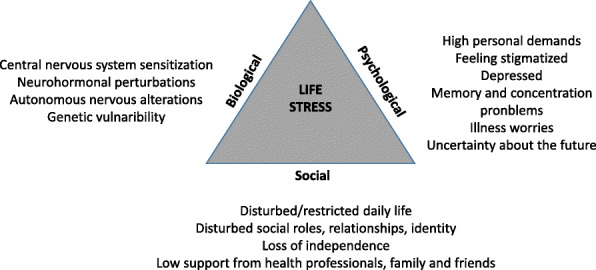
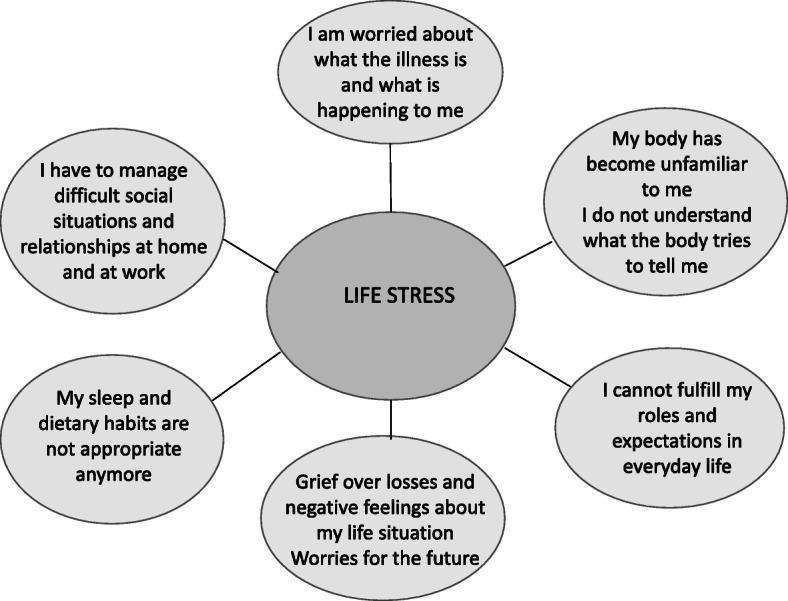
The biopsychosocial model displays the research evidence across biological, mental and social impacts of FM, justifying that life stress can be an illness-maintaining factor in FM. The content addresses enabling patients to heal their own life and self by modifying life stress. Patients engage in making sense of the relationship between FM, themselves, and life through exploring, discovering and creating appropriate solutions for their daily social life. The PROP reduced uncertainties and brought a positive attitude and hope to the groups. After 1 year, patients are still engaged in recovery work, experience more good days, and maintain hope for further recovery. By sharing and reflecting on clinical experiences, a unified clinical team was established that continues to develop their competency.
To our knowledge, the PROP is the first programme for patients with FM that results from a process of coproducing knowledge, is based on explicit theoretical rationale, and facilitates a personal experiential recovery process. PROP is found to be meaningful and to work by patients and clinicians.
纤维肌痛(FM)是一种存在争议的慢性广泛性疼痛综合征,推荐的治疗方法效果持续时间短且效果中等。然而,一些患者症状消失,他们的康复经历启发我们制定了一种以患者为中心、以康复为导向的团体形式方案(PROP)。目前,我们描述了PROP的理论依据、目的和内容,以及它对临床医生和患者的意义。
一个多学科临床团队、一个康复单元的负责人和两名研究人员共同制定了PROP。安排了五次全天研讨会,以衔接研究和临床经验。关于患者疾病和康复经历的定性研究以及研究人员提出的问题促进了对临床经验的反思。在课程结束后以及1 - 1.5年之后,通过焦点小组以及对患者和临床医生的个人访谈来考察PROP的意义。
生物心理社会模型展示了关于FM在生物学、心理和社会方面影响的研究证据,证明生活压力可能是FM的一个维持疾病的因素。该方案的内容旨在使患者通过改变生活压力来治愈自己的生活和自我。患者通过探索、发现并为其日常社交生活创造合适的解决方案,来理解FM、自身与生活之间的关系。PROP减少了不确定性,并给团体带来了积极的态度和希望。1年后,患者仍在进行康复工作,经历更多美好的日子,并对进一步康复保持希望。通过分享和反思临床经验,建立了一个统一的临床团队,该团队不断提升自身能力。
据我们所知,PROP是首个为FM患者制定的方案,它源于知识共同生产过程,基于明确的理论依据,并促进个人的体验式康复过程。患者和临床医生都认为PROP是有意义且有效的。