Villarino Sebastián H, Pinto Priscila, Jackson Robert B, Piñeiro Gervasio
Consejo Nacional de Investigaciones Científicas y Técnicas (CONICET), Buenos Aires, Argentina.
Facultad de Ciencias Agrarias (FCA), Universidad Nacional de Mar del Plata (UNMdP), Mar del Plata, Argentina.
Sci Adv. 2021 Apr 14;7(16). doi: 10.1126/sciadv.abd3176. Print 2021 Apr.
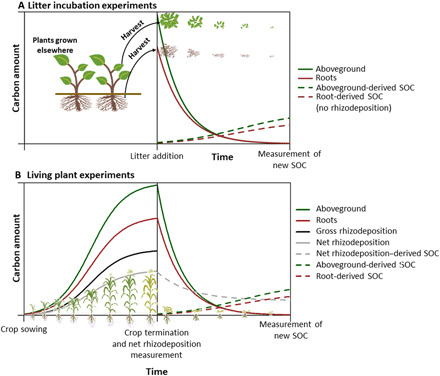
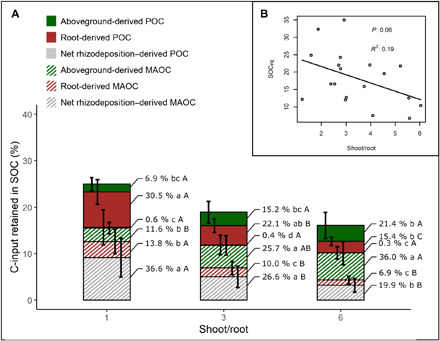
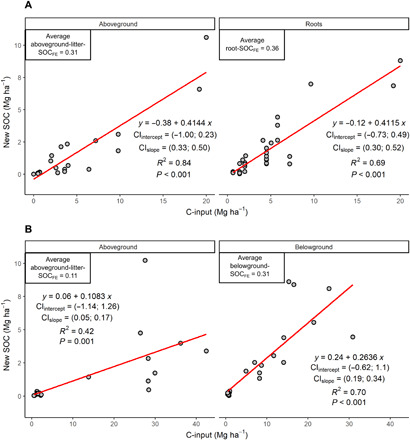
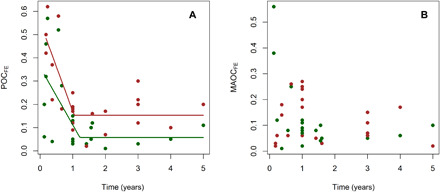
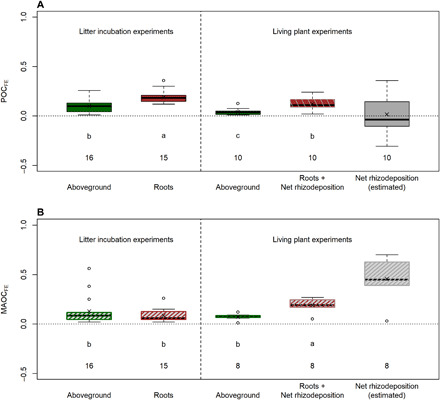
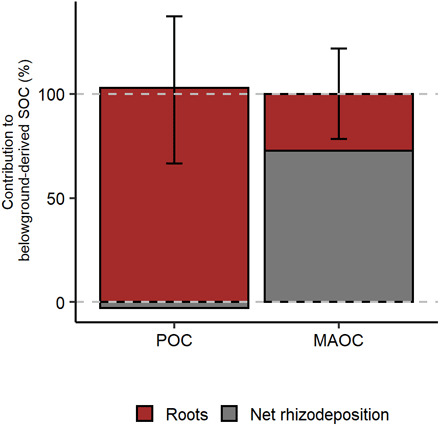
Soil organic carbon formation remains poorly understood despite its importance for human livelihoods. Uncertainties remain for the relative contributions of aboveground, root, and rhizodeposition inputs to particulate (POC) and mineral-associated (MAOC) organic carbon fractions. Combining a novel framework with isotope tracer studies, we quantified POC and MAOC formation efficiencies (% of C-inputs incorporated into each fraction). We found that rhizodeposition inputs have the highest MAOC formation efficiency (46%) as compared to roots (9%) or aboveground inputs (7%). In addition, rhizodeposition unexpectedly reduced POC formation, likely because it increased decomposition rates of new POC. Conversely, root biomass inputs have the highest POC formation efficiency (19%). Therefore, rhizodeposition and roots appear to play opposite but complementary roles for building MAOC and POC fractions.
尽管土壤有机碳形成对人类生计至关重要,但其形成过程仍未得到充分理解。地上部分、根系以及根际沉积对颗粒有机碳(POC)和矿物结合有机碳(MAOC)组分的相对贡献仍存在不确定性。通过将一个新框架与同位素示踪研究相结合,我们量化了POC和MAOC的形成效率(即碳输入量中纳入各组分的百分比)。我们发现,与根系(9%)或地上部分输入(7%)相比,根际沉积输入具有最高的MAOC形成效率(46%)。此外,根际沉积意外地降低了POC的形成,这可能是因为它提高了新POC的分解速率。相反,根系生物量输入具有最高的POC形成效率(19%)。因此,根际沉积和根系在构建MAOC和POC组分方面似乎发挥着相反但互补作用。