School of Life Sciences, Arizona State University, Tempe, Arizona, USA.
Center for Fundamental and Applied Microbiomics, The Biodesign Institute, Arizona State University, Tempe, Arizona, USA.
mSphere. 2021 Apr 14;6(2):e00040-21. doi: 10.1128/mSphere.00040-21.
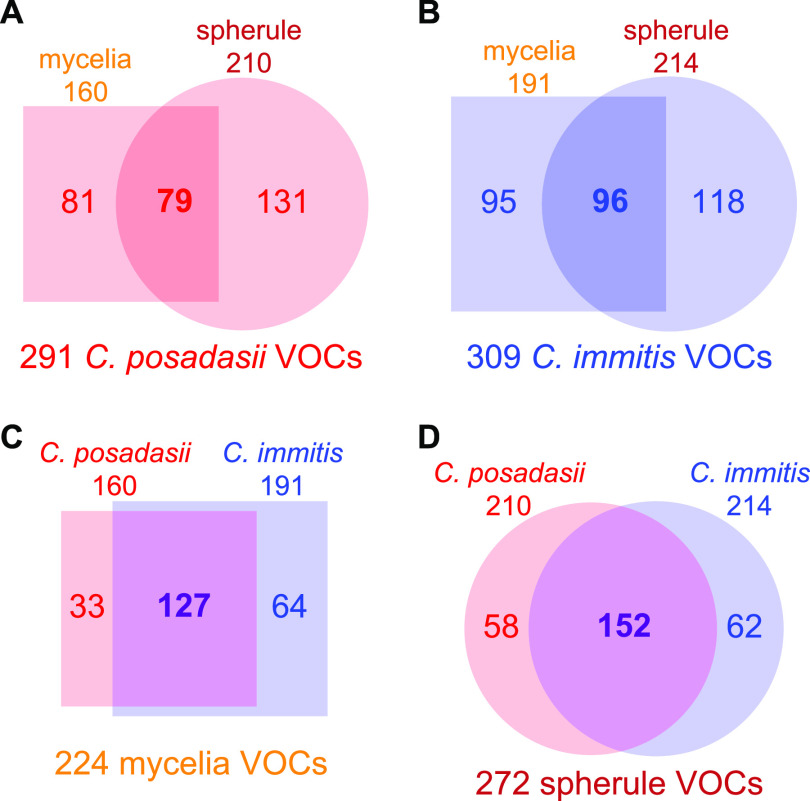
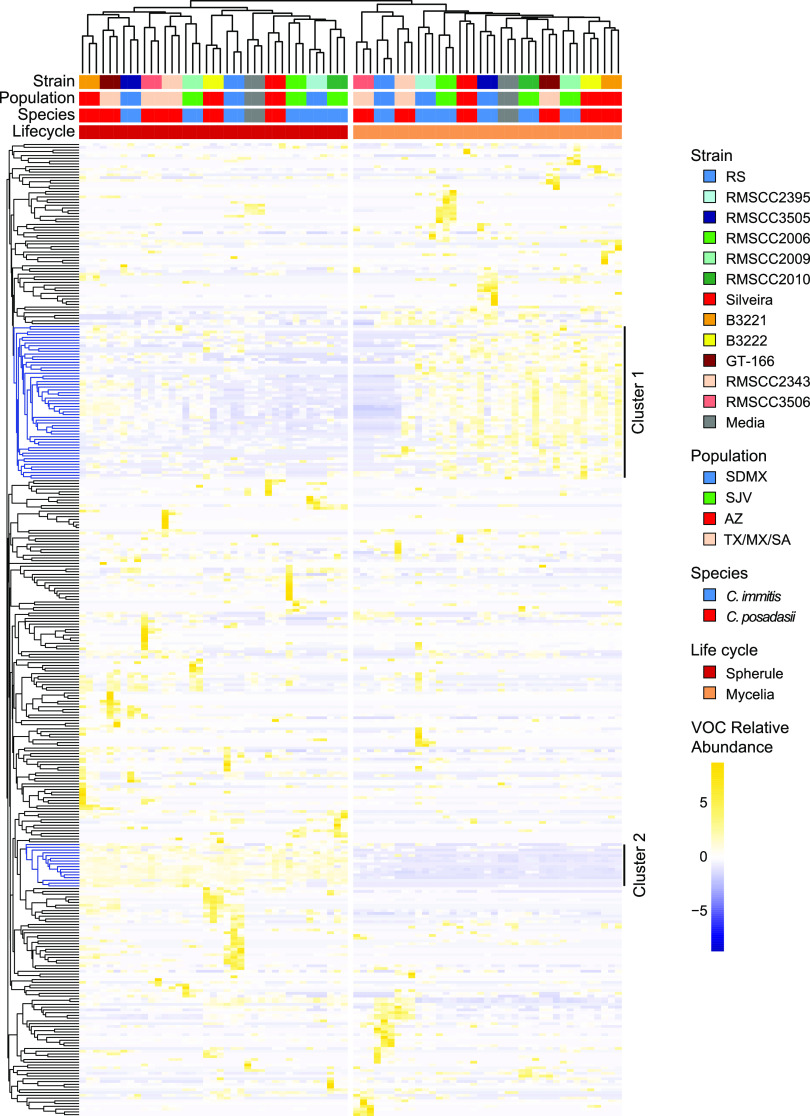
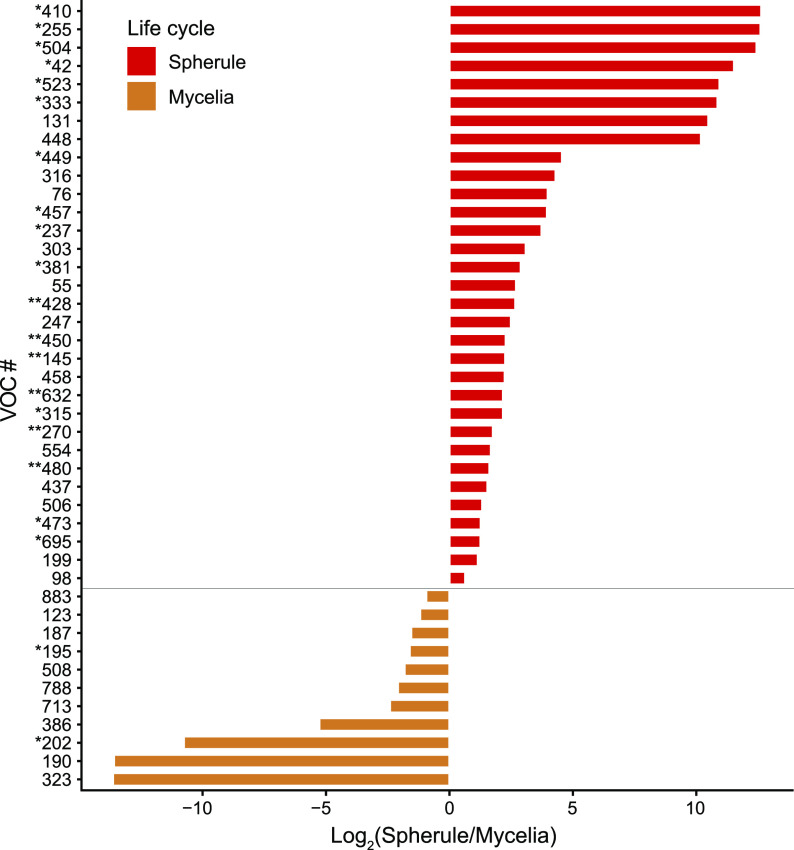
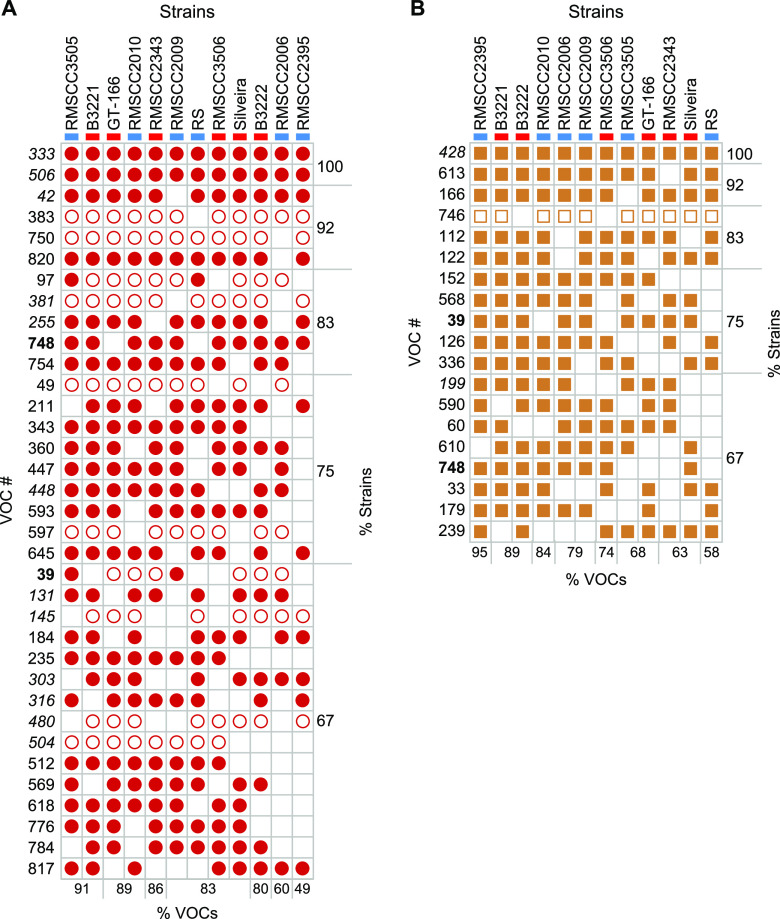
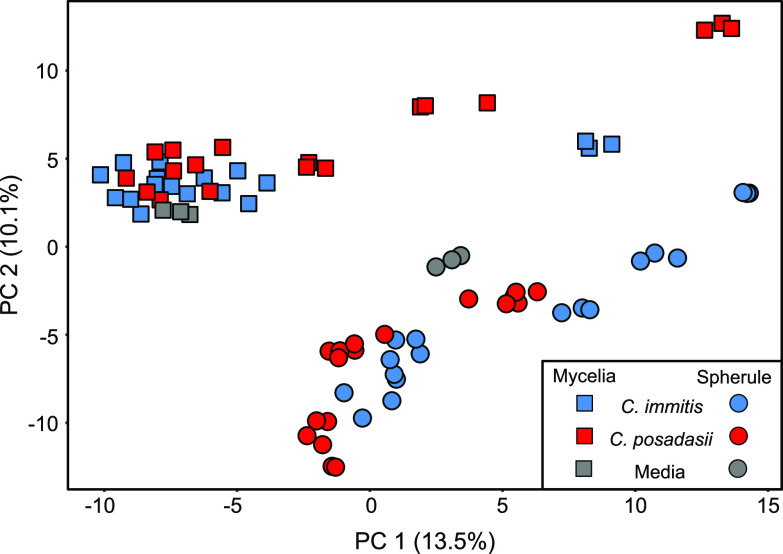
Valley fever (coccidioidomycosis) is an endemic fungal pneumonia of the North and South American deserts. The causative agents of Valley fever are the dimorphic fungi and , which grow as mycelia in the environment and as spherules within the lungs of vulnerable hosts. Current diagnostics for Valley fever are severely lacking due to poor sensitivity and invasiveness, contributing to a 23-day median time to diagnosis, and therefore, new diagnostic tools are needed. We are working toward the development of a breath-based diagnostic for coccidioidomycosis, and in this initial study, we characterized the volatile metabolomes (or volatilomes) of cultures of Using solid-phase microextraction (SPME) and comprehensive two-dimensional gas chromatography coupled to time of flight mass spectrometry (GC×GC-TOFMS), we characterized the volatile organic compounds (VOCs) produced by six strains of each species during mycelial or spherule growth. We detected a total of 353 VOCs that were at least 2-fold more abundant in a culture than in medium controls and found that the volatile metabolome of is more dependent on the growth phase (spherules versus mycelia) than on the species. The volatile profiles of and have strong similarities, indicating that a single suite of Valley fever breath biomarkers can be developed to detect both species. Coccidioidomycosis, or Valley fever, causes up to 30% of community-acquired pneumonias in highly populated areas of the U.S. desert southwest where the disease is endemic. The infection is difficult to diagnose by standard serological and histopathological methods, which delays appropriate treatment. Therefore, we are working toward the development of breath-based diagnostics for Valley fever. In this study, we characterized the volatile metabolomes (or volatilomes) of six strains each of and , the dimorphic fungal species that cause Valley fever. By analyzing the volatilomes during the two modes of growth of the fungus-mycelia and spherules-we observed that the life cycle plays a significant role in the volatiles produced by In contrast, we observed no significant differences in the versus volatilomes. These data suggest that life cycle, rather than species, should guide the selection of putative biomarkers for a Valley fever breath test.
谷热(球孢子菌病)是北美和南美沙漠地区地方性真菌性肺炎。谷热的病原体是二相真菌 和 ,它们在环境中生长为菌丝,在易感染宿主的肺部生长为球体。由于敏感性和侵袭性差,目前的谷热诊断方法严重不足,导致中位诊断时间为 23 天,因此需要新的诊断工具。我们正在努力开发一种基于呼吸的球孢子菌病诊断方法,在这项初步研究中,我们对 的培养物进行了挥发性代谢组(或挥发组)的特征分析。使用固相微萃取(SPME)和全二维气相色谱-飞行时间质谱联用(GC×GC-TOFMS),我们对两种真菌的六个菌株在菌丝或球体生长过程中产生的挥发性有机化合物(VOCs)进行了特征分析。我们共检测到 353 种 VOCs,它们在 培养物中的丰度至少是对照培养基中的 2 倍,并发现 的挥发性代谢组受生长阶段(球体与菌丝)的影响大于物种。 和 的挥发性图谱具有很强的相似性,这表明可以开发出一套单一的谷热呼吸生物标志物来检测这两种物种。球孢子菌病,或谷热,在美国沙漠西南部人口密集地区高达 30%的社区获得性肺炎是由这种疾病引起的。这种感染很难通过标准的血清学和组织病理学方法诊断,这导致了适当的治疗被延误。因此,我们正在努力开发针对谷热的基于呼吸的诊断方法。在这项研究中,我们对六个菌株的 和 进行了挥发性代谢组(或挥发组)的特征分析,这两种真菌是引起谷热的二相真菌物种。通过分析真菌在菌丝和球体两种生长模式下的挥发组,我们观察到生命周期在 产生的挥发物中起着重要作用。相比之下,我们没有观察到 和 挥发组之间有显著差异。这些数据表明,生命周期而不是物种,应该指导谷热呼吸测试的候选生物标志物的选择。