Chen Yating, Huang Yun, Bai Jing, Liu Chuanbin, Ma Shanshan, Li Jiaxin, Lu Xu, Fu Zihao, Fang Lihua, Li Yang, Zhang Jiancheng
Department of Cardiology, Fujian Provincial Hospital, Provincial Clinical Medicine College of Fujian Medical University, Fuzhou, China.
Department of Gerontology, Union Hospital, Tongji Medical College, Huazhong University of Science and Technology, Wuhan, China.
Front Physiol. 2021 Mar 29;12:636485. doi: 10.3389/fphys.2021.636485. eCollection 2021.
The aim was to study the effect of Allitridum (Allicin) on the heterologous expression of the late sodium current on the ΔKPQ-SCN5A mutations in HEK293 cells, with a view to screening new drugs for the treatment of long QT syndrome type 3 (LQT3).
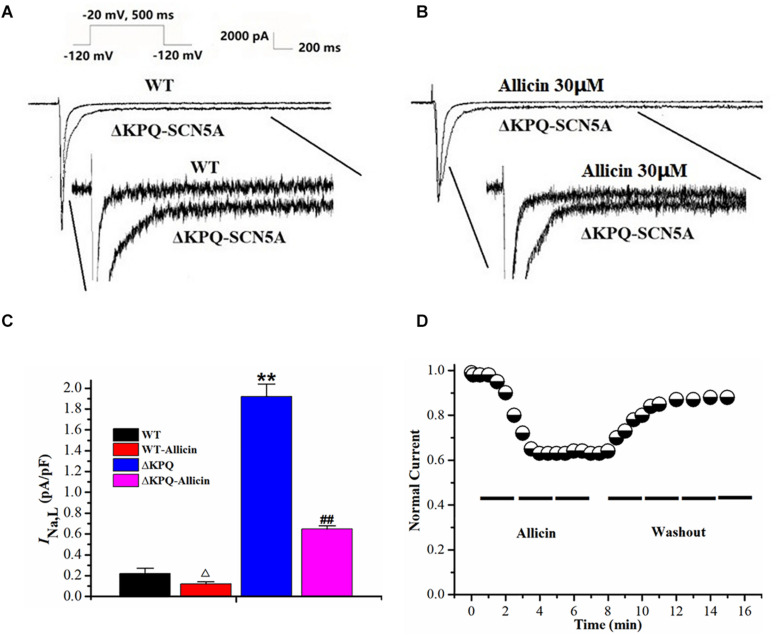
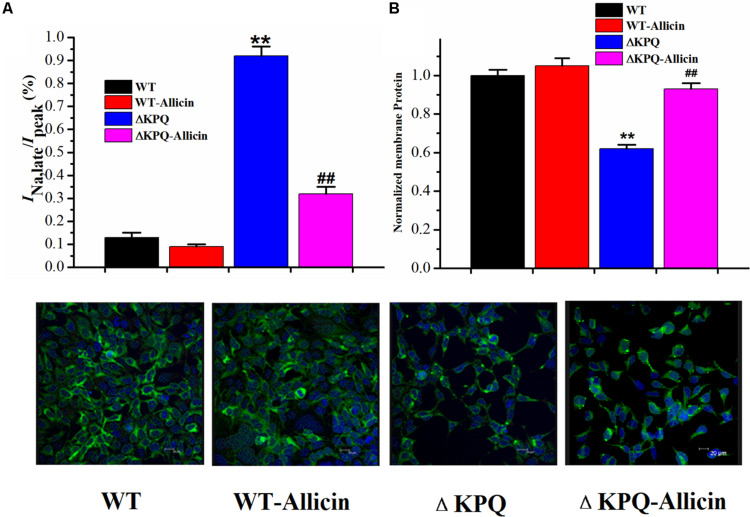
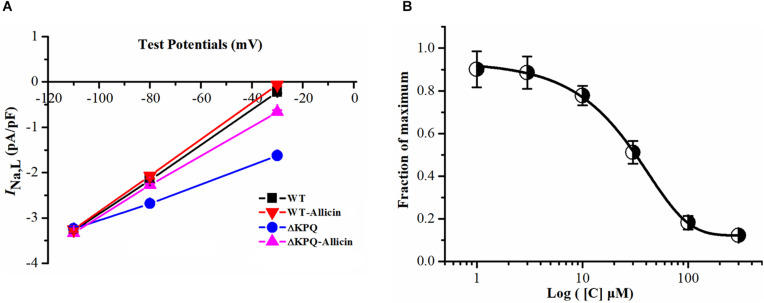
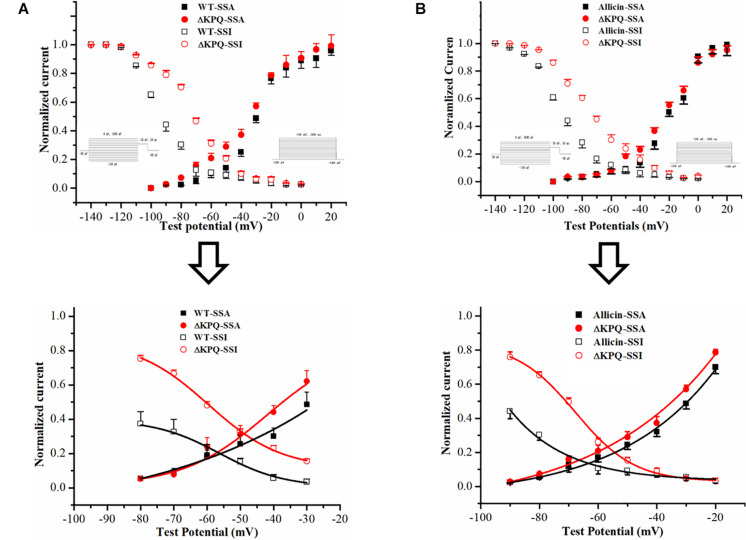
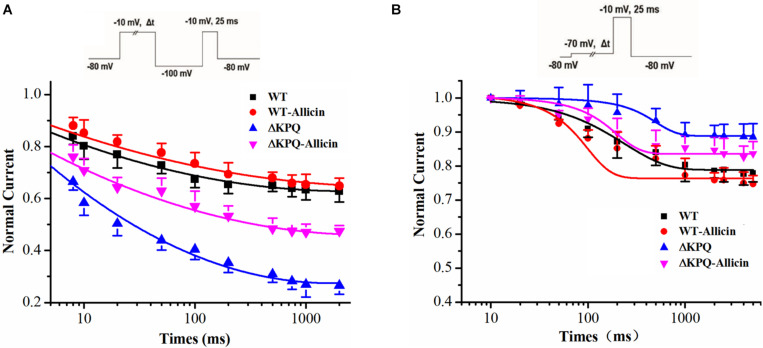
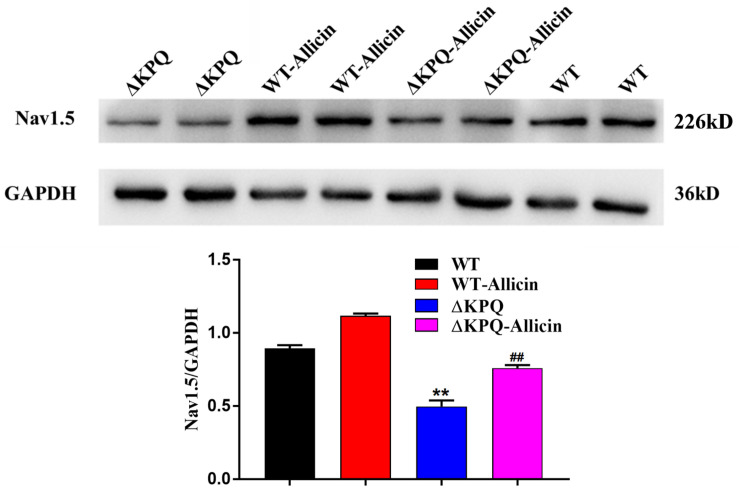
The ΔKPQ-SCN5A plasmid was transiently transferred into HEK293 cells by liposome technology and administered by extracellular perfusion, and the sodium current was recorded by whole-cell patch-clamp technology. Application of Allicin 30 μM reduced the late sodium current ( ) of the Nav1.5 channel current encoded by ΔKPQ-SCN5A from 1.92 ± 0.12 to 0.65 ± 0.03 pA/pF ( < 0.01, = 15), which resulted in the decrease of / (from 0.94% ± 0.04% to 0.32% ± 0.02%). Furthermore, treatment with Allicin could move the steady-state inactivation of the channel to a more negative direction, resulting in an increase in channel inactivation at the same voltage, which reduced the increase in the window current and further increased the inactivation of the channel intermediate state. However, it had no effect on channel steady-state activation (SSA), inactivation mechanics, and recovery dynamics after inactivation. What's more, the Nav1.5 channel protein levels of membrane in the ΔKPQ-SCN5A mutation were enhanced from 0.49% ± 0.04% to 0.76% ± 0.02% with the effect of 30 mM Allicin, close to 0.89% ± 0.02% of the WT.
Allicin reduced the late sodium current of ΔKPQ-SCN5A, whose mechanism may be related to the increase of channel steady-state inactivation (SSI) and intermediate-state inactivation (ISI) by the drug, thus reducing the window current.
研究大蒜素对人胚肾293(HEK293)细胞中ΔKPQ-SCN5A突变体晚期钠电流异源表达的影响,以期筛选出治疗3型长QT综合征(LQT3)的新药。
采用脂质体技术将ΔKPQ-SCN5A质粒瞬时转染至HEK293细胞,通过细胞外灌流给药,采用全细胞膜片钳技术记录钠电流。应用30 μM大蒜素可使ΔKPQ-SCN5A编码的Nav1.5通道电流的晚期钠电流( )从1.92±0.12降至0.65±0.03 pA/pF( <0.01, =15),导致 / 降低(从0.94%±0.04%降至0.32%±0.02%)。此外,大蒜素处理可使通道的稳态失活向更负的方向移动,导致在相同电压下通道失活增加,从而减少窗电流的增加,并进一步增加通道中间状态的失活。然而,它对通道稳态激活(SSA)、失活机制以及失活后的恢复动力学没有影响。此外,在30 mM大蒜素作用下,ΔKPQ-SCN5A突变体膜上的Nav1.5通道蛋白水平从0.49%±0.04%提高到0.76%±0.02%,接近野生型的0.89%±0.02%。
大蒜素降低了ΔKPQ-SCN5A的晚期钠电流,其机制可能与该药物增加通道稳态失活(SSI)和中间状态失活(ISI)从而减少窗电流有关。