Division of Developmental Biology, National Institute of Child Health and Human Development, National Institutes of Health, Bethesda, MD, United States.
Front Immunol. 2021 Mar 29;12:621333. doi: 10.3389/fimmu.2021.621333. eCollection 2021.
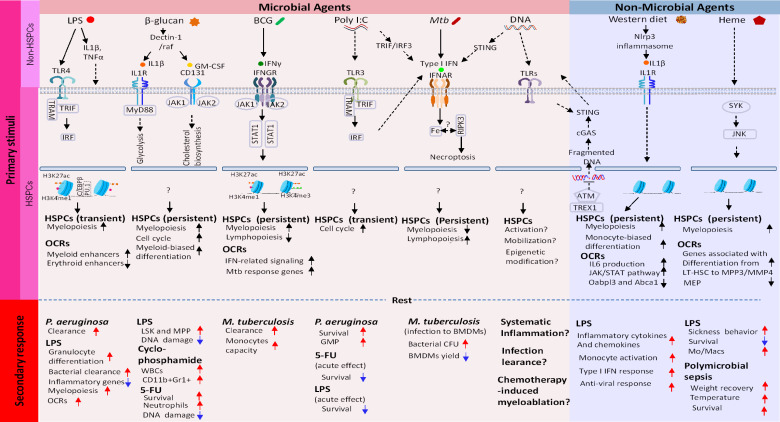
Innate immune memory was first described for monocytes and other myeloid cells. This memory is designated , in which the host animals that had experienced pathogen infection earlier acquire improved resistance to a second infection. Innate immune memory is mediated by an epigenetic mechanism traced to that is conserved throughout evolution and has been selected for the ability to mount an adaptive response to shifting environments. Accumulating evidence shows that not only peripheral myeloid cells but hematopoietic stem/progenitor cells (HSCs/HSPCs) can acquire epigenetic memory upon pathogen exposure. Systemic pathogen infection causes HSCs to exit from quiescence and facilitate myeloid-biased differentiation that leads to efficient host defense. This sequence of events is common in HSC memory generation, which is triggered by different stimuli. Recent studies show that not only pathogens but other stimuli such as metabolic stress can generate memory in HSCs. This review summarizes recent publications relevant to HSC memory. We discuss the current understanding of initial sensors, soluble mediators/cytokines involved in memory formation, including Type I and Type II interferons along with future implications.
先天免疫记忆最初是在单核细胞和其他髓样细胞中描述的。这种记忆被指定为 ,其中先前经历过病原体感染的宿主动物获得对第二次感染的增强抵抗力。先天免疫记忆是由一种表观遗传机制介导的,这种机制可以追溯到 ,它在整个进化过程中是保守的,并且已经被选择来具有适应不断变化的环境的能力。越来越多的证据表明,不仅外周髓样细胞,而且造血干细胞/祖细胞 (HSCs/HSPCs) 在暴露于病原体后也可以获得表观遗传记忆。系统性病原体感染导致 HSCs 从静止状态退出,并促进偏向髓样的分化,从而导致有效的宿主防御。这一系列事件在 HSC 记忆生成中很常见,这是由不同的刺激引发的。最近的研究表明,不仅病原体,而且其他刺激物,如代谢应激,也可以在 HSCs 中产生记忆。这篇综述总结了与 HSC 记忆相关的最近出版物。我们讨论了参与记忆形成的初始传感器、可溶性介质/细胞因子的当前理解,包括 I 型和 II 型干扰素以及未来的影响。