Slotved Hans-Christian, Fuursted Kurt, Kavalari Ioanna Drakaki, Hoffmann Steen
Neisseria and Streptococcus Reference Laboratory, Department of Bacteria, Parasites and Fungi, Statens Serum Institut, Copenhagen, Denmark.
Front Cell Infect Microbiol. 2021 Mar 29;11:571901. doi: 10.3389/fcimb.2021.571901. eCollection 2021.
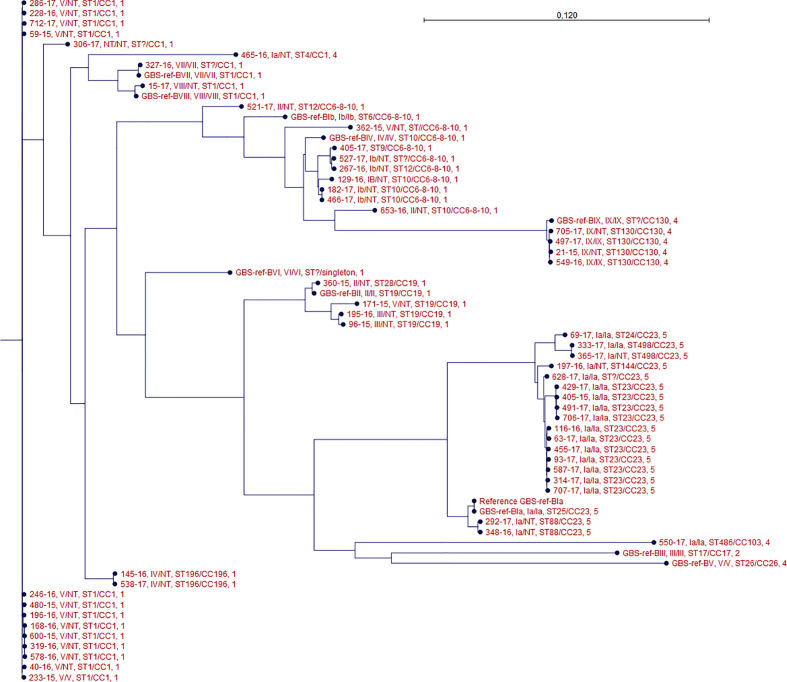
The number of invasive (GBS) non-typeable (NT) isolates in Denmark received since 1999 has in general accounted for 10% of all invasive GBS isolates. We present data on 55 clinical NT isolates based on clinical manifestations, clonal relationship, antimicrobial resistance (AMR) determinants, and virulence factors. The GBS isolates included in this study were phenotypic-based NT obtained from 2015 to 2017, as well as 10 reference isolates. Whole genome sequencing (WGS) was performed on all isolates and the data were analyzed for the presence of both species specific genes, capsular genes (genotype), and other relevant genes. We furthermore compared different procedures for detection of serotype specific capsular genes. Overall we were able to genotype 54 of the 55 isolates. After retesting the isolates a phenotype was detected for 20 (36%) isolates, of which the initial phenotyping problem for 13 isolates was found to be due to a problem with serotype Ia specific antiserum. Thirty-five isolates remained phenotypic non-typeable with a majority of genotype V isolates which do not express a capsular gene. From all the Danish invasive GBS isolates from 2015 to 2017, the 35 NT isolates were all detected in the age group above 21 years with bacteremia. The 35 NT isolates belonged to six different well-known human pathogenic clonal complexes. The CDC recommended sequences for capsule genotyping were the most optimal for serotype prediction, because of the sequence simplicity and clear cutoff values. However we recommend to also use other capsular sequences for the NT isolates, if they cannot be genotyped by the CDC method.
自1999年以来,丹麦收到的侵袭性无荚膜群(GBS)不可分型(NT)分离株数量一般占所有侵袭性GBS分离株的10%。我们基于临床表现、克隆关系、抗菌药物耐药性(AMR)决定因素和毒力因子,展示了55株临床NT分离株的数据。本研究纳入的GBS分离株为2015年至2017年获得的基于表型的NT分离株以及10株参考分离株。对所有分离株进行了全基因组测序(WGS),并分析数据以确定是否存在物种特异性基因、荚膜基因(基因型)和其他相关基因。我们还比较了检测血清型特异性荚膜基因的不同方法。总体而言,我们能够对55株分离株中的54株进行基因分型。对分离株进行重新检测后,检测到20株(36%)分离株的表型,其中发现13株分离株最初的表型问题是由于血清型Ia特异性抗血清的问题。35株分离株仍为表型不可分型,其中大多数为不表达荚膜基因的基因型V分离株。在2015年至2017年丹麦所有侵袭性GBS分离株中,35株NT分离株均在21岁以上菌血症年龄组中检测到。35株NT分离株属于6个不同的知名人类致病克隆复合体。由于序列简单且截断值明确,美国疾病控制与预防中心(CDC)推荐的用于荚膜基因分型的序列对血清型预测最为理想。然而,如果NT分离株不能通过CDC方法进行基因分型,我们建议也使用其他荚膜序列。