Shao Ensi, Song Yujuan, Wang Yaomin, Liao Yichen, Luo Yufei, Liu Sijun, Guan Xiong, Huang Zhipeng
China National Engineering Research Center of JUNCAO Technology, School of Life Science, Fujian Agriculture and Forestry University, 350002, Fuzhou, Fujian, PR China.
Department of Entomology, Iowa State University, 50011-3222 Ames, Iowa, USA.
BMC Genomics. 2021 Apr 15;22(1):271. doi: 10.1186/s12864-021-07578-2.
Infestation by tea green leafhoppers (Empoasca (Matsumurasca) onukii) can cause a series of biochemical changes in tea leaves. As a typical cell-rupture feeder, E. onukii secretes proteases while using its stylet to probe the tender shoots of tea plants (Camellia sinensis). This study identified and analyzed proteases expressed specifically in the salivary gland (SG) and gut of E. onukii through enzymatic activity assays complemented with an integrated analysis of transcriptomic and proteomic data.
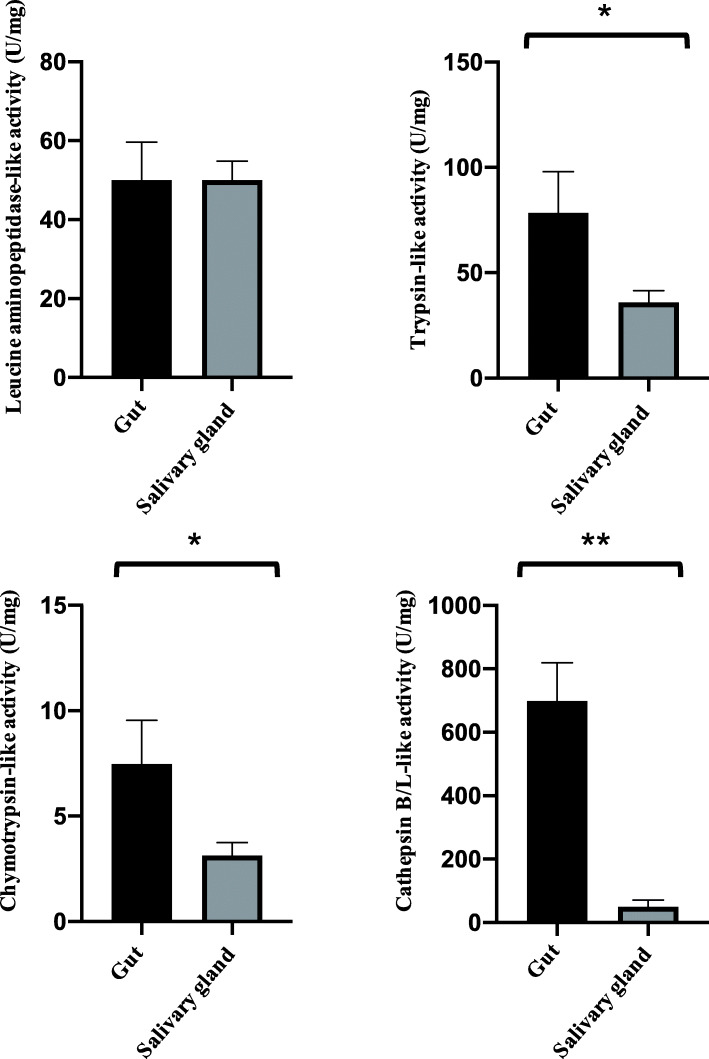
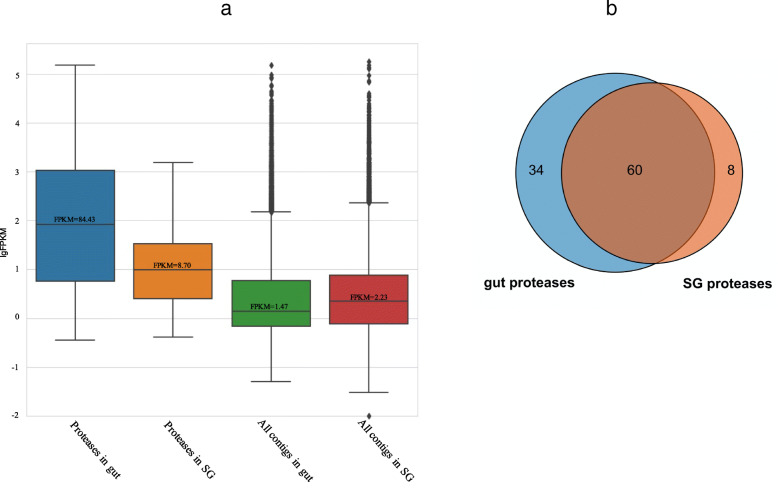
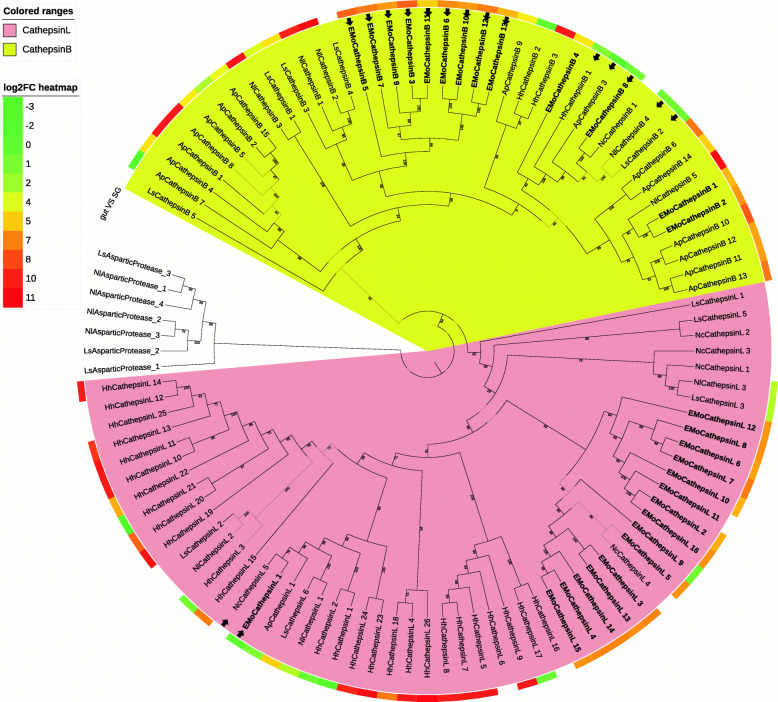
In total, 129 contigs representing seven types of putative proteases were identified. Transcript abundance of digestive proteases and enzymatic activity assays showed that cathepsin B-like protease, cathepsin L-like protease, and serine proteases (trypsin- and chymotrypsin-like protease) were highly abundant in the gut but moderately abundant in the SG. The abundance pattern of digestive proteases in the SG and gut of E. onukii differed from that of other hemipterans, including Nilaparvata lugens, Laodelphax striatellus, Acyrthosiphum pisum, Halyomorpha halys and Nephotettix cincticeps. Phylogenetic analysis showed that aminopeptidase N-like proteins and serine proteases abundant in the SG or gut of hemipterans formed two distinct clusters.
Altogether, this study provides insightful information on the digestive system of E. onukii. Compared to five other hemipteran species, we observed different patterns of proteases abundant in the SG and gut of E. onukii. These results will be beneficial in understanding the interaction between tea plants and E. onukii.
茶小绿叶蝉(假眼小绿叶蝉)的侵害会导致茶叶发生一系列生化变化。作为典型的细胞破裂取食者,茶小绿叶蝉在使用口针探测茶树(Camellia sinensis)嫩梢时会分泌蛋白酶。本研究通过酶活性测定,并结合转录组和蛋白质组数据的综合分析,鉴定并分析了在茶小绿叶蝉唾液腺(SG)和肠道中特异性表达的蛋白酶。
共鉴定出代表七种假定蛋白酶的129个重叠群。消化蛋白酶的转录丰度和酶活性测定表明,组织蛋白酶B样蛋白酶、组织蛋白酶L样蛋白酶和丝氨酸蛋白酶(胰蛋白酶样和胰凝乳蛋白酶样蛋白酶)在肠道中含量很高,但在唾液腺中含量适中。茶小绿叶蝉唾液腺和肠道中消化蛋白酶的丰度模式与其他半翅目昆虫不同,包括褐飞虱、灰飞虱、豌豆蚜、绿盲蝽和黑尾叶蝉。系统发育分析表明,半翅目昆虫唾液腺或肠道中丰富的氨肽酶N样蛋白和丝氨酸蛋白酶形成了两个不同的簇。
总之,本研究为茶小绿叶蝉的消化系统提供了有价值的信息。与其他五种半翅目物种相比,我们观察到茶小绿叶蝉唾液腺和肠道中蛋白酶存在不同的丰富模式。这些结果将有助于理解茶树与茶小绿叶蝉之间的相互作用。