Wang Chenchen, Liu Luojia, Zhao Shuo, Liu Yanchen, Yang Yubo, Yu Haijun, Lee Suwon, Lee Gi-Hyeok, Kang Yong-Mook, Liu Rong, Li Fujun, Chen Jun
Key Laboratory of Advanced Energy Materials Chemistry (Ministry of Education), Renewable Energy Conversion and Storage Center (RECAST), College of Chemistry, Nankai University, Tianjin, China.
College of Materials Science and Engineering, Beijing University of Technology, Beijing, China.
Nat Commun. 2021 Apr 15;12(1):2256. doi: 10.1038/s41467-021-22523-3.
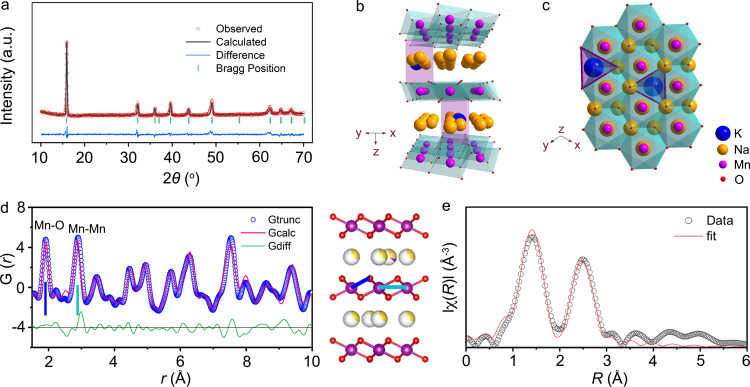
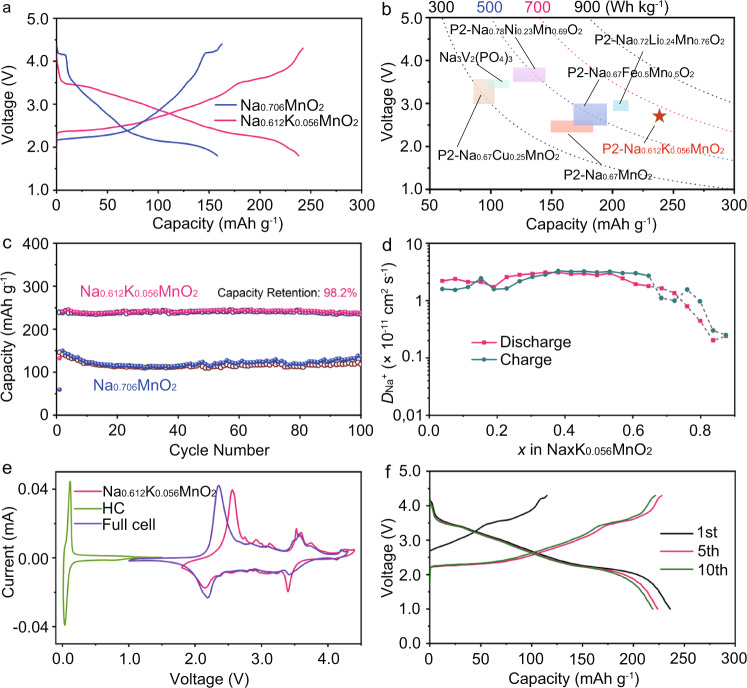
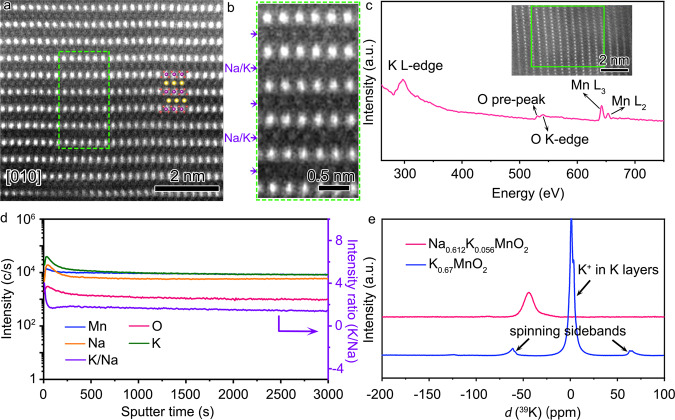
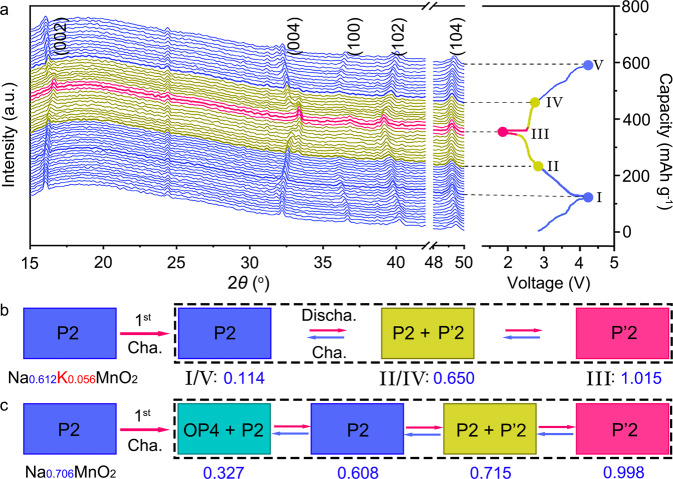
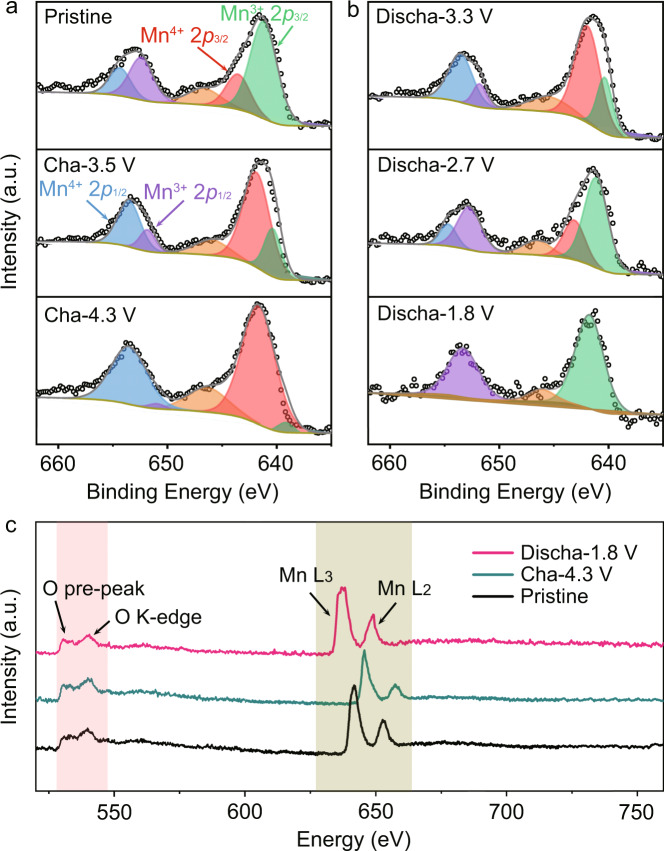
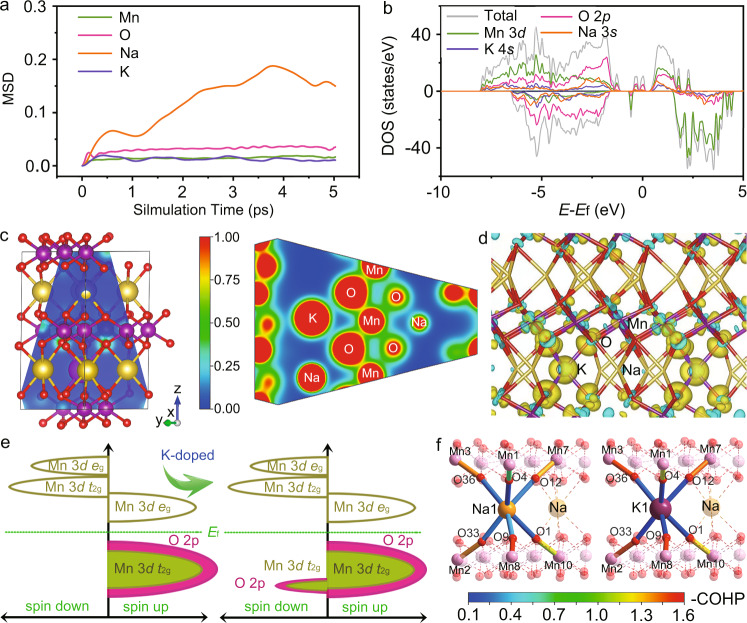
Layered transition-metal oxides have attracted intensive interest for cathode materials of sodium-ion batteries. However, they are hindered by the limited capacity and inferior phase transition due to the gliding of transition-metal layers upon Na extraction and insertion in the cathode materials. Here, we report that the large-sized K is riveted in the prismatic Na sites of P2-NaKMnO to enable more thermodynamically favorable Na vacancies. The Mn-O bonds are reinforced to reduce phase transition during charge and discharge. 0.901 Na per formula are reversibly extracted and inserted, in which only the two-phase transition of P2 ↔ P'2 occurs at low voltages. It exhibits the highest specific capacity of 240.5 mAh g and energy density of 654 Wh kg based on the redox of Mn/Mn, and a capacity retention of 98.2% after 100 cycles. This investigation will shed lights on the tuneable chemical environments of transition-metal oxides for advanced cathode materials and promote the development of sodium-ion batteries.
层状过渡金属氧化物作为钠离子电池的阴极材料引起了广泛关注。然而,由于在阴极材料中脱出和插入钠时过渡金属层的滑动,它们受到容量有限和相变较差的阻碍。在此,我们报道大尺寸的K铆接在P2-NaKMnO的棱柱形Na位点中,以形成更具热力学优势的Na空位。Mn-O键得到加强,以减少充放电过程中的相变。每个化学式有0.901个Na可逆地脱出和插入,其中在低电压下仅发生P2 ↔ P'2的两相转变。基于Mn/Mn的氧化还原反应,它表现出240.5 mAh g的最高比容量和654 Wh kg的能量密度,并且在100次循环后容量保持率为98.2%。这项研究将为先进阴极材料的过渡金属氧化物的可调化学环境提供启示,并促进钠离子电池的发展。