Science for Life Laboratory, Department of Protein Science, KTH Royal Institute of Technology, Solna, Sweden.
Department of Biosciences and Nutrition, Karolinska Institutet, Huddinge, Sweden.
Front Endocrinol (Lausanne). 2021 Mar 30;12:650625. doi: 10.3389/fendo.2021.650625. eCollection 2021.
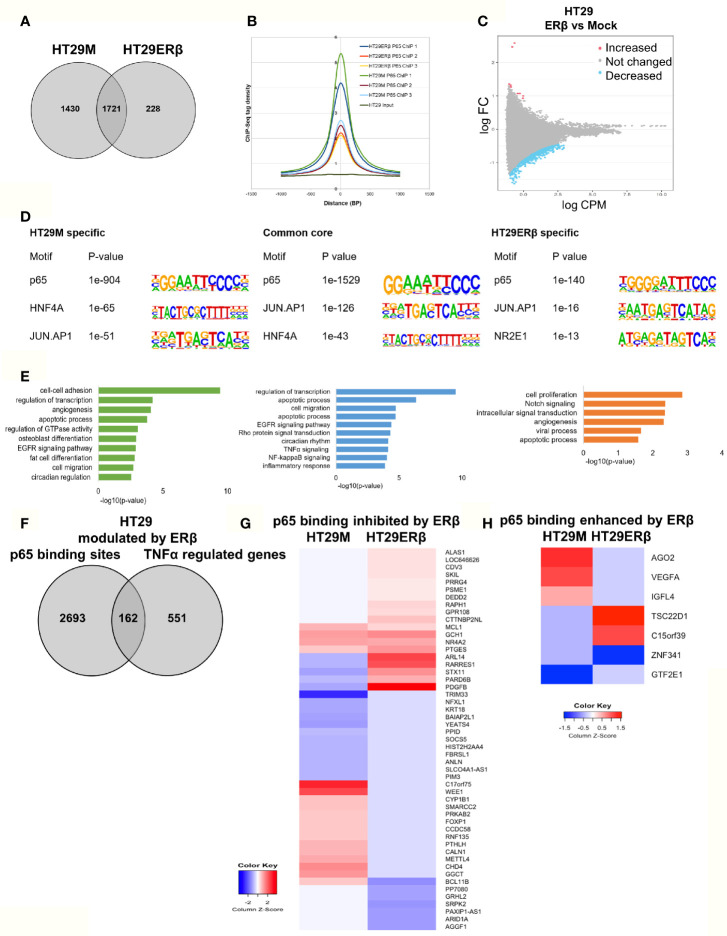
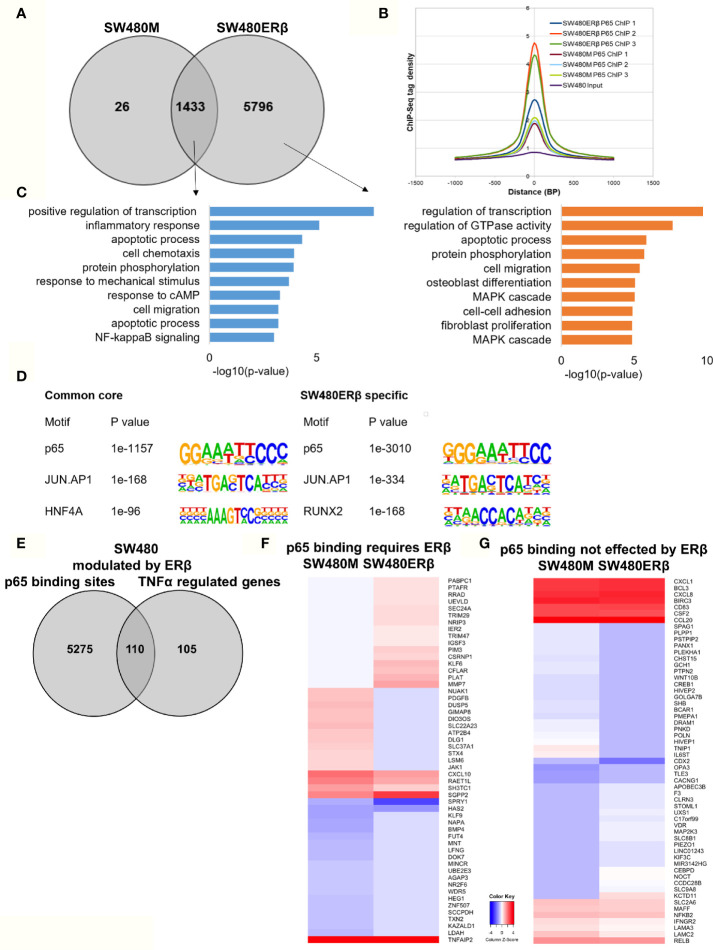
Inflammation is a primary component of both initiation and promotion of colorectal cancer (CRC). Cytokines secreted by macrophages, including tumor necrosis factor alpha (TNFα), activates the pro-survival transcription factor complex NFκB. The precise mechanism of NFκB in CRC is not well studied, but we recently reported the genome-wide transcriptional impact of TNFα in two CRC cell lines. Further, estrogen signaling influences inflammation in a complex manner and suppresses CRC development. CRC protective effects of estrogen have been shown to be mediated by estrogen receptor beta (ERβ, ), which also impacts inflammatory signaling of the colon. However, whether ERβ impacts the chromatin interaction (cistrome) of the main NFκB subunit p65 (RELA) is not known. We used p65 chromatin immunoprecipitation followed by sequencing (ChIP-Seq) in two different CRC cell lines, HT29 and SW480, with and without expression of ERβ. We here present the p65 colon cistrome of these two CRC cell lines. We identify that RELA and AP1 motifs are predominant in both cell lines, and additionally describe both common and cell line-specific p65 binding sites and correlate these to transcriptional changes related to inflammation, migration, apoptosis and circadian rhythm. Further, we determine that ERβ opposes a major fraction of p65 chromatin binding in HT29 cells, but enhances p65 binding in SW480 cells, thereby impacting the p65 cistrome differently in the two cell lines. However, the biological functions of the regulated genes appear to have similar roles in both cell lines. To our knowledge, this is the first time the p65 CRC cistrome is compared between different cell lines and the first time an influence by ERβ on the p65 cistrome is investigated. Our work provides a mechanistic foundation for a better understanding of how estrogen influences inflammatory signaling through NFκB in CRC cells.
炎症是结直肠癌(CRC)发生和促进的主要组成部分。巨噬细胞分泌的细胞因子,包括肿瘤坏死因子-α(TNFα),激活了生存相关转录因子复合物 NFκB。NFκB 在 CRC 中的确切机制尚未得到很好的研究,但我们最近报道了 TNFα 在两种 CRC 细胞系中的全基因组转录影响。此外,雌激素信号以复杂的方式影响炎症,并抑制 CRC 的发展。雌激素对 CRC 的保护作用已被证明是由雌激素受体β(ERβ)介导的,它也影响结肠的炎症信号。然而,ERβ 是否影响主要 NFκB 亚基 p65(RELA)的染色质相互作用(cistrome)尚不清楚。我们使用两种不同的 CRC 细胞系 HT29 和 SW480 中的 p65 染色质免疫沉淀测序(ChIP-Seq),在表达或不表达 ERβ 的情况下进行研究。我们在这里呈现了这两种 CRC 细胞系的 p65 结肠 cistrome。我们确定 RELA 和 AP1 基序在这两种细胞系中都占主导地位,并且还描述了共同的和细胞系特异性的 p65 结合位点,并将这些与与炎症、迁移、凋亡和昼夜节律相关的转录变化相关联。此外,我们确定 ERβ 在 HT29 细胞中拮抗 p65 染色质结合的主要部分,但在 SW480 细胞中增强 p65 结合,从而以不同的方式影响两种细胞系中的 p65 cistrome。然而,调节基因的生物学功能似乎在两种细胞系中都具有相似的作用。据我们所知,这是首次在不同细胞系之间比较 p65 CRC cistrome,也是首次研究 ERβ 对 p65 cistrome 的影响。我们的工作为更好地理解雌激素如何通过 NFκB 在 CRC 细胞中影响炎症信号提供了机制基础。