Liu Fan, Cheng Yu, Tan Junchao, Li Jiantong, Cheng Haoyan, Hu Hao, Du Chunya, Zhao Shuang, Yan Yan, Liu Mingkai
Jiangsu Key Laboratory of Green Synthetic Chemistry for Functional Materials, School of Chemistry & Materials Science, Jiangsu Normal University, Xuzhou, China.
Hubei Key Laboratory of Polymer Materials, Ministry-of-Education Key Laboratory for the Green Preparation and Application of Functional Materials, School of Materials Science & Engineering, Hubei University, Wuhan, China.
Front Chem. 2021 Mar 30;9:668336. doi: 10.3389/fchem.2021.668336. eCollection 2021.
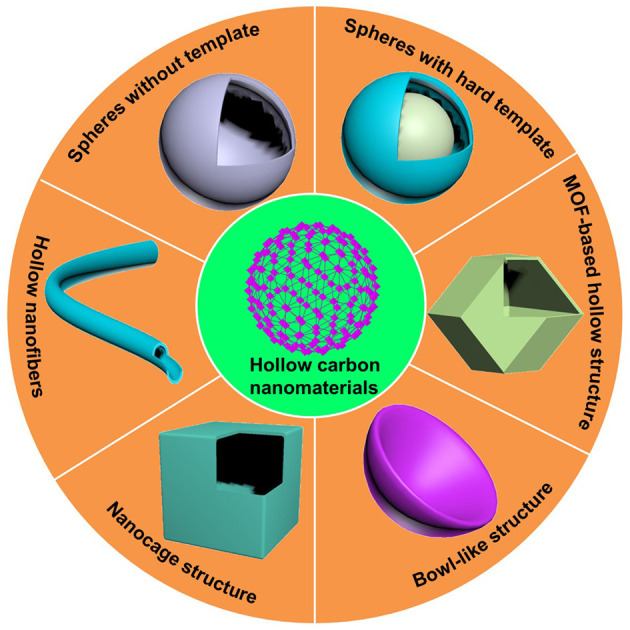
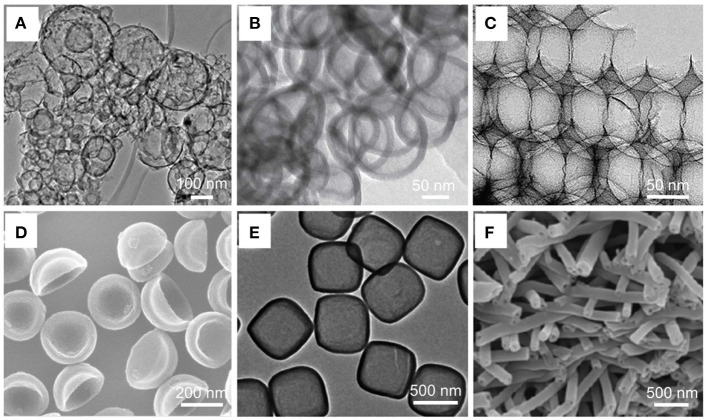
Carbon nanomaterials with high electrical conductivity, good chemical, and mechanical stability have attracted increasing attentions and shown wide applications in recent years. In particularly, hollow carbon nanomaterials, which possess ultrahigh specific surface area, large surface-to-volume ratios, and controllable pore size distribution, will benefit to provide abundant active sites, and mass loading vacancy, accelerate electron/ion transfer as well as contribute to the specific density of energy storage systems. In this mini-review, we summarize the recent progresses of hollow carbon nanomaterials by focusing on the synthesis approaches and corresponding nanostructures, including template-free and hard-template carbon hollow structures, metal organic framework-based hollow carbon structures, bowl-like and cage-like structures, as well as hollow fibers. The design and synthesis strategies of these hollow carbon nanomaterials have been systematically discussed. Finally, the emerging challenges and future prospective for developing advanced hollow carbon structures were outlined.
近年来,具有高电导率、良好化学稳定性和机械稳定性的碳纳米材料受到越来越多的关注,并展现出广泛的应用前景。特别是中空碳纳米材料,其具有超高的比表面积、大的表面体积比和可控的孔径分布,有利于提供丰富的活性位点和大量的负载空位,加速电子/离子转移,并有助于提高储能系统的比能量密度。在这篇综述中,我们聚焦于合成方法及相应的纳米结构,总结了中空碳纳米材料的最新进展,包括无模板和硬模板碳空心结构、基于金属有机框架的中空碳结构、碗状和笼状结构以及中空纤维。系统地讨论了这些中空碳纳米材料的设计和合成策略。最后,概述了开发先进中空碳结构面临的新挑战和未来展望。