Eddy Lucy H, Preston Nick, Mon-Williams Mark, Bingham Daniel D, Atkinson Jo M C, Ellingham-Khan Marsha, Otteslev Ava, Hill Liam J B
School of Psychology, University of Leeds, Leeds, United Kingdom.
Bradford Institute for Health Research, Bradford Royal Infirmary, Bradford, United Kingdom.
PLoS One. 2021 Apr 16;16(4):e0250002. doi: 10.1371/journal.pone.0250002. eCollection 2021.
A large proportion of children are not able to perform age-appropriate fundamental movement skills (FMS). Thus, it is important to assess FMS so that children needing additional support can be identified in a timely fashion. There is great potential for universal screening of FMS in schools, but research has established that current assessment tools are not fit for purpose.
To develop and validate the psychometric properties of a FMS assessment tool designed specifically to meet the demands of universal screening in schools.
A working group consisting of academics from developmental psychology, public health and behavioural epidemiology developed an assessment tool (FUNMOVES) based on theory and prior evidence. Over three studies, 814 children aged 4 to 11 years were assessed in school using FUNMOVES. Rasch analysis was used to evaluate structural validity and modifications were then made to FUNMOVES activities after each study based on Rasch results and implementation fidelity.
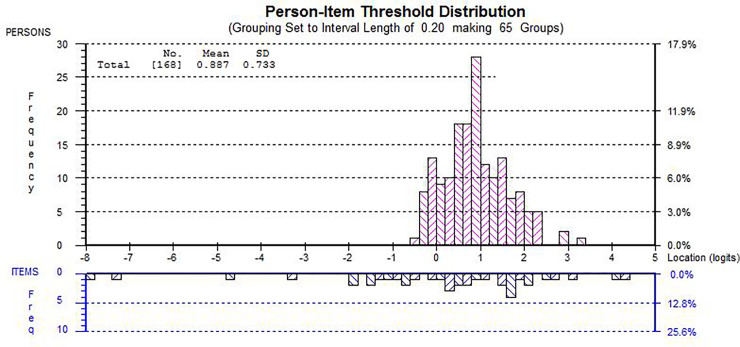
The initial Rasch analysis found numerous psychometric problems including multidimensionality, disordered thresholds, local dependency, and misfitting items. Study 2 showed a unidimensional measure, with acceptable internal consistency and no local dependency, but that did not fit the Rasch model. Performance on a jumping task was misfitting, and there were issues with disordered thresholds (for jumping, hopping and balance tasks). Study 3 revealed a unidimensional assessment tool with good fit to the Rasch model, and no further issues, once jumping and hopping scoring were modified.
The finalised version of FUNMOVES (after three iterations) meets standards for accurate measurement, is free and able to assess a whole class in under an hour using resources available in schools. Thus FUNMOVES has the potential to allow schools to efficiently screen FMS to ensure that targeted support can be provided and disability barriers removed.
很大一部分儿童无法掌握与其年龄相适应的基本运动技能(FMS)。因此,评估FMS很重要,以便能及时识别出需要额外支持的儿童。在学校对FMS进行普遍筛查具有很大潜力,但研究表明,目前的评估工具并不适用。
开发并验证一种专门为满足学校普遍筛查需求而设计的FMS评估工具的心理测量特性。
一个由发展心理学、公共卫生和行为流行病学领域的学者组成的工作组,基于理论和先前的证据开发了一种评估工具(FUNMOVES)。在三项研究中,使用FUNMOVES对814名4至11岁的儿童在学校进行了评估。采用拉施分析来评估结构效度,然后根据拉施分析结果和实施保真度,在每项研究后对FUNMOVES活动进行修改。
最初的拉施分析发现了许多心理测量问题,包括多维性、阈值紊乱、局部依赖性和不匹配项目。研究2显示该测量具有单维性,内部一致性可接受且无局部依赖性,但不符合拉施模型。一项跳跃任务的表现不匹配,并且在阈值(跳跃、单脚跳和平衡任务)方面存在问题。研究3显示,一旦对跳跃和单脚跳得分进行修改,就得到了一个与拉施模型拟合良好的单维评估工具,且没有进一步的问题。
最终版的FUNMOVES(经过三次迭代)符合准确测量的标准,免费且能够利用学校现有的资源在一小时内对整个班级进行评估。因此,FUNMOVES有潜力让学校有效地筛查FMS,以确保能够提供有针对性的支持并消除残疾障碍。