Fonagy Peter, Luyten Patrick, Allison Elizabeth, Campbell Chloe
Research Department of Clinical, Educational and Health Psychology, University College London, London, UK.
Faculty of Psychology and Educational Sciences, KU Leuven, Leuven, Belgium.
Borderline Personal Disord Emot Dysregul. 2017 Apr 11;4:9. doi: 10.1186/s40479-017-0062-8. eCollection 2017.
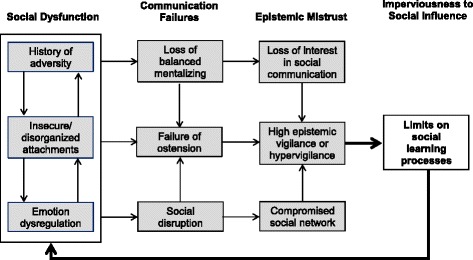
In Part 1 of this paper, we discussed emerging evidence suggesting that a general psychopathology or 'p' factor underlying the various forms of psychopathology should be conceptualized in terms of the absence of resilience, that is, the absence of positive reappraisal mechanisms when faced with adversity. These impairments in the capacity for positive reappraisal seem to provide a comprehensive explanation for the association between the p factor and comorbidity, future caseness, and the 'hard-to-reach' character of many patients with severe personality pathology, most notably borderline personality disorder (BPD). In this, the second part of the paper, we trace the development of the absence of resilience to disruptions in the emergence of human social communication, based on recent evolutionary and developmental psychopathology accounts. We argue that BPD and related disorders may be reconceptualized as a form of social understanding in which epistemic hypervigilance, distrust or outright epistemic freezing is an adaptive consequence of the social learning environment. Negative appraisal mechanisms become overriding, particularly in situations of attachment stress. This constitutes a shift towards a more socially oriented perspective on personality psychopathology in which the absence of psychological resilience is seen as a learned response to the transmission of social knowledge. This shift in our views has also forced us to reconsider the role of attachment in BPD. The implications for prevention and intervention of this novel approach are discussed.
在本文的第一部分,我们探讨了新出现的证据,这些证据表明,各种精神病理学形式背后的一种普遍精神病理学或“p”因素,应根据缺乏心理韧性来概念化,也就是说,在面对逆境时缺乏积极的重新评估机制。积极重新评估能力的这些损害似乎为p因素与共病、未来患病可能性以及许多患有严重人格病理学的患者(最显著的是边缘型人格障碍,即BPD)“难以治疗”的特征之间的关联提供了全面解释。在本文的第二部分,我们基于最近的进化和发展精神病理学观点,追溯缺乏心理韧性的发展,其源于人类社会交往出现过程中的干扰。我们认为,BPD及相关障碍可能会被重新概念化为一种社会理解形式,其中认知过度警惕、不信任或彻底的认知冻结是社会学习环境的适应性结果。消极评估机制变得占主导地位,尤其是在依恋压力的情况下。这构成了向人格精神病理学更具社会导向性视角的转变,在这种视角中,心理韧性的缺乏被视为对社会知识传递的一种习得反应。我们观点的这种转变也迫使我们重新考虑依恋在BPD中的作用。本文还讨论了这种新方法对预防和干预的影响。