Facharzt Forum Fürth, Bahnhofplatz 6, 90762, Fürth, Germany.
Evangelisches Krankenhaus Göttingen-Weende, Göttingen, Germany.
Respir Res. 2021 Apr 16;22(1):108. doi: 10.1186/s12931-021-01701-3.
Overuse of short-acting beta-2 agonists (SABA), which do not treat the underlying inflammation of asthma, is linked to poor clinical outcomes such as increased exacerbation risk. This study, as part of the SABINA program, estimated the prevalence of SABA overuse and associated variables in outpatients in Germany.
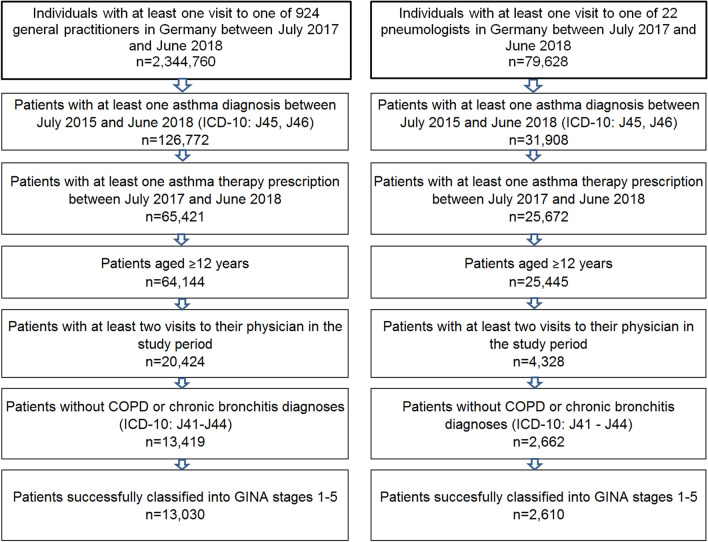
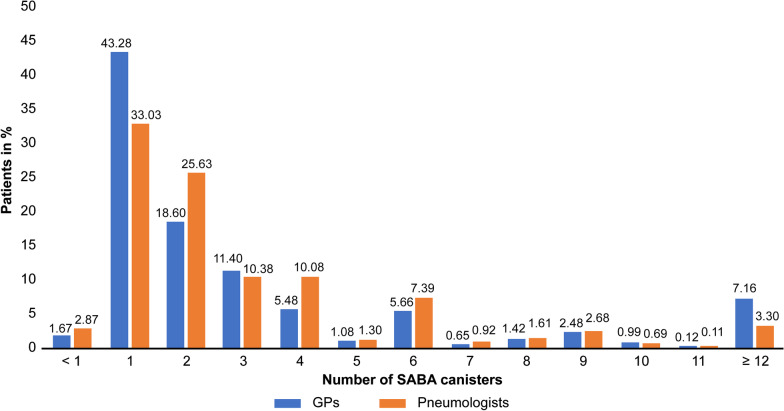
This retrospective study used anonymized electronic healthcare data from the Disease Analyzer database (IQVIA). A total of 15,640 patients aged ≥ 12 years with asthma who received ≥ 1 SABA prescription(s) between July 2017 and June 2018 in 924 general physician and 22 pneumologist (PN) practices were included. SABA overuse was defined as ≥ 3 prescribed inhalers (~ 200 puffs each) during the study period. The associations between SABA overuse and physician specialty, Global Initiative for Asthma (GINA) steps (based on asthma medications), age, sex, and inhaled corticosteroid (ICS)/long-acting beta agonist (LABA) use were estimated using multivariable regression for patients with probable moderate (GINA step 2) and probable severe (GINA steps 3-5) asthma.
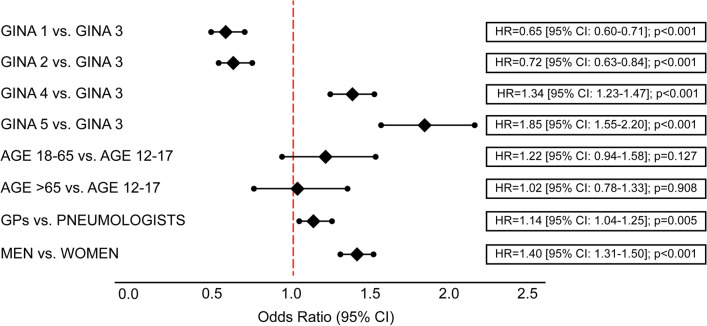
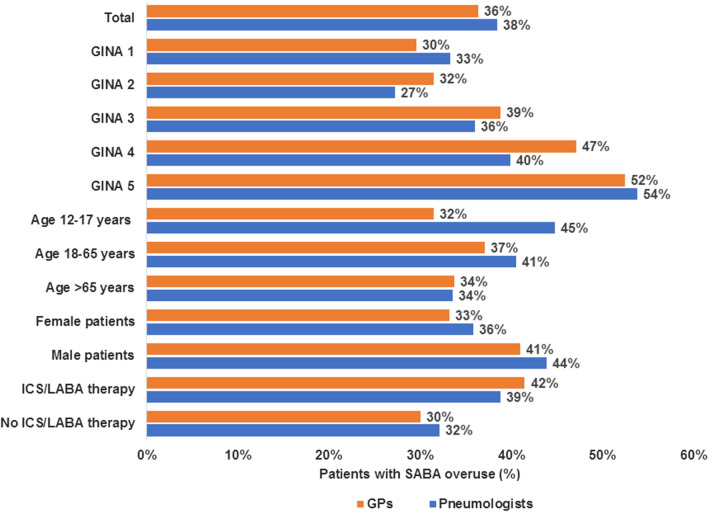
Annually, 36% of all patients (GINA steps 1-5) in general and 38% in PN practices received ≥ 3 SABA inhalers. The risk of SABA overuse was 14% higher in patients treated by a general practitioner vs. a PN; 34% and 85% higher in GINA steps 4 and 5, respectively, vs. GINA step 3; and 40% higher in male vs. female patients.
SABA overuse is prevalent among patients with asthma across all GINA steps in Germany, which may indicate suboptimal asthma control. Further studies are needed to investigate the reasons behind SABA overuse.
短效 β2 激动剂(SABA)的过度使用与哮喘的潜在炎症无关,但与较差的临床结局相关,例如增加恶化风险。这项作为 SABINA 计划的一部分的研究,评估了德国门诊患者中 SABA 过度使用的流行率及其相关变量。
这是一项回顾性研究,使用了 IQVIA 的 Disease Analyzer 数据库中的匿名电子医疗数据。共纳入了 15640 名年龄≥12 岁的哮喘患者,他们在 2017 年 7 月至 2018 年 6 月期间在 924 家全科医生和 22 家肺病医生(PN)诊所中至少接受了 1 次 SABA 处方。在研究期间,使用≥3 个处方吸入器(每个吸入器约 200 次吸药)被定义为 SABA 过度使用。使用多变量回归分析了 SABA 过度使用与医生专业、全球哮喘倡议(GINA)步骤(基于哮喘药物)、年龄、性别和吸入皮质类固醇(ICS)/长效 β 激动剂(LABA)使用之间的关系,用于可能患有中度(GINA 步骤 2)和可能患有重度(GINA 步骤 3-5)哮喘的患者。
每年,所有患者(GINA 步骤 1-5)中,有 36%的患者在全科医生处和 38%的患者在 PN 诊所中接受了≥3 个 SABA 吸入器。与 PN 相比,在全科医生处治疗的患者发生 SABA 过度使用的风险高 14%;与 GINA 步骤 3 相比,在 GINA 步骤 4 和 5 的患者中,SABA 过度使用的风险分别高 34%和 85%;与女性患者相比,男性患者发生 SABA 过度使用的风险高 40%。
德国所有 GINA 步骤的哮喘患者中 SABA 过度使用较为普遍,这可能表明哮喘控制不佳。需要进一步研究以调查 SABA 过度使用的原因。