Departments of Medicine and Neurology, Keck School of Medicine, University of Southern California, Los Angeles, CA, USA.
Huntington Medical Research Institutes, Pasadena, CA, USA.
Mol Neurodegener. 2021 Apr 16;16(1):26. doi: 10.1186/s13024-021-00438-3.
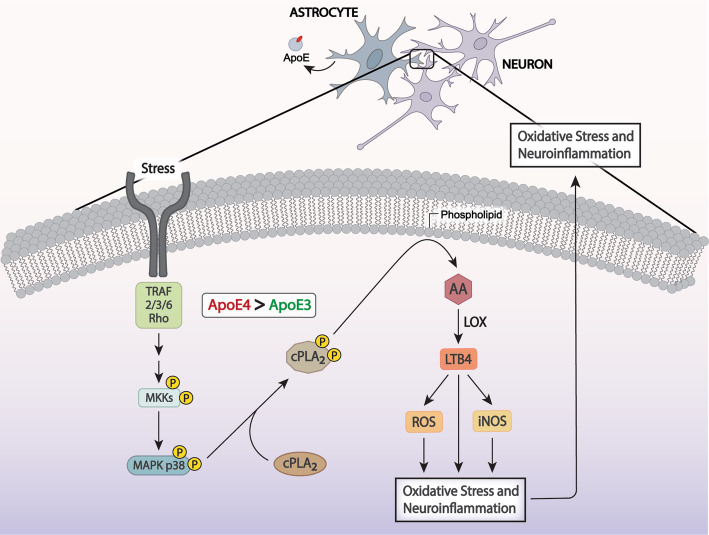
Apolipoprotein E4 (APOE4) is associated with a greater response to neuroinflammation and the risk of developing late-onset Alzheimer's disease (AD), but the mechanisms for this association are not clear. The activation of calcium-dependent cytosolic phospholipase A (cPLA2) is involved in inflammatory signaling and is elevated within the plaques of AD brains. The relation between APOE4 genotype and cPLA2 activity is not known.
Mouse primary astrocytes, mouse and human brain samples differing by APOE genotypes were collected for measuring cPLA2 expression, phosphorylation, and activity in relation to measures of inflammation and oxidative stress.
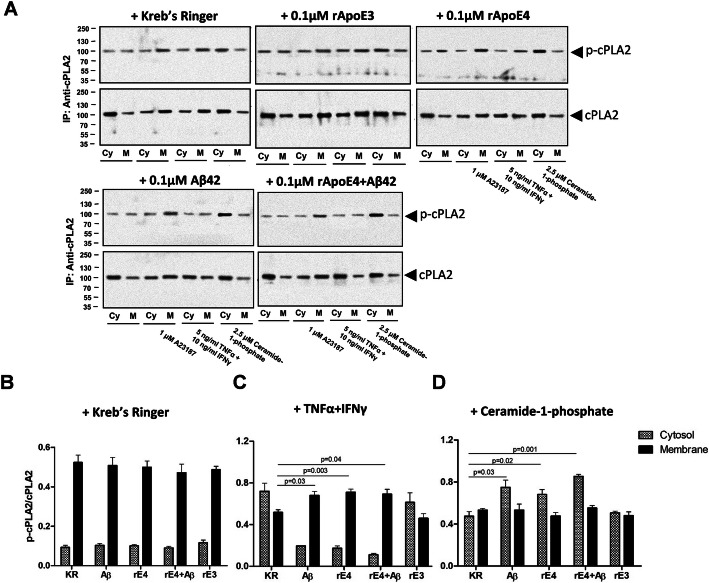
Greater cPLA2 phosphorylation, cPLA2 activity and leukotriene B (LTB4) levels were identified in ApoE4 compared to ApoE3 in primary astrocytes, brains of ApoE-targeted replacement (ApoE-TR) mice, and in human brain homogenates from the inferior frontal cortex of patients with AD carrying APOE3/E4 compared to APOE3/E3. Greater cPLA2 phosphorylation was also observed in human postmortem frontal cortical synaptosomes and primary astrocytes after treatment with recombinant ApoE4 ex vivo. In ApoE4 astrocytes, the greater levels of LTB4, reactive oxygen species (ROS), and inducible nitric oxide synthase (iNOS) were reduced after cPLA2 inhibition.
Our findings implicate greater activation of cPLA2 signaling system with APOE4, which could represent a potential drug target for mitigating the increased neuroinflammation with APOE4 and AD.
载脂蛋白 E4(APOE4)与神经炎症反应增强和迟发性阿尔茨海默病(AD)的发病风险增加相关,但这种关联的机制尚不清楚。钙依赖性胞质型磷脂酶 A(cPLA2)的激活参与炎症信号转导,并在 AD 大脑斑块中升高。APOE4 基因型与 cPLA2 活性之间的关系尚不清楚。
收集了具有不同 APOE 基因型的小鼠原代星形胶质细胞、小鼠和人类脑组织样本,以测量 cPLA2 的表达、磷酸化和活性与炎症和氧化应激的关系。
与 ApoE3 相比,原代星形胶质细胞、ApoE 靶向替换(ApoE-TR)小鼠的大脑以及 AD 患者下额前皮质的人脑中,ApoE4 中 cPLA2 的磷酸化、cPLA2 活性和白三烯 B(LTB4)水平更高。在用重组 ApoE4 进行体外处理后,人死后额皮质突触体和原代星形胶质细胞中也观察到 cPLA2 磷酸化增加。在 ApoE4 星形胶质细胞中,cPLA2 抑制后 LTB4、活性氧(ROS)和诱导型一氧化氮合酶(iNOS)的水平更高。
我们的研究结果表明,APOE4 中 cPLA2 信号系统的激活增强,这可能代表一种潜在的药物靶点,可用于减轻 APOE4 和 AD 引起的神经炎症增加。