Bhatia Sangeeta, Lassmann Britta, Cohn Emily, Desai Angel N, Carrion Malwina, Kraemer Moritz U G, Herringer Mark, Brownstein John, Madoff Larry, Cori Anne, Nouvellet Pierre
MRC Centre for Global Infectious Disease Analysis, School of Public Health, Imperial College London, Faculty of Medicine, London, UK.
ProMED, International Society for Infectious Diseases, Brookline, MA, USA.
NPJ Digit Med. 2021 Apr 16;4(1):73. doi: 10.1038/s41746-021-00442-3.
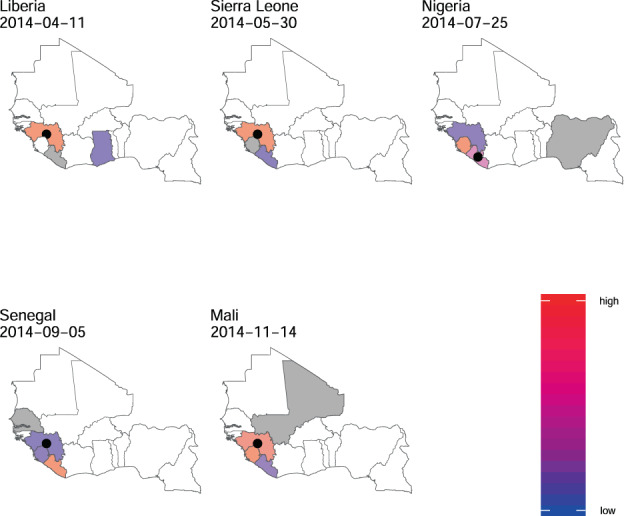
Data from digital disease surveillance tools such as ProMED and HealthMap can complement the field surveillance during ongoing outbreaks. Our aim was to investigate the use of data collected through ProMED and HealthMap in real-time outbreak analysis. We developed a flexible statistical model to quantify spatial heterogeneity in the risk of spread of an outbreak and to forecast short term incidence trends. The model was applied retrospectively to data collected by ProMED and HealthMap during the 2013-2016 West African Ebola epidemic and for comparison, to WHO data. Using ProMED and HealthMap data, the model was able to robustly quantify the risk of disease spread 1-4 weeks in advance and for countries at risk of case importations, quantify where this risk comes from. Our study highlights that ProMED and HealthMap data could be used in real-time to quantify the spatial heterogeneity in risk of spread of an outbreak.
来自ProMED和HealthMap等数字疾病监测工具的数据可以在疫情暴发期间补充现场监测。我们的目的是研究通过ProMED和HealthMap收集的数据在实时疫情分析中的应用。我们开发了一个灵活的统计模型,以量化疫情传播风险中的空间异质性,并预测短期发病率趋势。该模型被追溯应用于ProMED和HealthMap在2013 - 2016年西非埃博拉疫情期间收集的数据,并与世界卫生组织的数据进行比较。利用ProMED和HealthMap的数据,该模型能够提前1 - 4周有力地量化疾病传播风险,对于有病例输入风险的国家,还能量化这种风险的来源。我们的研究强调,ProMED和HealthMap的数据可用于实时量化疫情传播风险中的空间异质性。