UCL Medical School, University College London, Gower Street, London, WC1E 6BT, UK; EHRS Directorate, University College London Hospitals NHS Foundation Trust, 250 Euston Rd, London, NW1 2PG, UK.
EHRS Directorate, University College London Hospitals NHS Foundation Trust, 250 Euston Rd, London, NW1 2PG, UK; Clinical and Research Informatics Unit, UCL/UCLH NIHR Biomedical Research Centre, UCL Institute of Health Informatics, 222 Euston Road, London, NW1 2DA, UK.
Int J Med Inform. 2021 Jun;150:104452. doi: 10.1016/j.ijmedinf.2021.104452. Epub 2021 Apr 1.
To evaluate the completeness of diagnosis recording in problem lists in a hospital electronic health record (EHR) system during the COVID-19 pandemic.
Retrospective chart review with manual review of free text electronic case notes.
Major teaching hospital trust in London, one year after the launch of a comprehensive EHR system (Epic), during the first peak of the COVID-19 pandemic in the UK.
516 patients with suspected or confirmed COVID-19.
Percentage of diagnoses already included in the structured problem list.
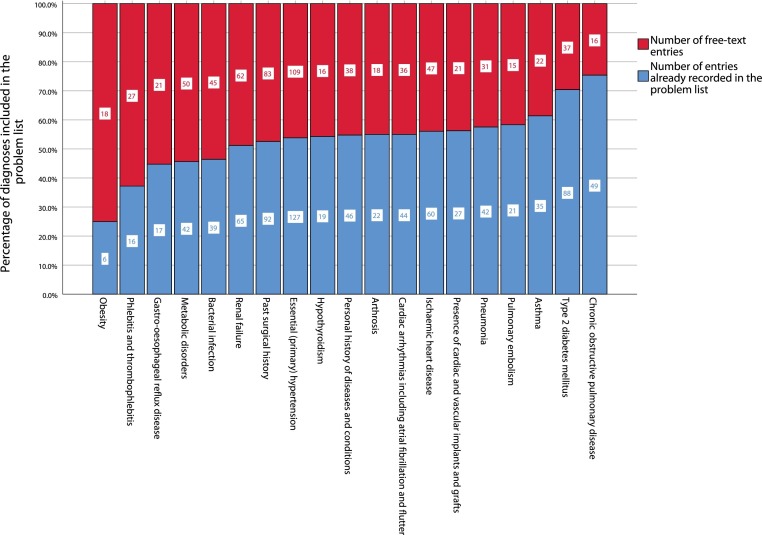
Prior to review, these patients had a combined total of 2841 diagnoses recorded in their EHR problem lists. 1722 additional diagnoses were identified, increasing the mean number of recorded problems per patient from 5.51 to 8.84. The overall percentage of diagnoses originally included in the problem list was 62.3% (2841 / 4563, 95% confidence interval 60.8%, 63.7%).
Diagnoses and other clinical information stored in a structured way in electronic health records is extremely useful for supporting clinical decisions, improving patient care and enabling better research. However, recording of medical diagnoses on the structured problem list for inpatients is incomplete, with almost 40% of important diagnoses mentioned only in the free text notes.
评估 COVID-19 大流行期间医院电子健康记录 (EHR) 系统中问题列表中诊断记录的完整性。
回顾性图表审查,对电子病历的自由文本进行手动审查。
伦敦一家大型教学医院信托基金,在英国 COVID-19 大流行的第一个高峰期期间,在全面推出 EHR 系统 (Epic) 一年后。
516 名疑似或确诊 COVID-19 的患者。
已包含在结构化问题列表中的诊断的百分比。
在审查之前,这些患者的 EHR 问题列表中共记录了 2841 个诊断。确定了 1722 个额外的诊断,使每位患者记录的诊断数量从 5.51 增加到 8.84。最初包含在问题列表中的诊断的总体百分比为 62.3%(2841 / 4563,95%置信区间 60.8%,63.7%)。
以电子方式以结构化方式存储的诊断和其他临床信息对于支持临床决策、改善患者护理和实现更好的研究非常有用。然而,住院患者结构化问题列表中记录的医疗诊断并不完整,近 40%的重要诊断仅在自由文本记录中提到。