Department of Bioengineering and Therapeutic Sciences, School of Pharmacy, University of California, San Francisco, 1700 4th Street, Room 501, San Francisco, CA, 94158, USA.
Department of Radiation Oncology, Stanford University School of Medicine, Stanford, CA, USA.
Drugs R D. 2021 Jun;21(2):169-178. doi: 10.1007/s40268-021-00340-9. Epub 2021 Apr 17.
Selenite is a radiosensitizer and inhibitor of androgen receptor expression and function. In a phase I study (NCT02184533) in 15 subjects with metastatic cancer receiving daily oral sodium selenite with palliative radiation therapy, disease stabilization was observed, as evidenced by tumor regression, marked reduction in pain symptoms, and decreased prostate-specific antigen levels (only patients with castrate-resistant prostate cancer).
The aim of this work was to characterize the pharmacokinetics of selenite to suggest dosing strategies and to propose a study design for further investigation.
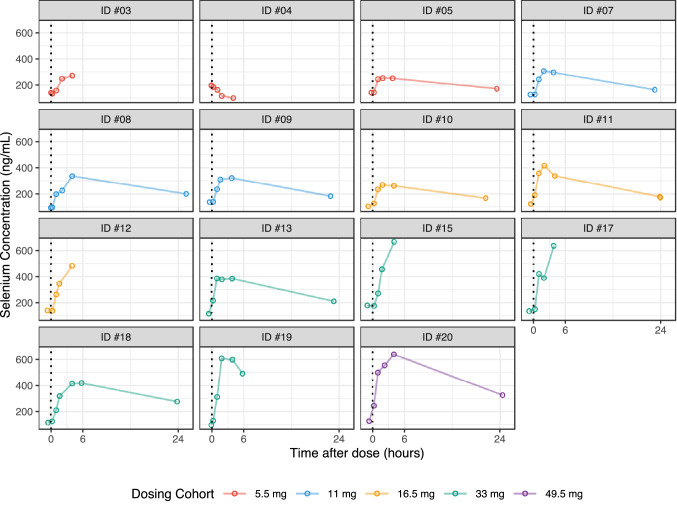
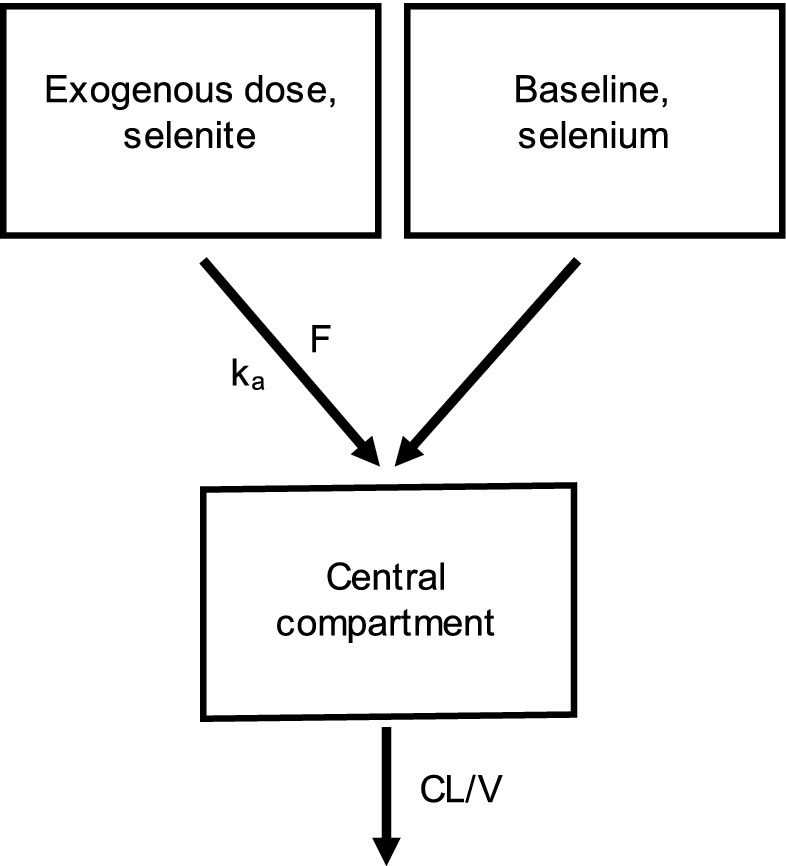
With selenium plasma concentrations obtained from five dosing cohorts (5.5, 11, 16.5, 33, and 49.5 mg), a population pharmacokinetic model was constructed using NONMEM. The model described externally administered selenite (inorganic) with a baseline component for endogenous selenium levels. Using the pharmacokinetic model, simulations were performed to suggest dosing regimens that achieved in vitro target selenite levels, and optimal pharmacokinetic sampling times for a subsequent study were proposed using PopED.
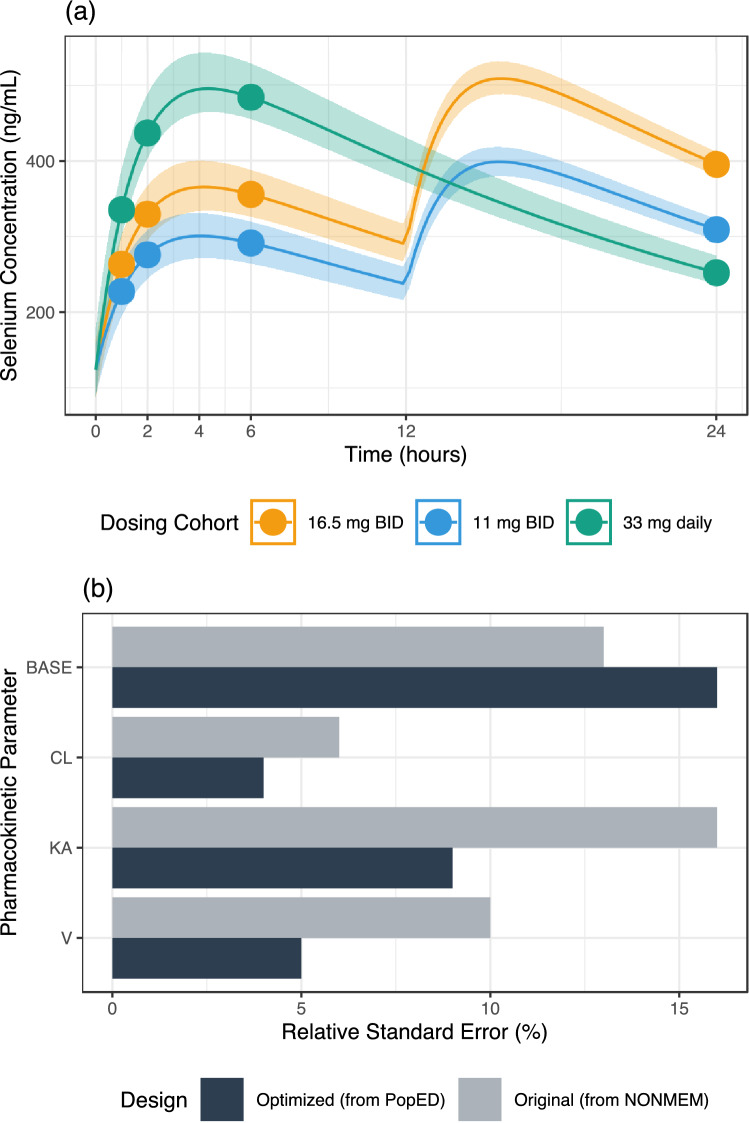
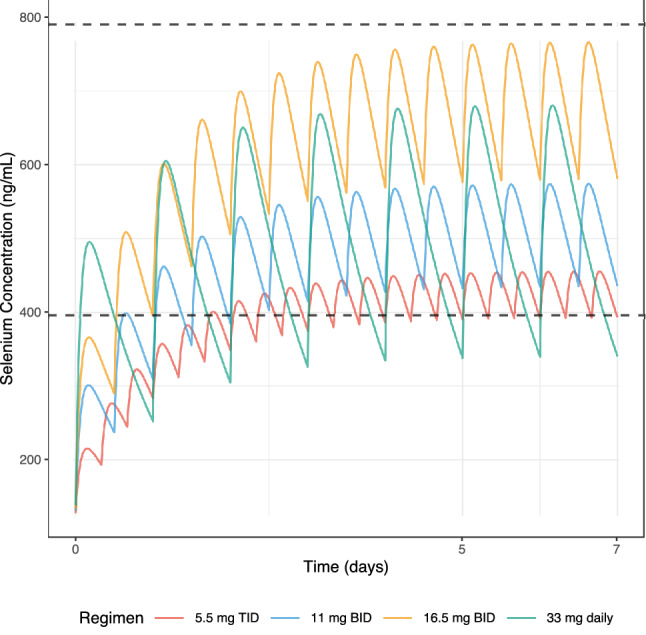
A one-compartment model characterized selenite pharmacokinetics. Parameter estimates were absorption rate constant (0.64 h), apparent clearance (1.58 L/h), apparent volume of distribution (42.3 L), and baseline selenium amount (5270 μg). A logarithmic function characterized the inverse relationship between dose level and bioavailability. Four regimens to reach in vitro target selenite levels were proposed: 33 mg daily, 16.5 mg twice daily (BID), 11 mg BID, and 5.5 mg thrice daily (TID). Optimal sampling times were 1, 2, 6, and 24 h.
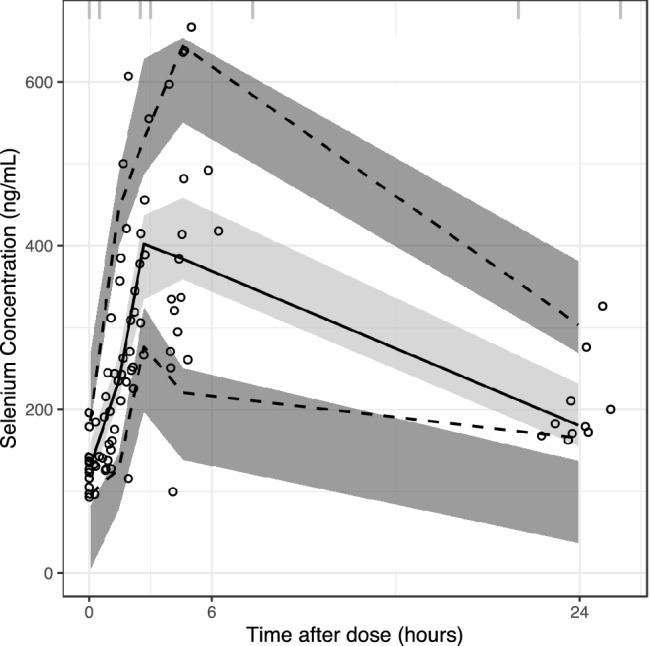
The population model described the pharmacokinetic data well. Three regimens (33 mg daily, 11 mg BID, 5.5 mg TID) achieved in vitro target selenite levels after one dose. The model and optimal sampling times may inform future studies evaluating the efficacy of selenite for metastatic cancer treatment.
亚硒酸钠是一种放射增敏剂和雄激素受体表达和功能的抑制剂。在一项 15 例转移性癌症患者的 I 期研究(NCT02184533)中,患者接受每日口服亚硒酸钠联合姑息性放射治疗,观察到疾病稳定,表现为肿瘤消退、疼痛症状明显减轻和前列腺特异性抗原水平降低(仅患有去势抵抗性前列腺癌的患者)。
本研究旨在描述亚硒酸钠的药代动力学特征,以提出给药方案,并为进一步研究提出研究设计。
根据 5.5、11、16.5、33 和 49.5 mg 五个剂量组的硒血浆浓度,使用 NONMEM 构建群体药代动力学模型。该模型描述了外源性给予的亚硒酸钠(无机)与内源性硒水平的基线成分。利用药代动力学模型进行模拟,提出了达到体外目标亚硒酸钠水平的给药方案,并使用 PopED 提出了后续研究的最佳药代动力学采样时间。
单室模型描述了亚硒酸钠的药代动力学特征。参数估计值为吸收速率常数(0.64 h)、表观清除率(1.58 L/h)、表观分布容积(42.3 L)和基线硒量(5270 μg)。剂量水平与生物利用度之间的反比关系用对数函数描述。提出了四种达到体外目标亚硒酸钠水平的方案:每天 33 毫克、每天两次 16.5 毫克(BID)、每天 11 毫克 BID 和每天三次 5.5 毫克 TID。最佳采样时间为 1、2、6 和 24 h。
群体模型很好地描述了药代动力学数据。三种方案(每天 33 毫克、每天两次 11 毫克、每天三次 5.5 毫克)在一次给药后达到了体外目标亚硒酸钠水平。该模型和最佳采样时间可能为评估亚硒酸钠治疗转移性癌症的疗效的未来研究提供信息。