Department of Public Health and Primary Care, University of Cambridge, Cambridge, UK.
J Alzheimers Dis. 2021;81(1):123-135. doi: 10.3233/JAD-210030.
Exploring the domains of cognitive function which are most strongly associated with future dementia may help with understanding risk factors for, and the natural history of dementia.
To examine the association of performance on a range of cognitive tests (both global and domain specific) with subsequent diagnosis of dementia through health services in a population of relatively healthy men and women and risk of future dementia.
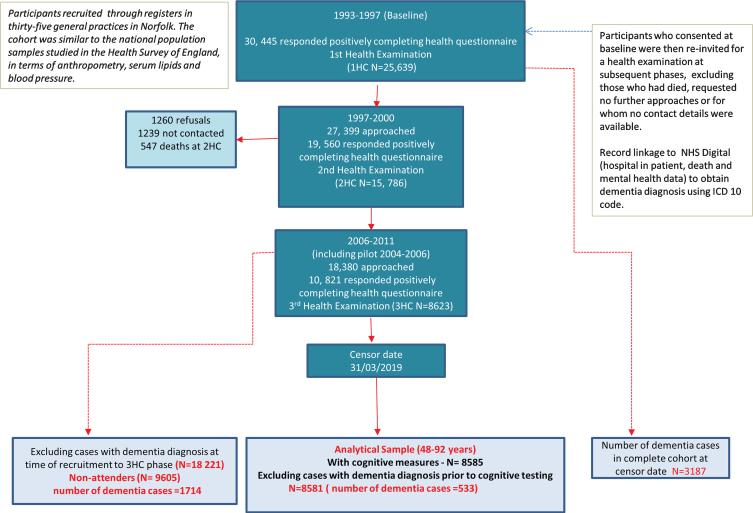
We examined the association between performance on different cognitive tests as well as a global score and future dementia risk ascertained through health record linkage in a cohort of 8,581 individuals (aged 48-92 years) between 2004-2019 with almost 15 years follow-up (average of 10 years) before and after adjustment for socio-demographic, lifestyle, and health characteristics.
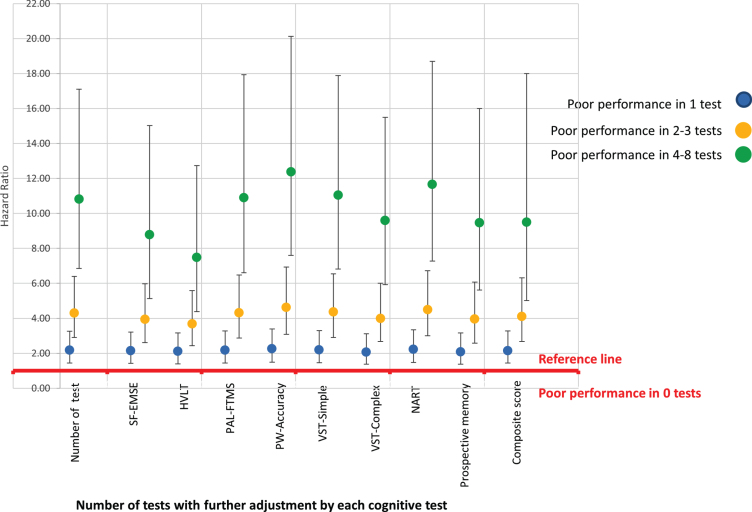
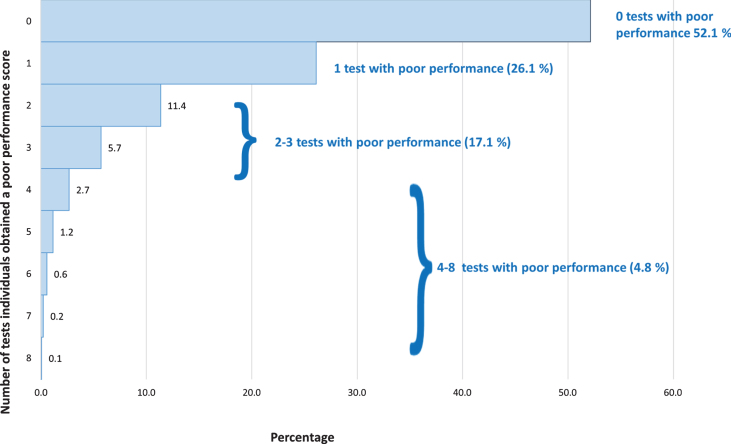
Those with poor performance for global cognition (bottom 10%) were almost four times as likely to receive a dementia diagnosis from health services over the next 15 years than those who performed well HR = 3.51 (95% CI 2.61, 4.71 p < 0.001) after adjustment for socioeconomic, lifestyle, and biological factors and also prevalent disease. Poor cognition performance in multiple tests was associated with 10-fold increased risk compared to those not performing poorly in any test HR = 10.82 (95% CI 6.85, 17.10 p < 0.001).
Deficits across multiple cognitive domains substantially increase risk of future dementia over and above neuropsychological test scores ten years prior to a clinical diagnosis. These findings may help further understanding of the natural history of dementia and how such measures could contribute to strengthening future models of dementia.
探索与未来痴呆症关联最密切的认知功能领域,有助于了解痴呆症的风险因素和自然病史。
通过健康服务,在相对健康的男性和女性人群中,检查一系列认知测试(包括整体和特定领域)的表现与随后通过健康记录确认的痴呆症诊断之间的关联,以及未来痴呆症的风险。
我们检查了在 2004-2019 年期间的 8581 名参与者(年龄 48-92 岁)队列中,不同认知测试的表现以及整体评分与未来痴呆症风险之间的关联,这些参与者的随访时间接近 15 年(平均 10 年),在调整社会人口统计学、生活方式和健康特征后。
在接下来的 15 年中,那些整体认知能力较差(排在倒数 10%)的人,通过健康服务诊断为痴呆症的可能性几乎是表现较好的人的四倍,调整社会经济、生活方式和生物因素以及现患疾病后,HR=3.51(95%CI 2.61,4.71 p<0.001)。与没有任何测试表现不佳的人相比,多项测试认知能力差与痴呆症风险增加 10 倍相关,HR=10.82(95%CI 6.85,17.10 p<0.001)。
与十年前临床诊断前的神经心理测试分数相比,多个认知领域的缺陷大大增加了未来痴呆症的风险。这些发现可能有助于进一步了解痴呆症的自然病史,以及这些措施如何有助于加强未来的痴呆症模型。